Reasoning about radioactivity and nuclear changes
Distinguish radiation from radioactive material, evaluate detector evidence and explain nuclear changes with valid accounting.
Specification 8.1, 8.2, 8.3, 8.4, 8.5, 8.6, 8.7, 8.8, 8.9, 8.10, 8.11, 8.12, 8.13, 8.14, 8.15, 8.16, 8.17, 8.18, 8.19, 8.20, 8.21, 8.22, 8.23, 8.24, 8.25, 8.26
Ratings, marks and Maths and Logic completion stay in this browser on this device. Written answers are temporary and are never recorded or transmitted. Reset clears only Physics practice progress, including Maths and Logic completion.
Answers and choices are temporary. Only started/completed flags are saved on this device. Practice can be retried or revealed; the check counts each question’s first answer. These are original practice tasks, not official exam questions.
Starting here
A radiation explanation must distinguish the emitting material, the radiation travelling from it and the detector response. Irradiation is exposure; contamination means radioactive material has been transferred. Ionisation can damage cells and cause mutations, but the exposure route and radiation properties matter.
Use a stated nuclear model rather than treating radioactivity as chemical burning. Fission splits a heavy nucleus; fusion joins light nuclei. Nuclear equations account for nucleon number and charge, while an energy-releasing process can involve a small decrease in total mass.
Key ideas
- Activity in Bq describes mean decays per second at the source, not automatically detector counts per second.
- Half-life describes a statistical trend for a particular isotope; it does not schedule the decay of an individual nucleus.
- A conclusion must fit background, geometry and detector sensitivity. A low reading is not proof that a source has stopped decaying.
Worked example
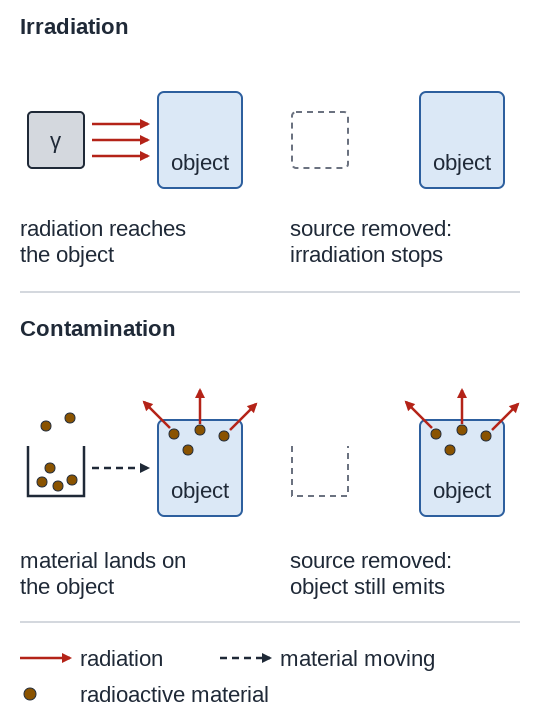
A student says every object exposed to radiation is contaminated. Use the two situations in the figure to assess this claim.
- External exposure. In the left example, radiation reaches the object from a separate source without source material being transferred.
- Material transfer. In the right example, radioactive deposits remain on the object and can keep emitting after the original source is removed.
- Conclusion. Both situations can produce exposure, but only the material-transfer case is contamination.
Answer: The claim confuses radiation travelling with radioactive material being transferred. The figure distinguishes routes rather than claiming they have equal effects.
Activities
Opens when you finish the stage above.
Build the skill
Opens when you finish the stage above.
Check
Opens when you finish the stage above.