Learning goals
- Explain spontaneous and random nuclear decay.
- Describe ionisation without confusing it with decay.
- Name the three specified radiations and their origin.
An unstable nucleus changes
radioactive decayA spontaneous, random change in an unstable nucleus that emits particles or electromagnetic radiation. is a spontaneous change of an unstable nucleusThe dense central region of an atom containing protons and neutrons, except hydrogen-1 which has no neutron. into a different nuclear state or nucleus, with radiation emitted. alpha particleA helium nucleus containing two protons and two neutrons, emitted during alpha decay., beta particleA fast electron emitted when a neutron changes into a proton during beta-minus decay. and gamma rayVery high-frequency electromagnetic radiation emitted when a nucleus loses energy. are three important forms of nuclear radiation. A particular decay mode has particular products; a nucleus does not generally choose at random between all three.
Spontaneous means an external trigger is not needed. Random means the exact time when an individual nucleus will decay cannot be predicted. It does not mean there is no pattern in a large sample: many nuclei together produce a statistically predictable decrease in activityThe number of nuclear decays per unit time in a radioactive sample, measured in becquerels..
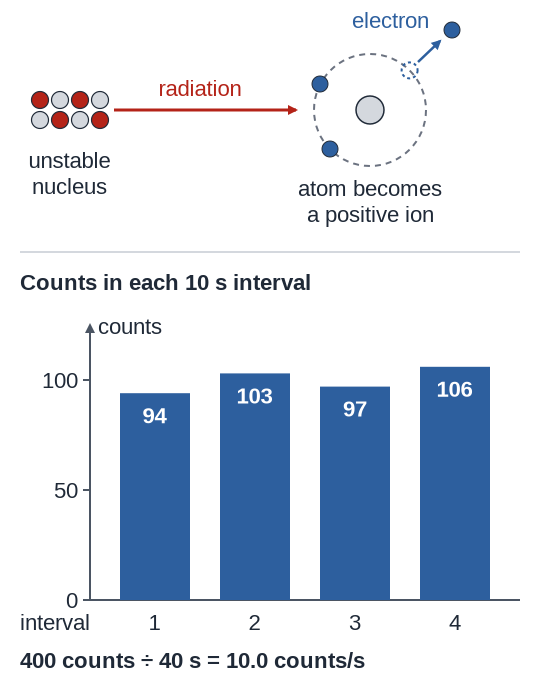
Ionisation is a different event
ionising radiationRadiation with enough energy to remove electrons from atoms or molecules and form ions. can transfer enough energyA conserved quantity transferred between stores by working, heating, electrical processes or radiation, measured in joules. to an atomAn electrically neutral particle with a small positive nucleus surrounded by electrons. to remove one or more electronA negatively charged subatomic particle found outside an atom’s nucleus.. Removing a negatively charged electron leaves a positive ionAn atom or group of atoms with a net charge because electrons have been gained or lost. and a free electron. The atom’s protonA positively charged nuclear particle with a mass approximately equal to that of a neutron. and neutronAn uncharged nuclear particle with a mass approximately equal to that of a proton. numbers are unchanged by this ordinary ionisationFormation of ions by the removal or addition of electrons..
The radioactive nucleusThe dense central region of an atom containing protons and neutrons, except hydrogen-1 which has no neutron. is the source of the radiation; other atoms along the radiation’s path can be ionised. One energetic particle can cause many ionisations as it loses energy. Decay and ionisation therefore need not happen in the same atom.
Interpreting random counts
Repeated counts over equal time intervals fluctuate even with unchanged apparatus. counts of 94, 103, 97 and 106 in four 10 s intervals total 400 in 40 s, giving a mean 10.0 counts/s. No one interval is guaranteed to equal the mean.
Repeat and combine measurements to reduce the relative effect of random fluctuation. Keep distanceThe length of a path travelled, without regard to direction., timing and absorbers fixed. A short low reading by itself does not prove that shieldingMaterial placed around a radiation source to absorb emissions and reduce exposure. stopped all radiation or that the source’s activityThe number of nuclear decays per unit time in a radioactive sample, measured in becquerels. changed.
Equations
- mean count rate = total counts ÷ total time
Common misconceptions
- Random decay is not caused by the detector observing the source.
- Ionisation removes electrons; it does not normally remove protons from an atom.