Learning goals
- Define proton number, nucleon number and isotope.
- Use A − Z to compare isotopes.
- Separate isotopes, ions and relative atomic mass.
Three definitions
The atomic numberThe number of protons in an atom’s nucleus, identifying the element., also called proton number Z, is the number of protonA positively charged nuclear particle with a mass approximately equal to that of a neutron. in a nucleusThe dense central region of an atom containing protons and neutrons, except hydrogen-1 which has no neutron.. Every carbon nucleus has six protons; seven protons would make it nitrogen. Changing proton number changes the element.
The mass numberThe total number of protons and neutrons in a nucleus., also called nucleon number A, is the total number of protons and neutronAn uncharged nuclear particle with a mass approximately equal to that of a proton. in one nucleus. It is a whole-number count. isotopeOne of the forms of an element with the same proton number but a different neutron number. are atomAn electrically neutral particle with a small positive nucleus surrounded by electrons. of the same element with different numbers of neutrons, so they share Z but have different A.
Worked comparison
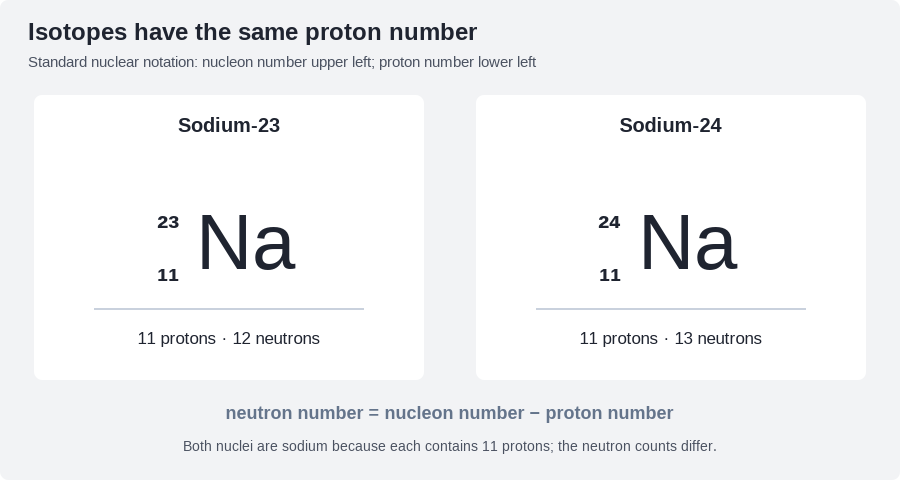
Sodium-23 has A = 23 and Z = 11: 11 protonA positively charged nuclear particle with a mass approximately equal to that of a neutron. and 23 − 11 = 12 neutronAn uncharged nuclear particle with a mass approximately equal to that of a proton.. Sodium-24 also has 11 protons but has 24 − 11 = 13 neutrons. Neutral atomAn electrically neutral particle with a small positive nucleus surrounded by electrons. of either isotopeOne of the forms of an element with the same proton number but a different neutron number. have 11 electronA negatively charged subatomic particle found outside an atom’s nucleus..
Their common electron arrangement gives the isotopes very similar chemical behaviour. Their nucleusThe dense central region of an atom containing protons and neutrons, except hydrogen-1 which has no neutron. can have different stability and radioactive behaviour: isotopes of an element need not all be radioactive.
Isotope versus ion
Removing an electronA negatively charged subatomic particle found outside an atom’s nucleus. makes a positive ionAn atom or group of atoms with a net charge because electrons have been gained or lost. but leaves both A and Z unchanged. Adding a neutronAn uncharged nuclear particle with a mass approximately equal to that of a proton. changes the isotopeOne of the forms of an element with the same proton number but a different neutron number. and A, while leaving the element and Z unchanged. These are different changes.
The decimal relative atomic massThe quantity measuring an object’s inertia, expressed in kilograms. in a periodic table is an average over an element’s isotopes. Do not put that decimal into a single-nucleus symbol or subtract Z from it to count neutrons in one atomAn electrically neutral particle with a small positive nucleus surrounded by electrons..
Equations
- N = A − Z
Common misconceptions
- Isotopes do not have different proton numbers.
- An ion and a radioactive isotope are not the same thing.