Learning goals
- Locate and compare the three subatomic particles.
- Interpret A and Z in nuclear notation.
- Calculate proton, neutron and electron counts.
Where the particles are
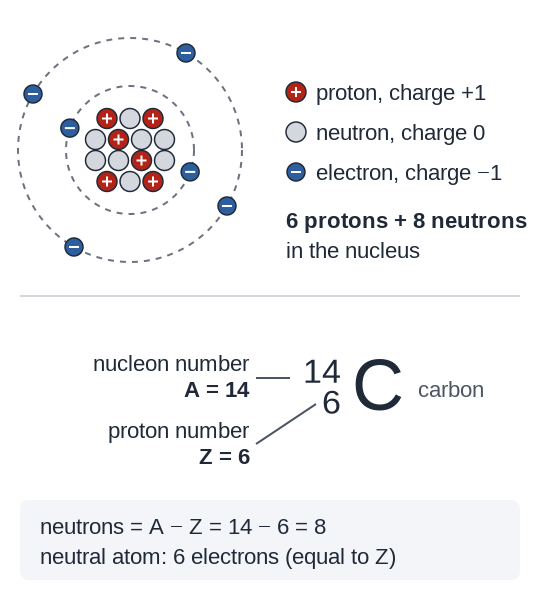
The nucleusThe dense central region of an atom containing protons and neutrons, except hydrogen-1 which has no neutron. is a very small central region containing positively charged protonA positively charged nuclear particle with a mass approximately equal to that of a neutron. and electrically neutral neutronAn uncharged nuclear particle with a mass approximately equal to that of a proton.. Negatively charged electronA negatively charged subatomic particle found outside an atom’s nucleus. occupy regions around the nucleus. Nearly all the atomAn electrically neutral particle with a small positive nucleus surrounded by electrons.’s massThe quantity measuring an object’s inertia, expressed in kilograms. is in the nucleus because a proton or neutron has roughly 1800 times the mass of an electron.
An atom is typically about 10⁻¹⁰ m across, whereas a nucleus is about 10⁻¹⁵ to 10⁻¹⁴ m across. A diagram enlarges the nucleus enormously to make its contents visible. Drawn electron shells are a useful level model, not literal circular tracks which electrons follow.
Charge and neutral atoms
protonA positively charged nuclear particle with a mass approximately equal to that of a neutron. and electronA negatively charged subatomic particle found outside an atom’s nucleus. have equal and opposite electric chargeA property of particles responsible for electrical interactions, measured in coulombs.. A neutral atomAn electrically neutral particle with a small positive nucleus surrounded by electrons. has equal numbers of each. neutronAn uncharged nuclear particle with a mass approximately equal to that of a proton. add to the nuclear massThe quantity measuring an object’s inertia, expressed in kilograms. but do not cancel proton charge.
If an atom loses an electron it becomes a positive ionAn atom or group of atoms with a net charge because electrons have been gained or lost.. This changes the atom’s overall charge, not its atomic numberThe number of protons in an atom’s nucleus, identifying the element. or the identity of its nucleusThe dense central region of an atom containing protons and neutrons, except hydrogen-1 which has no neutron.. Nuclear decay involves a change in the nucleus; ordinary ionisationFormation of ions by the removal or addition of electrons. involves electrons.
Reading a nuclear symbol
In ¹⁴₆C, the symbol C identifies carbon, the lower-left number Z = 6 is the atomic numberThe number of protons in an atom’s nucleus, identifying the element. and the upper-left number A = 14 is the mass numberThe total number of protons and neutrons in a nucleus.. Nucleons are protonA positively charged nuclear particle with a mass approximately equal to that of a neutron. and neutronAn uncharged nuclear particle with a mass approximately equal to that of a proton. together. Neutrons = A − Z = 14 − 6 = 8.
A neutral carbon-14 atomAn electrically neutral particle with a small positive nucleus surrounded by electrons. therefore has 6 protons, 8 neutrons and 6 electronA negatively charged subatomic particle found outside an atom’s nucleus.. If it loses one electron, it has 5 electrons and electric chargeA property of particles responsible for electrical interactions, measured in coulombs. +1, while A = 14 and Z = 6 remain unchanged. The nuclide symbol by itself describes the nucleusThe dense central region of an atom containing protons and neutrons, except hydrogen-1 which has no neutron.; infer electron count only when the charge state is given.
Equations
- A = number of protons + number of neutrons
- number of neutrons = A − Z
- neutral atom: number of electrons = Z
Common misconceptions
- Mass number is a particle count, not mass measured in grams.
- Electrons are outside the nucleus; beta electrons emitted in decay are not pre-existing orbital electrons.