Learning goals
- Describe the nature of alpha, beta-minus and gamma radiation.
- Compare ionising and penetrating abilities.
- Explain what absorber evidence can and cannot show.
What travels away from the nucleus
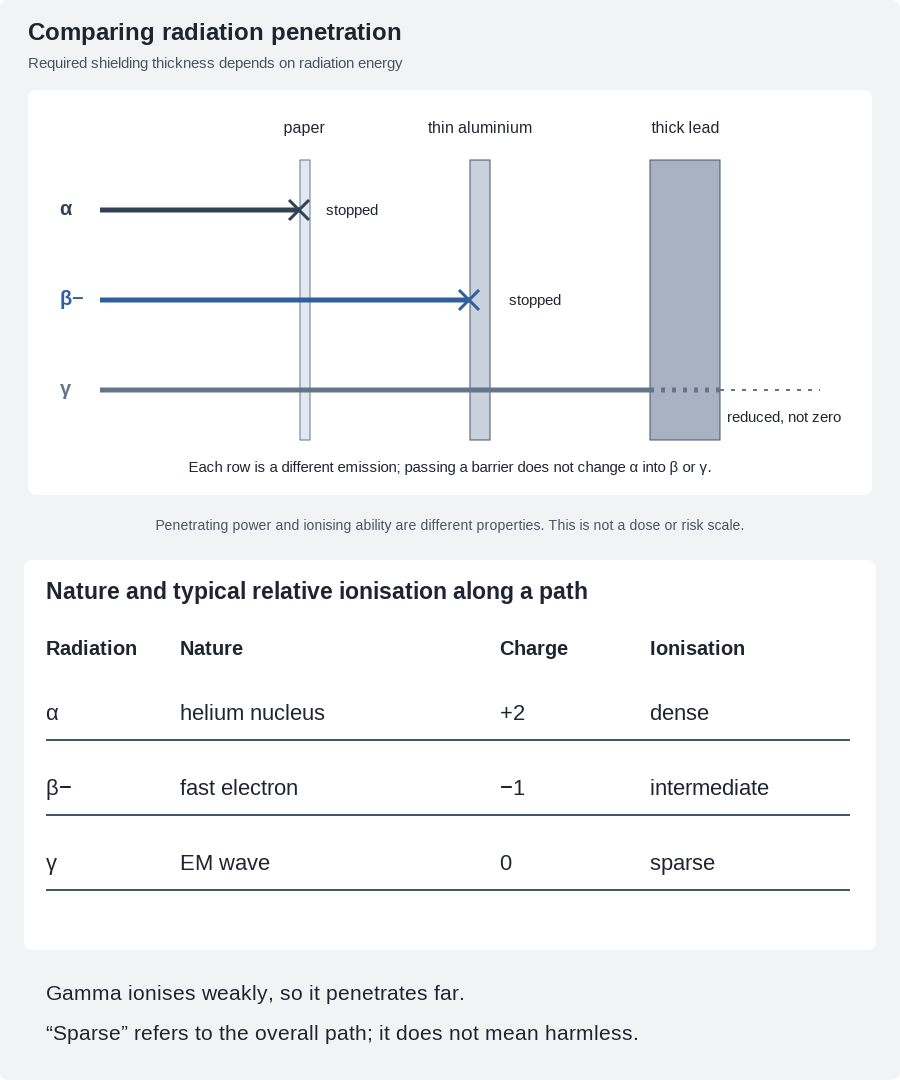
An alpha particleA helium nucleus containing two protons and two neutrons, emitted during alpha decay. is a helium nucleusThe dense central region of an atom containing protons and neutrons, except hydrogen-1 which has no neutron.: two protonA positively charged nuclear particle with a mass approximately equal to that of a neutron. and two neutronAn uncharged nuclear particle with a mass approximately equal to that of a proton., electric chargeA property of particles responsible for electrical interactions, measured in coulombs. +2 and mass numberThe total number of protons and neutrons in a nucleus. 4. It is not a neutral helium atomAn electrically neutral particle with a small positive nucleus surrounded by electrons. because it has no orbital electronA negatively charged subatomic particle found outside an atom’s nucleus..
A beta particleA fast electron emitted when a neutron changes into a proton during beta-minus decay. is a fast electron produced when a neutron in the nucleus changes into a proton. It has charge −1 and a very small massThe quantity measuring an object’s inertia, expressed in kilograms. compared with an alpha particle. It is not an electron shaken out of a shell.
A gamma rayVery high-frequency electromagnetic radiation emitted when a nucleus loses energy. is a high-frequency electromagnetic waveA transverse wave of oscillating electric and magnetic fields that travels through a vacuum at the speed of light.. It has no charge and no rest mass. Gamma emission removes excess nuclear energyA conserved quantity transferred between stores by working, heating, electrical processes or radiation, measured in joules. without changing proton or nucleon number.
Ionisation and penetration
alpha particleA helium nucleus containing two protons and two neutrons, emitted during alpha decay. usually produce dense ionisationFormation of ions by the removal or addition of electrons. over a short path. Their energyA conserved quantity transferred between stores by working, heating, electrical processes or radiation, measured in joules. is transferred to matter rapidly, so paper or the outer dead skin layer stops typical alpha radiation; its air range is only a few centimetres. This does not make alpha-emitting material safe inside the body.
Beta-minus radiation usually produces less dense ionisation and penetrates further. A few millimetres of aluminium can stop typical school-source beta radiation. gamma radiationHigh-frequency electromagnetic waves emitted as an excited nucleus loses energy without changing proton or nucleon numbers. is much more penetrating and produces sparse ionisation along its overall path through matter.
gamma rayVery high-frequency electromagnetic radiation emitted when a nucleus loses energy. can still transfer substantial energy when they interact. 'Weakly ionising' describes relatively little ionisation along a path; an individual gamma interaction can still cause harm.
Reading the shielding diagram
Compare each radiation using the same sequence of absorbers. Paper stops alpha; beta passes paper but is stopped by suitable aluminium; gamma passes both and is attenuated by thick lead or concrete. Attenuated means the transmitted intensity is reduced, not made exactly zero.
Actual ranges and suitable shieldingMaterial placed around a radiation source to absorb emissions and reduce exposure. depend on radiation energyA conserved quantity transferred between stores by working, heating, electrical processes or radiation, measured in joules. and material. The widths of the arrows in the schematic do not specify measured transmission fractions.
Equations
Common misconceptions
- Gamma is electromagnetic radiation, not a positively charged particle.
- The most penetrating radiation is not the most densely ionising along its path.
Separate absorber effects from background counts
Change aluminium thickness and background, then distinguish corrected radiation signals from total registered rates.
What you see
- Labelled diagrams and numerical outputs describe the same selected state.
How to use it
- Change one control at a time, predict the outcome, then compare the readouts. All controls have keyboard-accessible sliders and step buttons.
- Reset restores every model control to its initial value. Nothing is saved.
What it shows
- Absorption can reduce radiation reaching a detector without changing the source activity. Add background to obtain the total registered rate; subtract the same matched background to recover the corrected signal. These curves illustrate different penetration in this setup. A real background-level result is limited by counting variation and detector sensitivity.
Limits of the model
- Three separate signals each begin at 100 corrected counts/s with no absorber. Geometry and detector sensitivity stay fixed; the detector can register the alpha signal before adding the absorber. Equal initial count rates do not establish equal source activities.
- Curves join the recorded points; they are not general stopping laws. Radiation energy, absorber and detector affect real results. Background is known exactly here; counting fluctuations are not simulated.
Controls
A zero corrected curve value represents no detected source contribution in this model. It does not prove zero source activity or safe exposure. Background correction does not repair an unsuitable detector or changed geometry.
Predict, change and explain
At 1 mm aluminium, compare the corrected alpha, beta and gamma rates. Increase background alone: predict which totals change and whether the corrected curves should change. Explain why a zero corrected model value does not mean the source has stopped decaying.
Connect the outcome to the Physics
Absorption can reduce radiation reaching a detector without changing the source activity. Add background to obtain the total registered rate; subtract the same matched background to recover the corrected signal. These curves illustrate different penetration in this setup. A real background-level result is limited by counting variation and detector sensitivity.