Learning goals
- Describe a balanced fusion example.
- Include every product in the mass comparison.
- Distinguish mass number from exact rest mass.
A balanced light-nucleus example
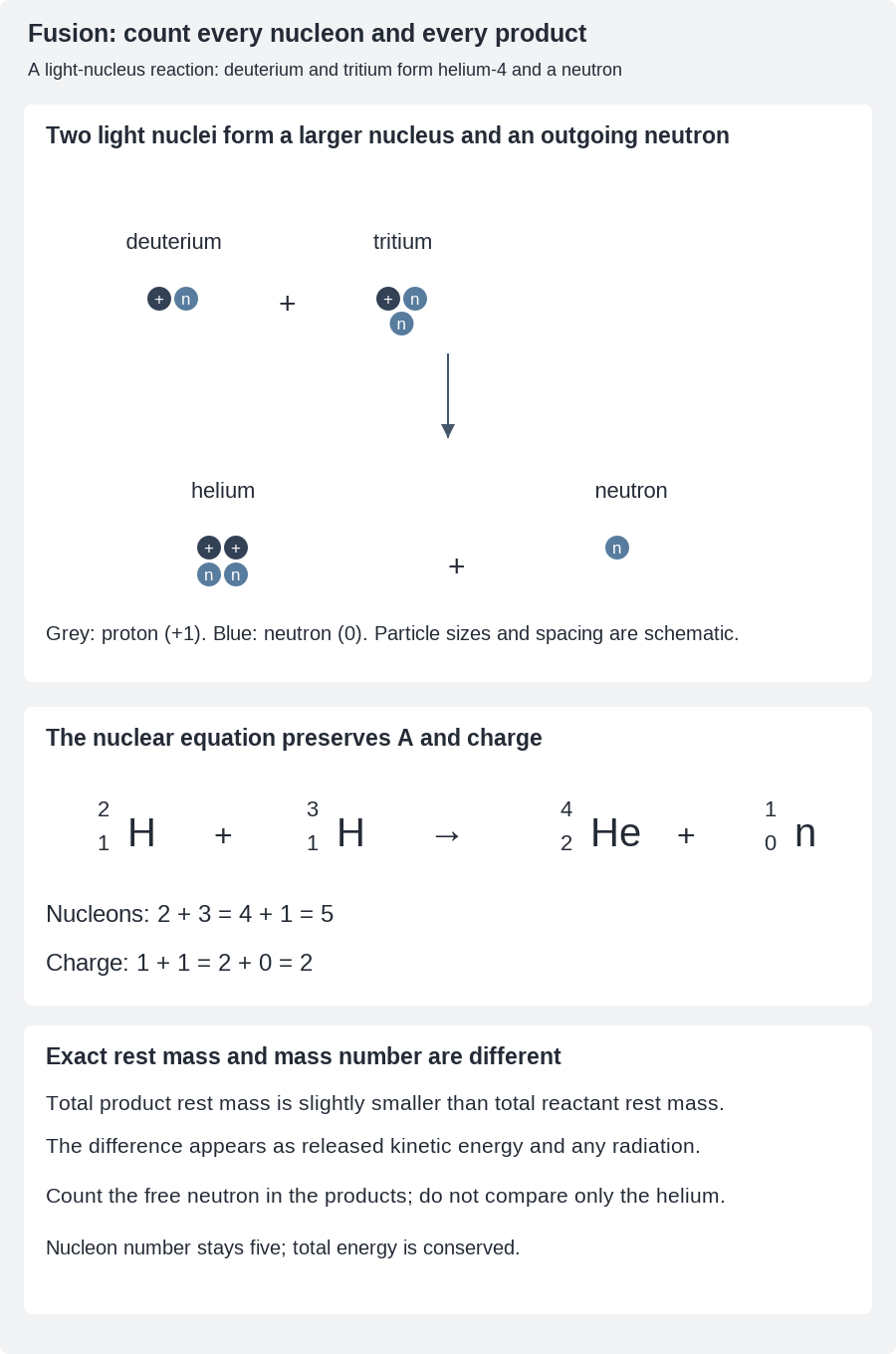
Deuterium contains one protonA positively charged nuclear particle with a mass approximately equal to that of a neutron. and one neutronAn uncharged nuclear particle with a mass approximately equal to that of a proton.; tritium contains one proton and two neutrons. A possible reaction is ²₁H + ³₁H → ⁴₂He + ¹₀n. The helium nucleusThe dense central region of an atom containing protons and neutrons, except hydrogen-1 which has no neutron. contains two protons and two neutrons, and one neutron leaves separately.
Check upper numbers: 2 + 3 = 4 + 1 = 5. Check lower numbers: 1 + 1 = 2 + 0 = 2. Compare all products, including the free neutron, with all reactants.
Rest-mass difference
The exact combined rest massThe quantity measuring an object’s inertia, expressed in kilograms. of the helium nucleusThe dense central region of an atom containing protons and neutrons, except hydrogen-1 which has no neutron. and neutronAn uncharged nuclear particle with a mass approximately equal to that of a proton. is smaller than that of the initial deuterium and tritium nuclei. The mass difference corresponds to energyA conserved quantity transferred between stores by working, heating, electrical processes or radiation, measured in joules. released, principally as kinetic energyThe energy associated with motion, equal to half the mass multiplied by speed squared for a moving object. of the products in this example.
The mass difference is small, but it corresponds to a substantial release of energy. Include both the helium nucleus and the free neutron when comparing the total mass before and after the reaction.
Conservation still holds
The number of nucleons has not vanished: the total remains five. mass numberThe total number of protons and neutrons in a nucleus. is a whole-number count, while the exact massThe quantity measuring an object’s inertia, expressed in kilograms. depends on how the nucleons are arranged in the nucleusThe dense central region of an atom containing protons and neutrons, except hydrogen-1 which has no neutron.. Total energyA conserved quantity transferred between stores by working, heating, electrical processes or radiation, measured in joules., including rest energy and the outgoing kinetic and radiation energy, is conserved.
Do not compare only the helium nucleus with both starting nuclei: that would leave out the free neutronAn uncharged nuclear particle with a mass approximately equal to that of a proton. and grossly overstate the mass difference.
Equations
- ²₁H + ³₁H → ⁴₂He + ¹₀n
Common misconceptions
- Mass number is not an exact mass in kilograms.
- Released energy does not imply a failure of total energy conservation.