Learning goals
- Compare inputs, products and conditions.
- Distinguish a fission chain from a fusion reaction.
- Explain the shared energy-accounting principle.
Fission
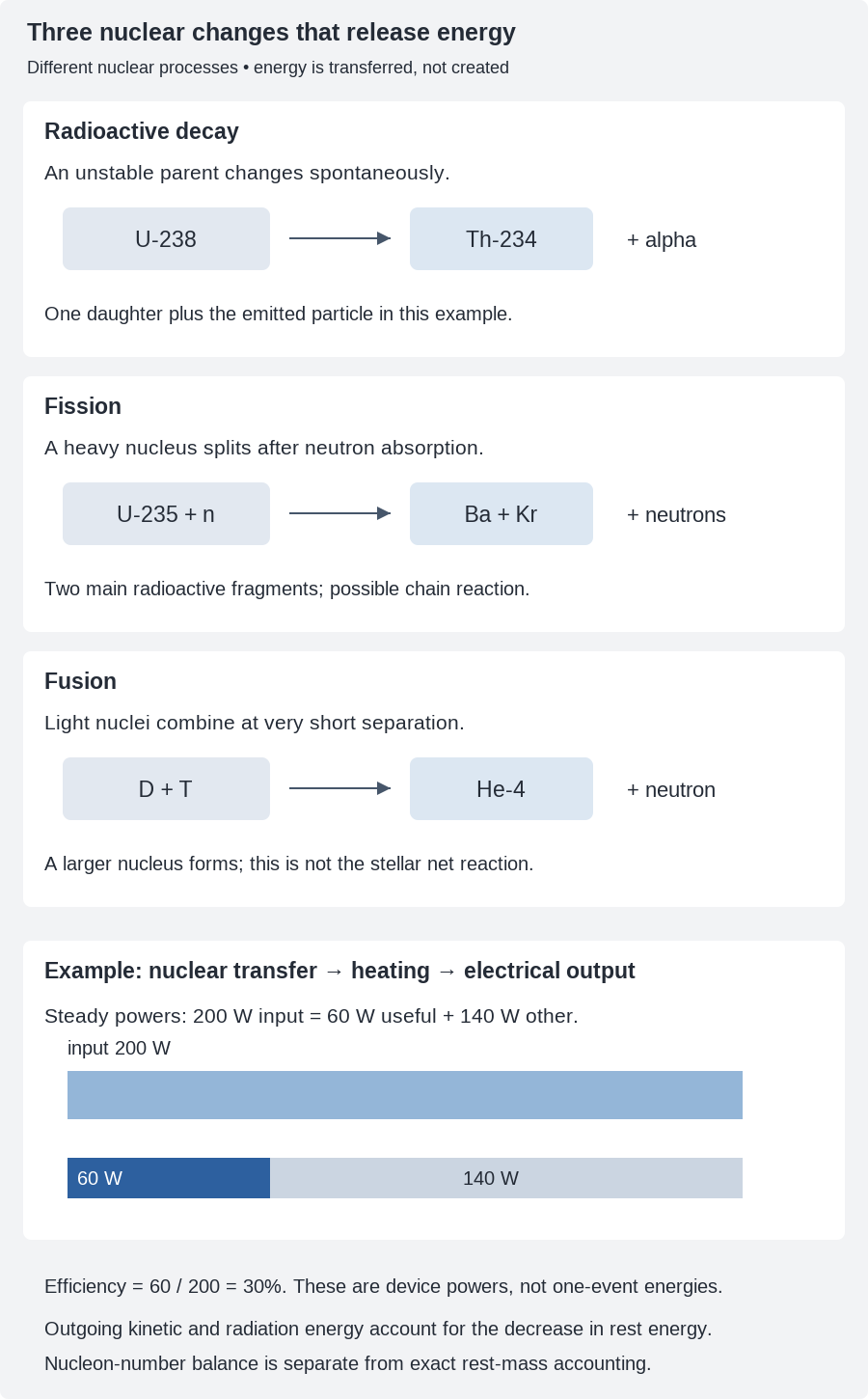
A heavy U-235 nucleusThe dense central region of an atom containing protons and neutrons, except hydrogen-1 which has no neutron. can absorb a neutronAn uncharged nuclear particle with a mass approximately equal to that of a proton. and split into two main daughter nuclei plus a few neutrons. Those neutrons can cause further fissions, forming a chain reactionA sequence in which neutrons released by fission cause further fissions that release more neutrons.. Fast fragments transfer energyA conserved quantity transferred between stores by working, heating, electrical processes or radiation, measured in joules. to the surrounding material.
In the barium/krypton channel, the incoming 236 nucleons remain distributed among two daughter nuclei and three free neutrons. Equal total mass numberThe total number of protons and neutrons in a nucleus. is compatible with a smaller total rest massThe quantity measuring an object’s inertia, expressed in kilograms..
Fusion
Light nucleusThe dense central region of an atom containing protons and neutrons, except hydrogen-1 which has no neutron. combine at very short separation. A useful example is deuterium and tritium, isotopeOne of the forms of an element with the same proton number but a different neutron number. of hydrogen, reacting to form helium-4 and a neutronAn uncharged nuclear particle with a mass approximately equal to that of a proton.. The helium nucleus is larger than either starting nucleus, but not every product must be part of that larger nucleus.
Positive nuclei repel, so achieving a useful fusion rate requires high temperatureA measure of how hot a system is, related to the average kinetic energy of its particles. and high pressureThe normal force exerted per unit area, measured in pascals. to maintain frequent close encounters. The energyA conserved quantity transferred between stores by working, heating, electrical processes or radiation, measured in joules. source of starA self-gravitating sphere of hot gas and plasma that produces energy by nuclear fusion during its main-sequence lifetime. is fusion, but their dominant hydrogen reaction sequences are not simply the laboratory deuterium–tritium example.
What is shared and what differs
Both processes can transfer released energyA conserved quantity transferred between stores by working, heating, electrical processes or radiation, measured in joules. into kinetic energyThe energy associated with motion, equal to half the mass multiplied by speed squared for a moving object. and radiation, and then into thermal energyThe part of internal energy associated with the random motion and interactions of particles.. Neither is ordinary chemical burning. Their fuels, reaction pathways, conditions and products differ.
Fusion is not simply the exact reverse of one chosen fission reaction. Nor does 'fusion' mean that every possible joining of nucleusThe dense central region of an atom containing protons and neutrons, except hydrogen-1 which has no neutron. releases energy: this course focuses on appropriate light-nucleus reactions.
Equations
Common misconceptions
- Fusion can produce an outgoing neutron as well as a larger nucleus.
- Fission products are not necessarily two equal halves.