Learning goals
- Explain the need for neutron and gamma shielding.
- Distinguish shielding, containment and control rods.
- Explain why protection is needed after shutdown.
Radiation from the core
Fission and radioactive products produce ionising radiationRadiation with enough energy to remove electrons from atoms or molecules and form ions., including neutronAn uncharged nuclear particle with a mass approximately equal to that of a proton. and gamma rayVery high-frequency electromagnetic radiation emitted when a nucleus loses energy.. Unshielded exposure could damage living tissue. Fuel cladding and other structures retain material, but they do not by themselves provide every required radiation barrier.
Thick surrounding shieldingMaterial placed around a radiation source to absorb emissions and reduce exposure. absorbs and scatters radiation. Dense materials help attenuate gamma rays; hydrogen-containing materials can slow neutrons, which can then be captured. Real shielding uses appropriate materials and thicknesses for the radiation present.
Different barriers, different jobs
Containment is intended to limit release of radioactive material into the environment. shieldingMaterial placed around a radiation source to absorb emissions and reduce exposure. is intended to reduce radiation travelling through it. A structure can contribute to both, but the words do not mean the same thing.
Fuel cladding, the reactor vessel, biological shielding and containment provide layers of protection; exact layouts vary between reactor designs. Monitoring checks for changes and releases; it is not a physical barrier.
Protection after shutdown
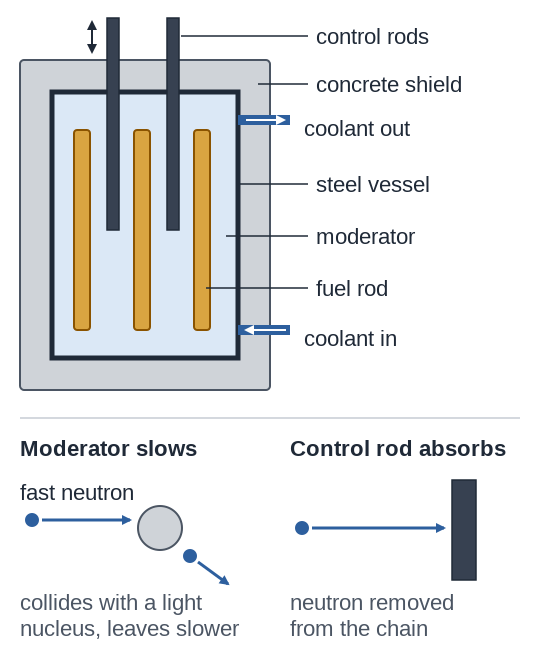
control rodA reactor component that absorbs neutrons to regulate the rate of the fission chain reaction. suppress neutronAn uncharged nuclear particle with a mass approximately equal to that of a proton. multiplication. Radioactive fission products continue emitting radiation, and their decays continue releasing heat. shieldingMaterial placed around a radiation source to absorb emissions and reduce exposure. and cooling can therefore remain necessary after shutdown.
A claim that a reactor is safe merely because the chain reactionA sequence in which neutrons released by fission cause further fissions that release more neutrons. has stopped leaves out these sources. Explain which hazard a proposed control actually reduces.
Equations
Common misconceptions
- Shielding does not change the half-life of the nuclei behind it.
- Containment is not a substitute for adequate shielding or cooling.