Learning goals
- Explain moderator and control-rod roles.
- Predict the effect of inserting or withdrawing rods.
- Distinguish neutron control from heat removal.
Why use a moderator?
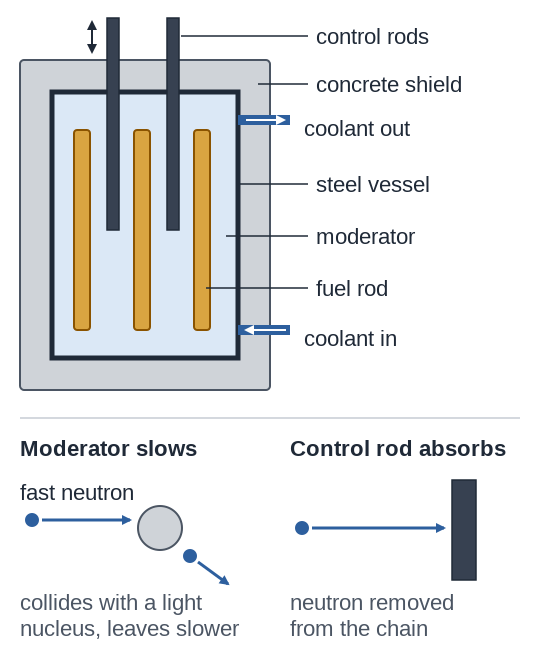
Fission neutronAn uncharged nuclear particle with a mass approximately equal to that of a proton. are initially fast. In the reactor model studied here, repeated collisions with light nucleusThe dense central region of an atom containing protons and neutrons, except hydrogen-1 which has no neutron. in the moderatorA reactor material that slows neutrons to increase their probability of causing further fission in the fuel. reduce neutron speedThe distance travelled per unit time, without specifying direction.. Slow neutrons are more likely to cause U-235 fission in this type of reactor.
Water or graphite can act as moderators. The main intended role is slowing, not removing all neutrons. The diagram shows their role in the reactor model studied here.
What control rods do
control rodA reactor component that absorbs neutrons to regulate the rate of the fission chain reaction. contain neutron-absorbing material, for example boron-containing material. Further insertion removes more neutronAn uncharged nuclear particle with a mass approximately equal to that of a proton. from the chain, tending to reduce the rate of fission. Withdrawal allows more neutrons to remain available, tending to increase it.
For steady operation, controls maintain approximately one subsequent fission per fission on average. Rods do not slow neutrons in the same sense as a moderatorA reactor material that slows neutrons to increase their probability of causing further fission in the fuel.; an absorbed neutron is no longer a free particle available to cause fission.
Cooling is a separate requirement
A coolant carries thermal energyThe part of internal energy associated with the random motion and interactions of particles. away from the fuel to another part of the system. In some designs, water acts as both moderatorA reactor material that slows neutrons to increase their probability of causing further fission in the fuel. and coolant, but the two functions remain conceptually distinct.
Inserting rods can stop the sustained chain without stopping radioactive daughter decays. Cooling must still remove decay heat. The diagram separates fuel, moderator, control rodA reactor component that absorbs neutrons to regulate the rate of the fission chain reaction., coolant path and external shieldingMaterial placed around a radiation source to absorb emissions and reduce exposure. so each purpose is clear.
Equations
Common misconceptions
- Moderator: slows. Control rod: absorbs. Coolant: transfers heat.
- Control rods do not make the fuel nonradioactive.