Learning goals
- Explain a neutron-driven chain reaction.
- Compare dying, steady and growing chains.
- Distinguish emitted neutrons from successful neutron links.
A repeating cause-and-effect sequence
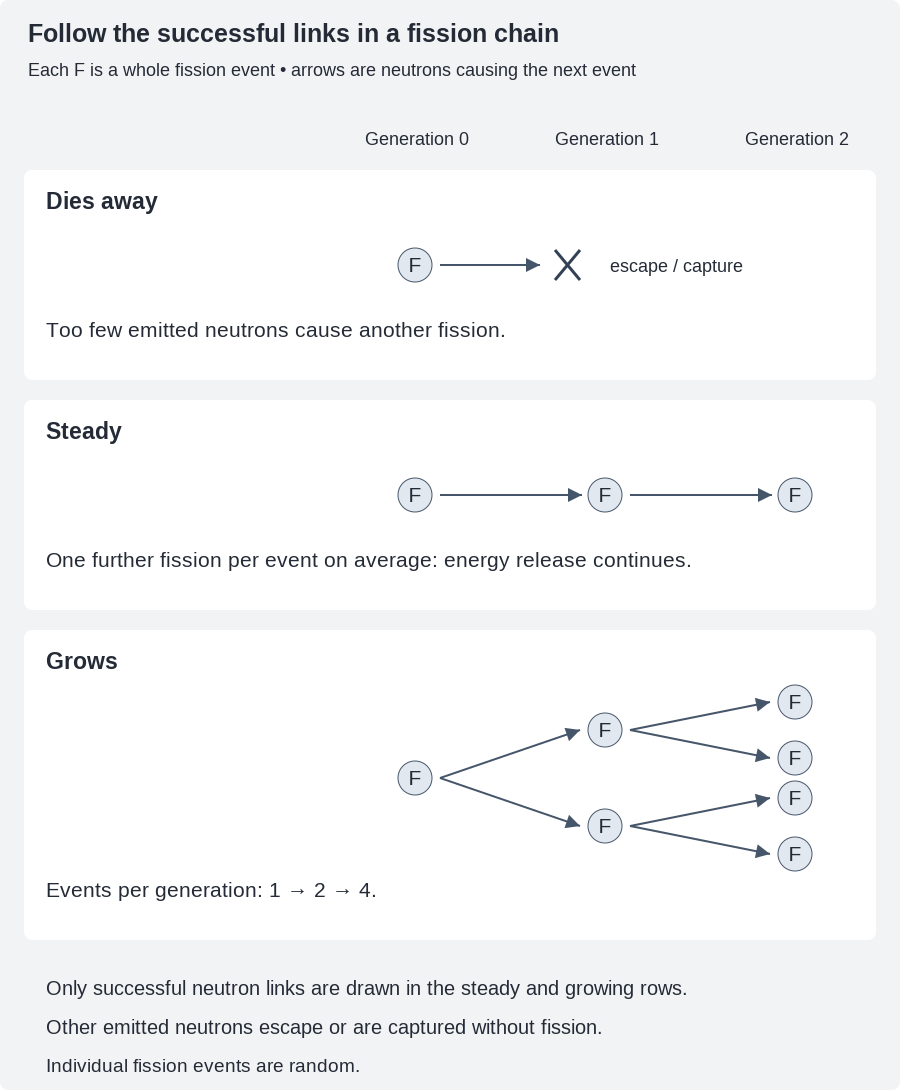
A neutronAn uncharged nuclear particle with a mass approximately equal to that of a proton. is absorbed by a U-235 nucleusThe dense central region of an atom containing protons and neutrons, except hydrogen-1 which has no neutron., which can fission and release more neutrons. If one of those neutrons causes another U-235 fission, the sequence repeats. Each event transfers energyA conserved quantity transferred between stores by working, heating, electrical processes or radiation, measured in joules.; the diagram’s F symbols represent complete fissions, not intact fuel nuclei.
A neutron can also escape the fuel or be absorbed without fission. Therefore the number of neutrons produced and the number of subsequent fissions are different.
Three average behaviours
If each event causes fewer than one further fission on average, the population of events decreases and the chain dies away. If the average is one, the chain can remain steady. More than one causes growth.
The illustration uses ideal generations 1 → 1 → 1 for steady behaviour and 1 → 2 → 4 for growth. Actual chains involve huge populations and random individual events.
Controlled does not mean stopped
A steady chain continues releasing energyA conserved quantity transferred between stores by working, heating, electrical processes or radiation, measured in joules. at a sustained rate. control rodA reactor component that absorbs neutrons to regulate the rate of the fission chain reaction. adjust the availability of neutronAn uncharged nuclear particle with a mass approximately equal to that of a proton. to keep the desired average behaviour. Inserting them deeply can suppress the chain, while radioactive daughters still produce decay heat.
Neutrons that escape or are absorbed without fission do not continue the chain. This explains why the number of emitted neutrons alone does not determine the rate of energy release.
Equations
Common misconceptions
- A chain reaction is not necessarily a continuously accelerating event.
- Steady operation still produces heat; it is not a chain with no energy release.