Learning goals
- Identify both kinds of fission product.
- Explain radioactive daughters and decay heat.
- Relate emitted neutrons to possible further fissions.
Two daughter nuclei
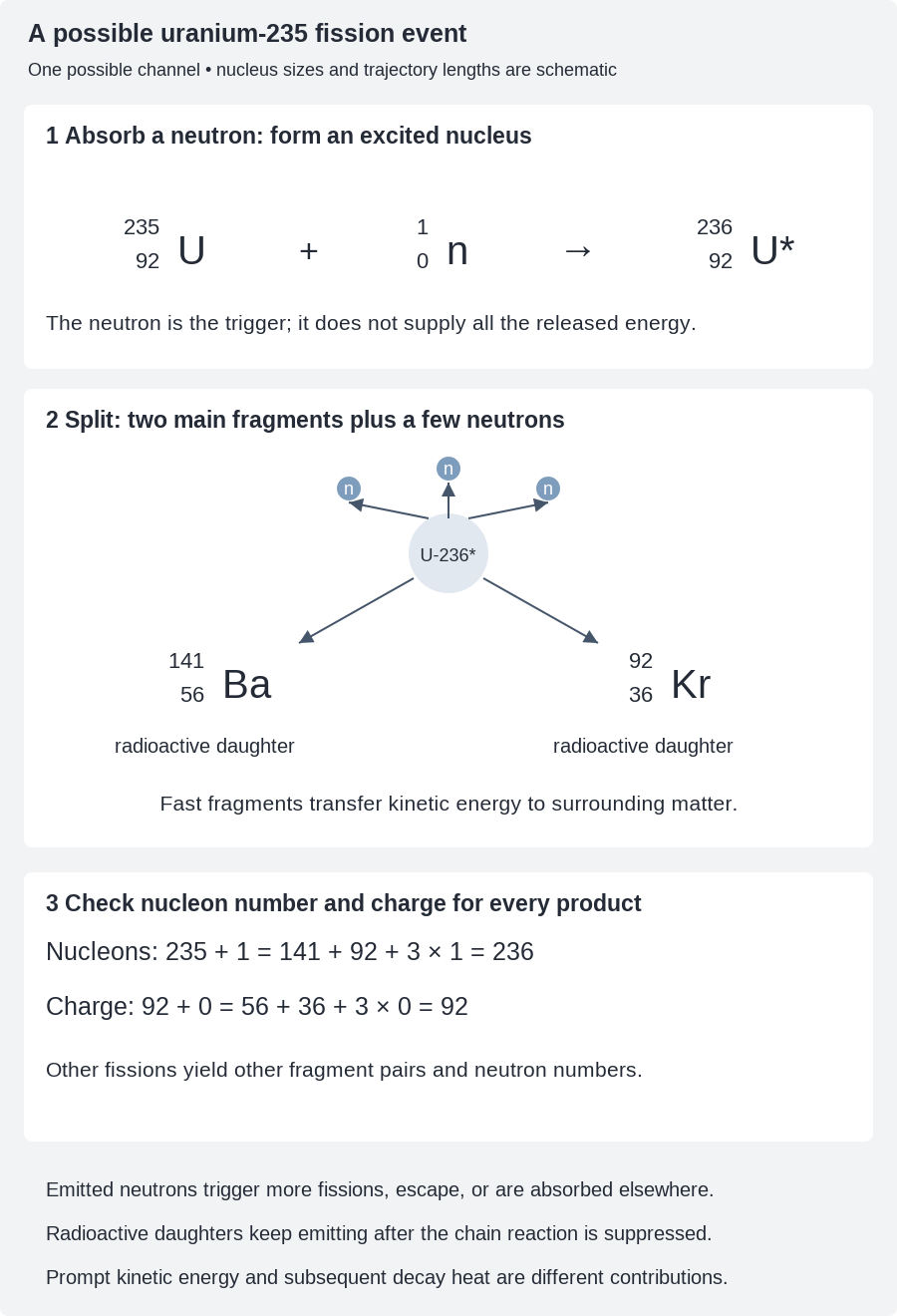
Each main fission fragment is a nucleusThe dense central region of an atom containing protons and neutrons, except hydrogen-1 which has no neutron. with its own protonA positively charged nuclear particle with a mass approximately equal to that of a neutron. and neutronAn uncharged nuclear particle with a mass approximately equal to that of a proton.. They are not particles called alpha or beta. The fragments are typically neutron-rich for their new atomic numberThe number of protons in an atom’s nucleus, identifying the element. and radioactive; they may decay through a sequence towards more stable nuclei.
In the worked channel, Ba-141 and Kr-92 are the two daughters. Other fissions can produce other pairs, so a drawing of one channel is an example rather than the only possible outcome.
A small number of neutrons
A few neutronAn uncharged nuclear particle with a mass approximately equal to that of a proton. are emitted. Some may be absorbed by other U-235 nucleusThe dense central region of an atom containing protons and neutrons, except hydrogen-1 which has no neutron. and cause more fissions. Others escape or are absorbed without producing another fission.
The existence of emitted neutrons makes a chain reactionA sequence in which neutrons released by fission cause further fissions that release more neutrons. possible, but their presence alone does not guarantee one. What matters is how many cause further fissions on average.
Immediate heat and later heat
Fragments carry large kinetic energyThe energy associated with motion, equal to half the mass multiplied by speed squared for a moving object. immediately after fission and slow in surrounding material, heating it. Their later radioactive decayA spontaneous, random change in an unstable nucleus that emits particles or electromagnetic radiation. also release energyA conserved quantity transferred between stores by working, heating, electrical processes or radiation, measured in joules.. This continuing decay heat is why a reactor and recently removed fuel can still need cooling after the main chain reactionA sequence in which neutrons released by fission cause further fissions that release more neutrons. has stopped.
Stopping neutronAn uncharged nuclear particle with a mass approximately equal to that of a proton. multiplication therefore does not instantly remove every radioactive source or all heating. This connects fission products to the shieldingMaterial placed around a radiation source to absorb emissions and reduce exposure. and waste-management lessons.
Equations
Common misconceptions
- The fission fragments do not disappear when the control rods are inserted.
- Three emitted neutrons do not automatically mean three further fissions.