Learning goals
- Describe neutron-induced U-235 fission.
- Follow a balanced example through its intermediate nucleus.
- Explain how moving fragments heat surrounding material.
Absorb, deform, split
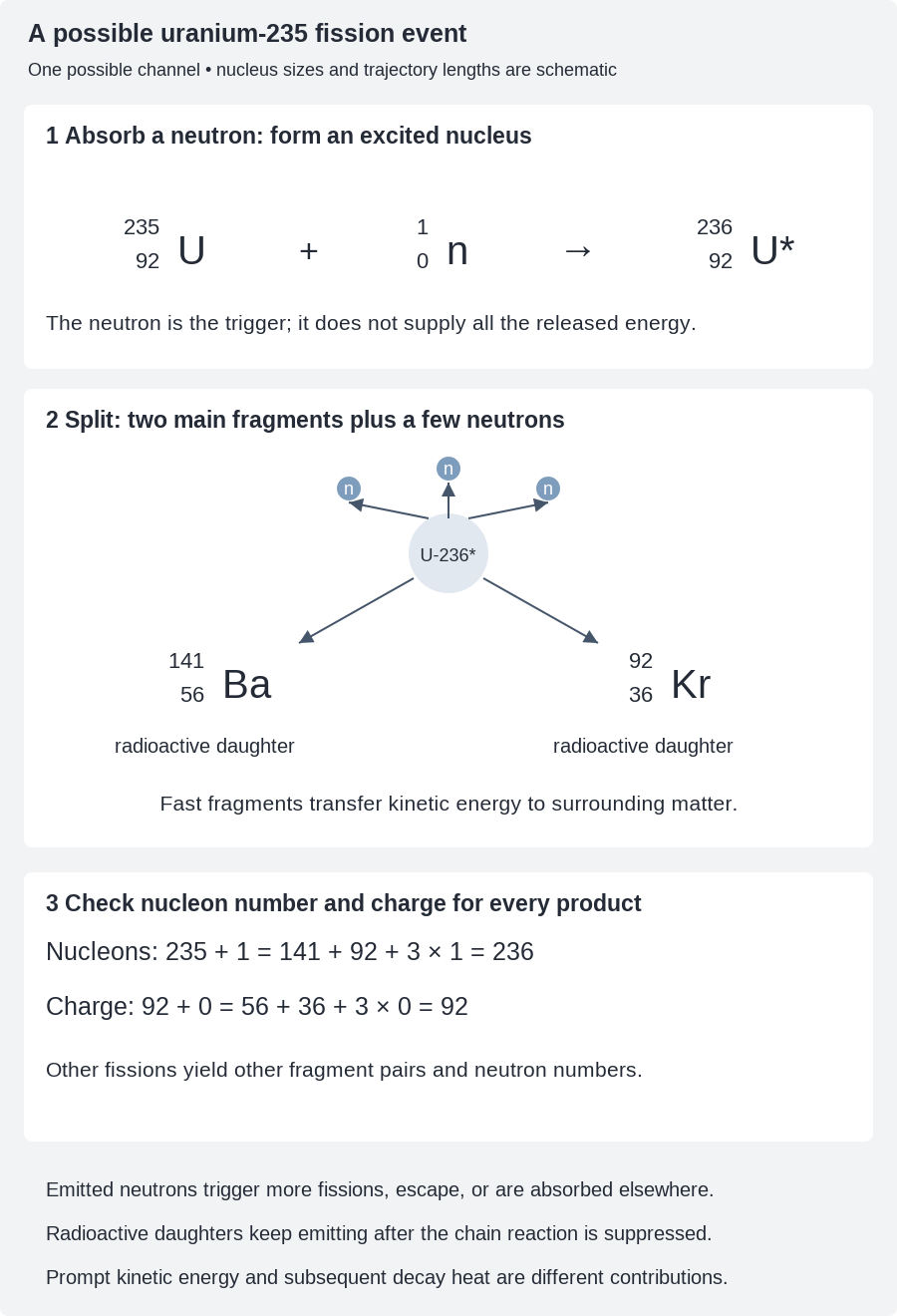
A neutronAn uncharged nuclear particle with a mass approximately equal to that of a proton. has no electric chargeA property of particles responsible for electrical interactions, measured in coulombs., so it is not repelled electrically by a positive nucleusThe dense central region of an atom containing protons and neutrons, except hydrogen-1 which has no neutron. as another positive nucleus would be. When a U-235 nucleus absorbs a neutron, it forms an excited U-236 nucleus. This can deform and split into two smaller daughter nuclei.
Absorption does not guarantee fission in every encounter. The diagram illustrates a possible fission event, not a deterministic outcome for every neutron.
One possible set of products
One possible channel is ²³⁵₉₂U + ¹₀n → ¹⁴¹₅₆Ba + ⁹²₃₆Kr + 3 ¹₀n. The incoming total is A = 236, Z = 92. The outgoing totals are 141 + 92 + 3 = 236 and 56 + 36 = 92.
Actual fission can produce several different pairs of fragments and different small numbers of neutronAn uncharged nuclear particle with a mass approximately equal to that of a proton.. The two fragments are not necessarily equal halves. The barium/krypton example is used to practise bookkeeping, not to imply that every U-235 nucleusThe dense central region of an atom containing protons and neutrons, except hydrogen-1 which has no neutron. follows it.
Energy transfer after splitting
The fragments fly apart rapidly. Their kinetic energyThe energy associated with motion, equal to half the mass multiplied by speed squared for a moving object. is transferred to nearby material through collisions and interactions, increasing its internal energyThe total microscopic kinetic and potential energies of the particles within a system.. Emitted neutronAn uncharged nuclear particle with a mass approximately equal to that of a proton. and gamma rayVery high-frequency electromagnetic radiation emitted when a nucleus loses energy. also carry some energyA conserved quantity transferred between stores by working, heating, electrical processes or radiation, measured in joules..
The incoming neutron is a trigger; it does not provide all the released energy. The energy comes from the change in the nuclear arrangement. Heating can then be used to produce steam and turn a turbine, while a generatorA device transferring mechanical energy to electrical energy by electromagnetic induction. converts mechanical transfer into electrical transfer.
Equations
- 235 + 1 = 141 + 92 + 3 × 1
- 92 + 0 = 56 + 36 + 3 × 0
Common misconceptions
- Fission splits the nucleus, not an electron shell.
- The two fragments are usually unequal and their kinetic energy is not necessarily shared equally.