Learning goals
- Distinguish the three nuclear processes.
- Explain how nuclear energy can become thermal energy.
- Keep nucleon-number and mass–energy accounting separate.
Three different changes
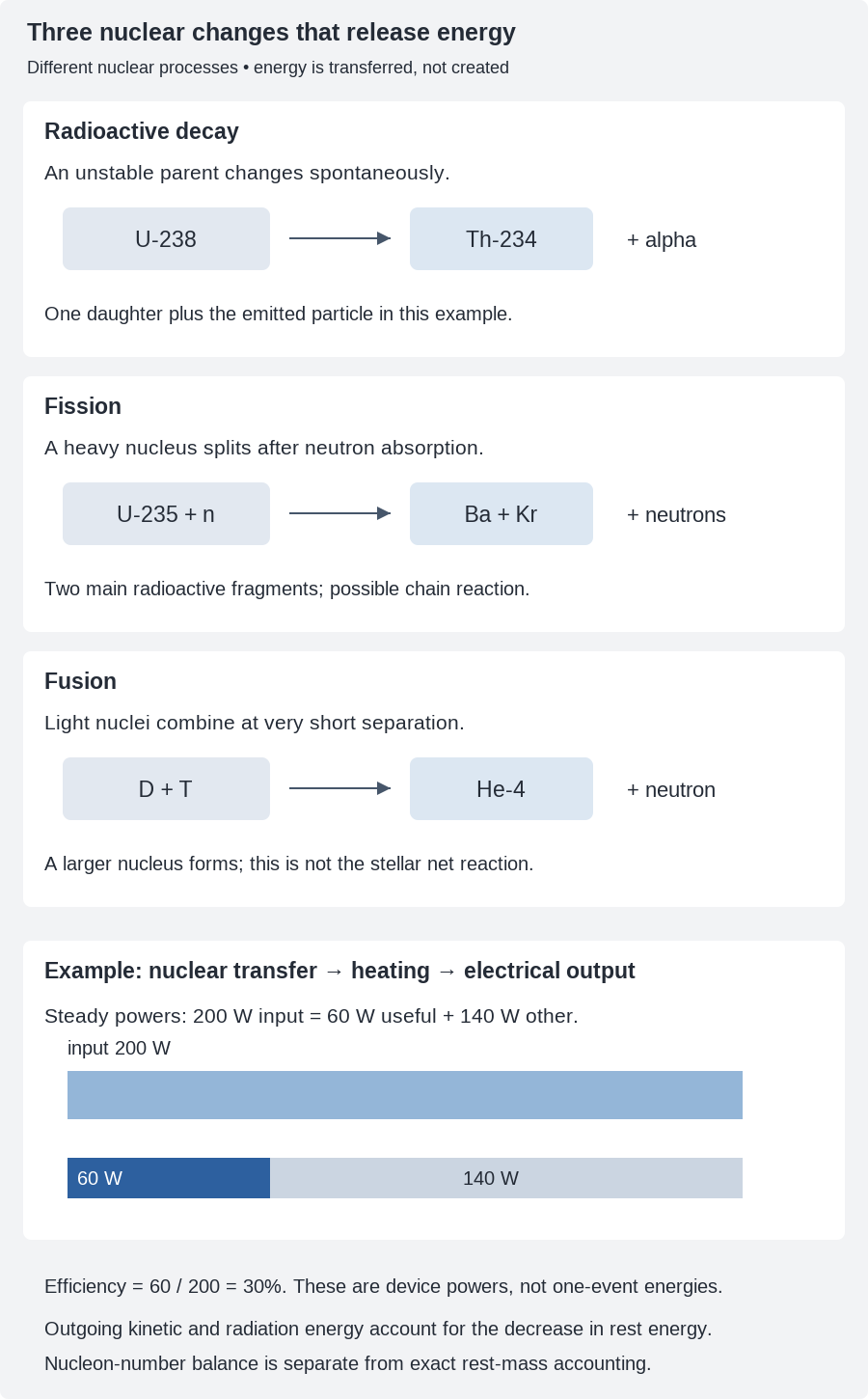
In radioactive decayA spontaneous, random change in an unstable nucleus that emits particles or electromagnetic radiation. an unstable nucleusThe dense central region of an atom containing protons and neutrons, except hydrogen-1 which has no neutron. changes spontaneously, emitting particles or electromagnetic radiation. Fission splits a heavy nucleus into two main fragments, often after absorption of a neutronAn uncharged nuclear particle with a mass approximately equal to that of a proton.. Fusion joins light nuclei to form a more tightly bound product arrangement.
These processes involve nuclei rather than the rearrangement of outer electronA negatively charged subatomic particle found outside an atom’s nucleus. found in ordinary chemical reactions. Appropriate nuclear reactions release much more energyA conserved quantity transferred between stores by working, heating, electrical processes or radiation, measured in joules. per reacting particle than typical chemical reactions, but not every conceivable nuclear rearrangement releases energy.
Where the released energy goes
Fast particles and recoiling nucleusThe dense central region of an atom containing protons and neutrons, except hydrogen-1 which has no neutron. carry kinetic energyThe energy associated with motion, equal to half the mass multiplied by speed squared for a moving object.; gamma rayVery high-frequency electromagnetic radiation emitted when a nucleus loses energy. carry electromagnetic energyA conserved quantity transferred between stores by working, heating, electrical processes or radiation, measured in joules.. As these interact with nearby matter, energy is transferred into its internal store, raising temperatureA measure of how hot a system is, related to the average kinetic energy of its particles. if losses and phase changeA transition between states of matter, such as melting or boiling, involving a change in particle arrangement. are accounted for.
For a steady device transferring 200 J of nuclear energy each second into thermal energyThe part of internal energy associated with the random motion and interactions of particles., the heating powerThe energy transferred or work done per unit time, measured in watts. is 200 W. If 60 W becomes useful electrical power, the efficiencyThe fraction of total energy input transferred usefully, also equal to useful power output divided by total power input. is 60/200 = 0.30 = 30%; the remaining 140 W is transferred elsewhere. These powers describe a device, rather than a single nuclear event.
Why rest mass can decrease
For an energy-releasing reaction, the total rest massThe quantity measuring an object’s inertia, expressed in kilograms. of all products is slightly less than that of all reactants. The difference corresponds to released kinetic and radiation energyA conserved quantity transferred between stores by working, heating, electrical processes or radiation, measured in joules.. Total mass–energy is conserved.
Adding mass numberThe total number of protons and neutrons in a nucleus. is still a separate check: A counts nucleons, not exact kilograms. A balanced total of nucleons does not require identical total rest mass. Later examples show the same distinction in fusion.
Equations
- power = transferred energy ÷ time
- efficiency = useful output power ÷ total input power
Common misconceptions
- Nuclear reactions do not create energy from nothing.
- Radioactive decay is not the same process as induced fission.