Learning goals
- Identify fusion as the source of stellar energy.
- Separate outward energy transfer from mechanical support.
- Distinguish stellar hydrogen fusion from chemical burning.
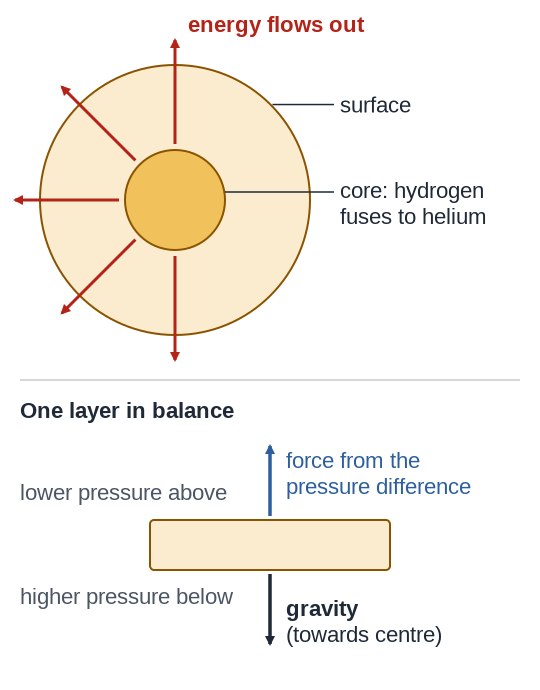
Fusion in the core
A starA self-gravitating sphere of hot gas and plasma that produces energy by nuclear fusion during its main-sequence lifetime.’s gravityThe attractive interaction between objects with mass. confines its material, creating a dense, hot core. During the main sequenceThe stable stage of a star’s life during which hydrogen fusion in its core supplies energy., nuclear reaction sequences convert hydrogen into helium. The products have less total rest massThe quantity measuring an object’s inertia, expressed in kilograms., and released energyA conserved quantity transferred between stores by working, heating, electrical processes or radiation, measured in joules. heats the surrounding material.
The overall sequence is not one simple collision of four hydrogen nucleusThe dense central region of an atom containing protons and neutrons, except hydrogen-1 which has no neutron.. Several reactions and intermediate products are involved. The deuterium–tritium example used elsewhere illustrates fusion accounting, not the dominant sequence in a Sun-like star.
From core to surface
energyA conserved quantity transferred between stores by working, heating, electrical processes or radiation, measured in joules. moves outwards through radiation and, in appropriate regions, convectionEnergy transfer by bulk movement of a fluid, commonly driven by density differences within it.. Repeated interactions redistribute the energy as it travels from the core towards the surface. The surface emits radiation into space, including visible lightElectromagnetic radiation with wavelengths detected by the human eye, from violet to red..
The starA self-gravitating sphere of hot gas and plasma that produces energy by nuclear fusion during its main-sequence lifetime. can keep radiating for a long time because fusion replenishes the energy being transferred away. It does not require an external oxygen supply and is not a giant chemical fire.
Support against gravity
gravityThe attractive interaction between objects with mass. pulls stellar material inward. pressureThe normal force exerted per unit area, measured in pascals. is greater deeper inside; the difference in pressure across a layer produces an outward forceA push or pull arising from an interaction between objects, measured in newtons.. In a stable starA self-gravitating sphere of hot gas and plasma that produces energy by nuclear fusion during its main-sequence lifetime. this balances the inward gravitational force. gasA state of matter whose widely separated particles move randomly, filling the available container. pressure and, especially in massive stars, radiation pressure can contribute.
Do not label the inward force as 'pressure'. The outward energy-flow arrows in the diagram are also different from force arrows. A star can be in mechanical balance while energyA conserved quantity transferred between stores by working, heating, electrical processes or radiation, measured in joules. continues flowing through it and escaping.
Equations
Common misconceptions
- A stable star is not a star with no energy transfer.
- Gravity acts inward; pressure differences provide outward support.