Learning goals
- Explain the electrostatic barrier.
- Relate temperature to nuclear kinetic energy.
- Explain density, pressure and confinement without treating them as guarantees.
Positive nuclei repel
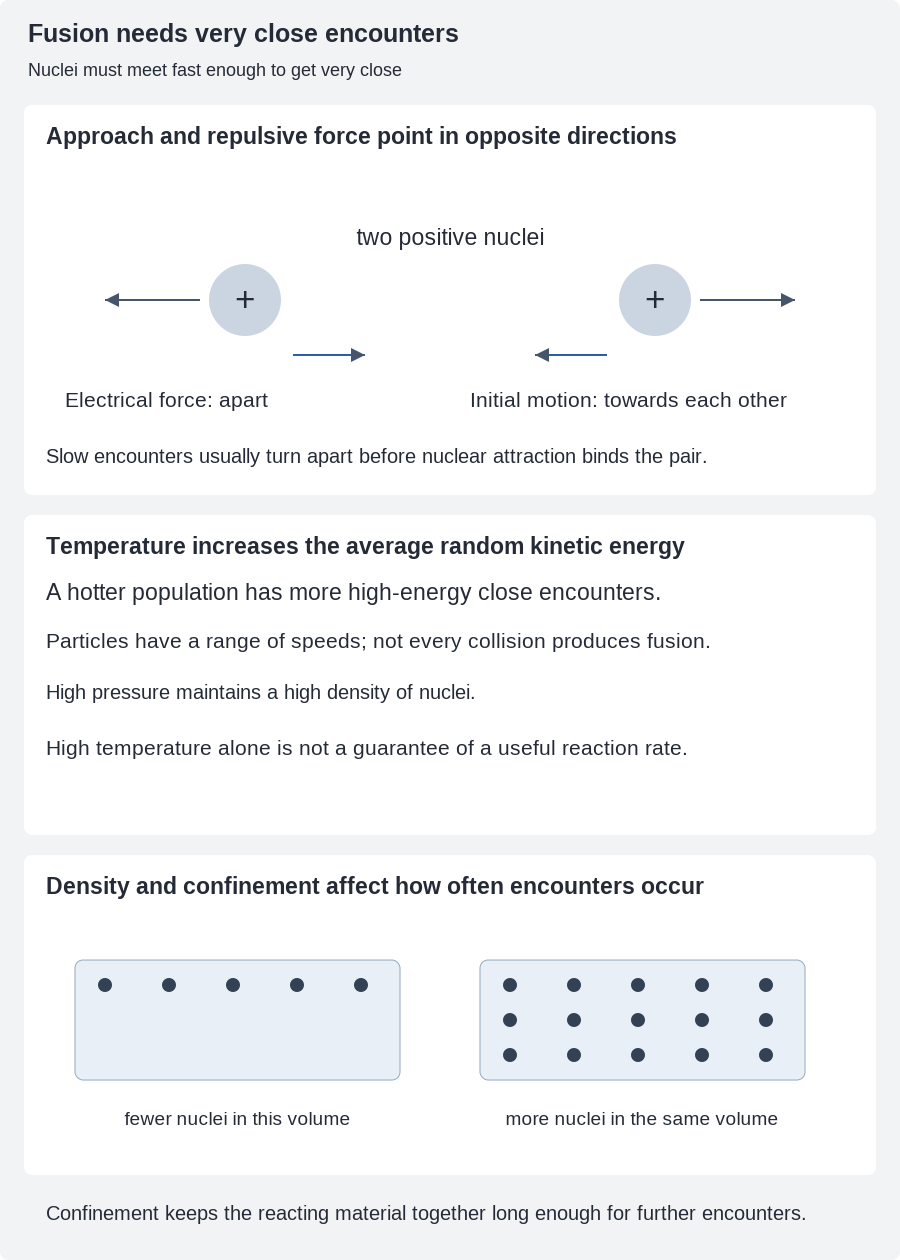
Each nucleusThe dense central region of an atom containing protons and neutrons, except hydrogen-1 which has no neutron. contains positive protonA positively charged nuclear particle with a mass approximately equal to that of a neutron., so two approaching nuclei exert repulsive electrical forceA push or pull arising from an interaction between objects, measured in newtons. on one another. As they get closer, energyA conserved quantity transferred between stores by working, heating, electrical processes or radiation, measured in joules. must be transferred into their electrical potential energy. Slowly approaching nuclei usually turn apart before they reach the very short separations where nuclear attraction can bind them.
Removing electronA negatively charged subatomic particle found outside an atom’s nucleus. does not remove the positive nuclear electric chargeA property of particles responsible for electrical interactions, measured in coulombs.. A neutral atomAn electrically neutral particle with a small positive nucleus surrounded by electrons. overall is not the same thing as an uncharged nucleus.
Temperature and close encounters
Higher temperatureA measure of how hot a system is, related to the average kinetic energy of its particles. means greater average random kinetic energyThe energy associated with motion, equal to half the mass multiplied by speed squared for a moving object.. More pairs can approach closely enough for fusion to become possible. Not all nucleusThe dense central region of an atom containing protons and neutrons, except hydrogen-1 which has no neutron. have the same speedThe distance travelled per unit time, without specifying direction., and an individual collision does not guarantee fusion.
The diagram shows why close approach is difficult. It does not predict that every collision results in fusion or calculate the reaction rate.
Density, pressure and confinement
Greater densityThe mass of material per unit volume, measured in kilograms per cubic metre in SI units. puts more nucleusThe dense central region of an atom containing protons and neutrons, except hydrogen-1 which has no neutron. in a given volume, increasing opportunities for collisions. High pressureThe normal force exerted per unit area, measured in pascals. and confinement in a stellar core help maintain dense reacting matter. A hot, sparse gasA state of matter whose widely separated particles move randomly, filling the available container. that escapes immediately will not sustain a useful fusion rate.
Different fusion systems achieve confinement in different ways. The essential idea is a suitable combination of temperatureA measure of how hot a system is, related to the average kinetic energy of its particles., particle density and time held together. High temperature or pressure by itself is not a guarantee.
Equations
Common misconceptions
- High pressure does not turn the electrostatic repulsion into attraction.
- Fusion can occur statistically without every collision succeeding.