Reasoning about orbits, stars and cosmic evidence
Separate observations from models, apply orbital assumptions and distinguish temperature, brightness and spectral shifts.
Specification 9.2, 9.3, 9.4, 9.5, 9.6, 9.7, 9.8, 9.9, 9.10, 9.11P, 9.12P, 9.13P, 9.14P, 9.15P, 9.16P, 9.17P, 9.18P
Ratings, marks and Maths and Logic completion stay in this browser on this device. Written answers are temporary and are never recorded or transmitted. Reset clears only Physics practice progress, including Maths and Logic completion.
Answers and choices are temporary. Only started/completed flags are saved on this device. Practice can be retried or revealed; the check counts each question’s first answer. These are original practice tasks, not official exam questions.
Starting here
Astronomical reasoning separates the observation from the model used to interpret it. Check circular-orbit assumptions before using orbital speed, distinguish a star’s intrinsic brightness from its apparent brightness at Earth, and compare fractional wavelength changes rather than shifts alone.
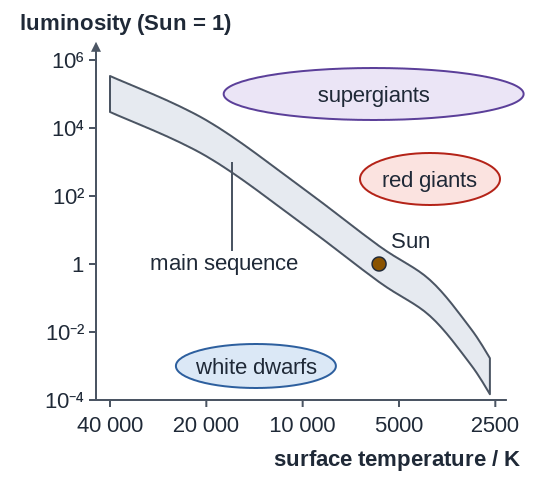
On the H–R diagram, surface temperature decreases to the right. Surface colour, apparent brightness and the displacement of identifiable spectral lines provide different kinds of information. A red spectral shift is not the same observation as a cool red stellar surface.
Key ideas
- In a circular orbit, gravity changes velocity direction even when speed is constant.
- Absolute magnitude compares stars at a standard distance; apparent brightness also depends on their actual distance.
- Galaxy redshifts and the cosmic microwave background support an expanding universe with a hotter, denser past. They do not establish Earth as a unique centre.
Worked example
A hot white dwarf can be intrinsically faint, while a cooler red giant can be luminous. Does this contradict the use of colour to infer temperature?
- What colour indicates. Intrinsic surface colour indicates surface temperature: blue-white stars are hotter than red stars.
- What brightness depends on. Total emitted power also depends on the emitting surface area. A white dwarf is small; a red giant has a much larger surface.
- Reading the diagram. Hot faint white dwarfs and cool luminous giants therefore occupy different regions of the H–R diagram without contradiction.
Answer: No. Surface temperature alone does not determine total emitted power. Apparent brightness adds a further dependence on distance.
Activities
Opens when you finish the stage above.
Build the skill
Opens when you finish the stage above.
Check
Opens when you finish the stage above.