Learning goals
- Define g as force per unit mass.
- Explain the roles of mass and distance.
- Compare weights using supplied g values.
What makes a stronger field?
At a point, g is the gravitational forceA push or pull arising from an interaction between objects, measured in newtons. on each kilogram placed there. For a spherical body, a larger attracting massThe quantity measuring an object’s inertia, expressed in kilograms. makes the field stronger at the same centre-to-centre distanceThe length of a path travelled, without regard to direction.. Increasing that distance weakens the field. A surface comparison depends on both the mass of the world and its radius.
A more massive planetA large body orbiting a star that is rounded by its own gravity and has cleared its orbital neighbourhood. need not have a stronger surface field if its radius is also much larger. The moonA natural satellite orbiting a planet or other non-stellar body., Earth and other planets therefore have different surface g values. g also falls with altitude above any one body.
Same object, different weights
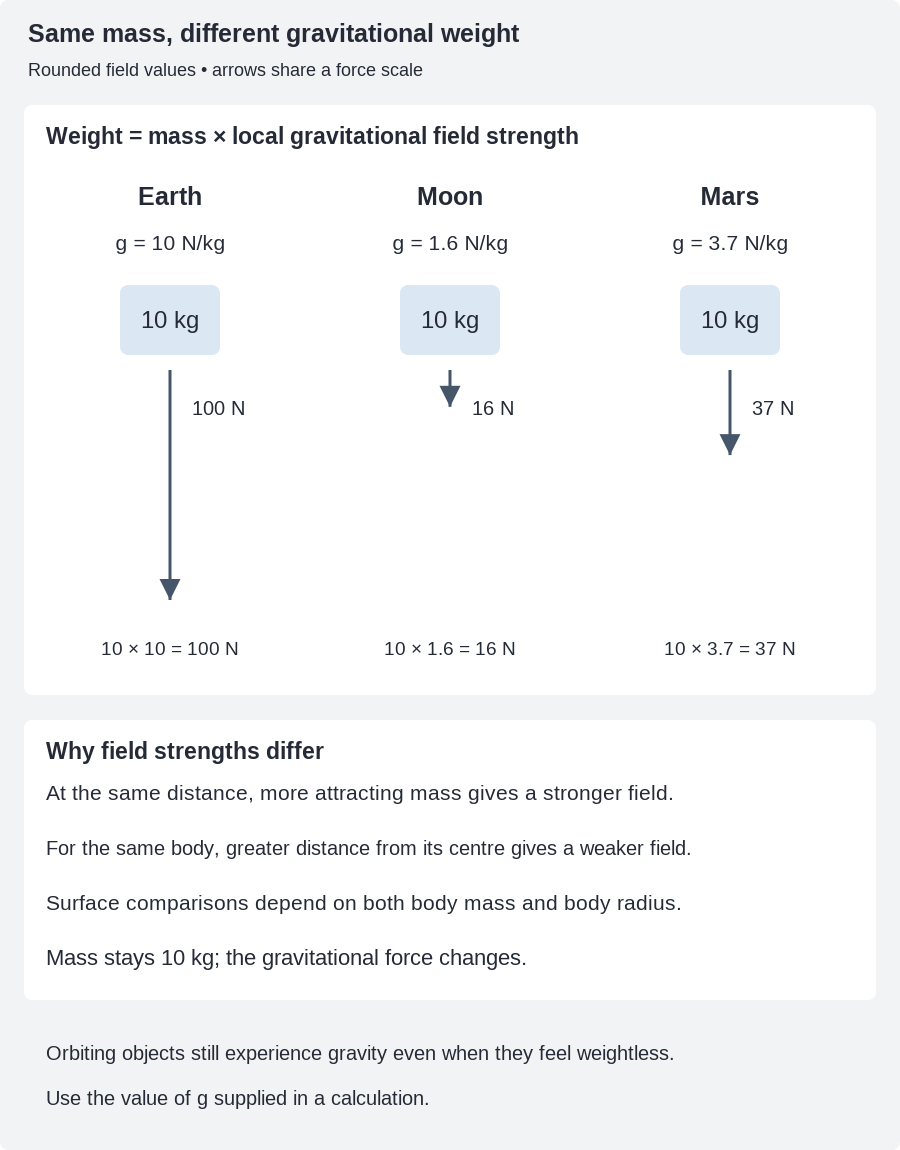
Take the same 10 kg object to three locations. Using rounded values Earth g = 10 N/kg, moonA natural satellite orbiting a planet or other non-stellar body. g = 1.6 N/kg and Mars g = 3.7 N/kg: Earth weightThe gravitational force acting on an object, equal to its mass multiplied by gravitational field strength. = 10 × 10 = 100 N; Moon weight = 10 × 1.6 = 16 N; Mars weight = 10 × 3.7 = 37 N. Its massThe quantity measuring an object’s inertia, expressed in kilograms. stays 10 kg in every case.
The Moon/Earth weight ratio is 16/100 = 0.16 under these rounded values. Use the field strength supplied in a question; 10 N/kg is an approximation for Earth, not a universal constant.
Weightlessness does not mean no gravity
An orbiting astronaut and spacecraft are both falling under gravityThe attractive interaction between objects with mass.. The astronaut lacks the usual support forceA push or pull arising from an interaction between objects, measured in newtons. from a floor and feels weightless even though gravity still acts. Without gravity the spacecraft would not maintain its curved orbitThe curved path of a body moving around another under gravity..
Equations
- g = gravitational force ÷ mass
- W = mg
Common misconceptions
- An object does not lose mass when moved to the Moon.
- Surface g cannot be inferred from planet mass alone.