Learning goals
- Explain orbital motion using velocity and inward force.
- Identify both objects in each required example.
- Distinguish speed from velocity and free fall from absence of gravity.
Why an orbit curves
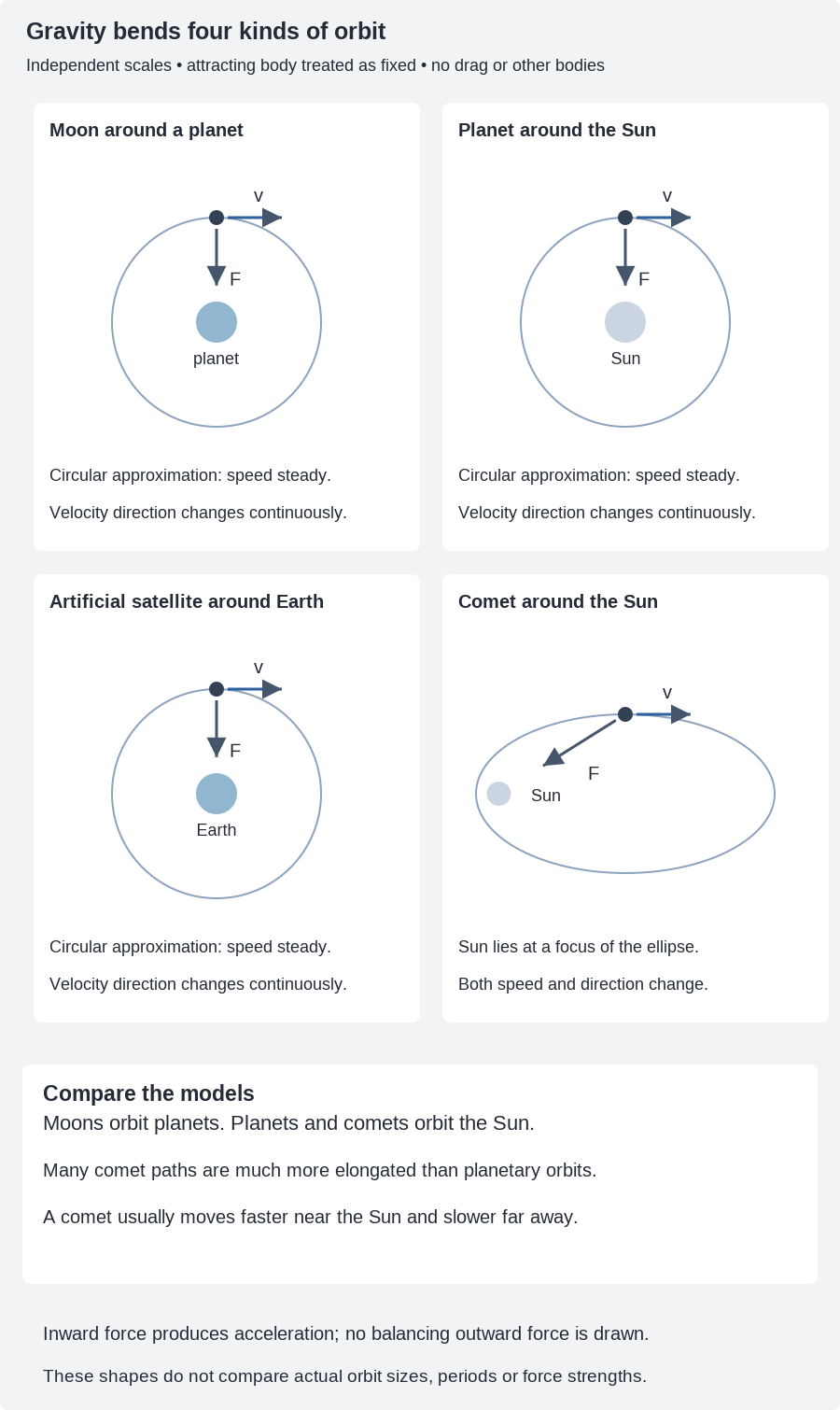
An object already moving sideways would continue along a straight tangentA straight line with the same local gradient as a curve at the point where it touches. if no resultant forceThe single force that has the same combined effect as all the forces acting on an object. acted. gravityThe attractive interaction between objects with mass. changes its velocityThe rate of change of displacement, including the direction of motion. towards the attracting body, bending its path. An orbitThe curved path of a body moving around another under gravity. combines this continuing fall with sideways motion, so the object keeps missing the central body.
For a circular orbit, speedThe distance travelled per unit time, without specifying direction. can stay constant while direction changes continuously. The object is therefore accelerating. Gravity points radially inward and the instantaneous velocity is tangential, perpendicular to it. A separate outward forceA push or pull arising from an interaction between objects, measured in newtons. is not needed to balance gravity in this explanation.
Apply the explanation four times
Earth attracts the moonA natural satellite orbiting a planet or other non-stellar body. and supplies the forceA push or pull arising from an interaction between objects, measured in newtons. that maintains its orbitThe curved path of a body moving around another under gravity.. The Sun attracts planetA large body orbiting a star that is rounded by its own gravity and has cleared its orbital neighbourhood. and cometA small icy body orbiting the Sun, developing a coma and sometimes tails when heated near it.. Earth attracts artificial satelliteAn object kept in orbit around another body by gravity.. In each case specify the attracting body and say that its force continually changes the direction of the orbiting object’s velocityThe rate of change of displacement, including the direction of motion..
In an elliptical orbit the attracting body lies at a focus, not generally the geometrical centre. gravityThe attractive interaction between objects with mass. still points towards that body; it may also change the speedThe distance travelled per unit time, without specifying direction.. A comet usually speeds up as it approaches the Sun and slows as it recedes.
Limits of the simple model
The diagram treats the main attracting body as fixed and ignores other bodies, dragA force exerted by a fluid that opposes an object’s motion relative to the fluid. and propulsion. The required explanation is that gravitational attraction produces the change in velocityThe rate of change of displacement, including the direction of motion. needed for orbital motion.
Equations
Common misconceptions
- Constant speed does not mean constant velocity around a circle.
- Satellites are not beyond gravity; gravity is what curves their paths.
Connect circular path, orbital period and speed
Change circular radius and period while comparing tangent velocity with inward gravitational-force direction.
What you see
- Labelled diagrams and numerical outputs describe the same selected state.
How to use it
- Change one control at a time, predict the outcome, then compare the readouts. All controls have keyboard-accessible sliders and step buttons.
- Reset restores every model control to its initial value. Nothing is saved.
What it shows
- Orbital speed=2πr/T, with radius in metres and period in seconds for m/s. Velocity is tangent to a circle, while gravitational force acts towards the centre and changes velocity direction. A circular-speed calculation does not establish an elliptical comet speed or the central mass needed for that orbit.
Limits of the model
- Circular motion at constant speed. The selected fraction is a fraction of one orbital period. The central body and orbiter symbols are not drawn to physical size.
- This compares circular geometry; it does not solve gravitational dynamics for a specified central body. Around a fixed body, radius and period are linked, so arbitrary settings do not predict valid Earth orbits. Arrows show directions, not force or speed magnitudes.
Controls
Radius=10000000 m and period=10800 s. Use 2πr/T to calculate speed. The centre dot represents the attracting body; this geometric model does not specify its mass.
Predict, change and explain
At 10000 km radius and a 3 h period, predict speed using SI units. Halve speed by changing period alone. Scrub the orbit fraction and explain why velocity changes even when speed stays constant; compare the two arrows at several positions.
Connect the outcome to the Physics
Orbital speed=2πr/T, with radius in metres and period in seconds for m/s. Velocity is tangent to a circle, while gravitational force acts towards the centre and changes velocity direction. A circular-speed calculation does not establish an elliptical comet speed or the central mass needed for that orbit.