Learning goals
- Compare the central bodies and shapes of the three required orbit types.
- Locate the Sun at a focus of an elliptical orbit.
- Explain why orbital speed can vary.
Compare the paths
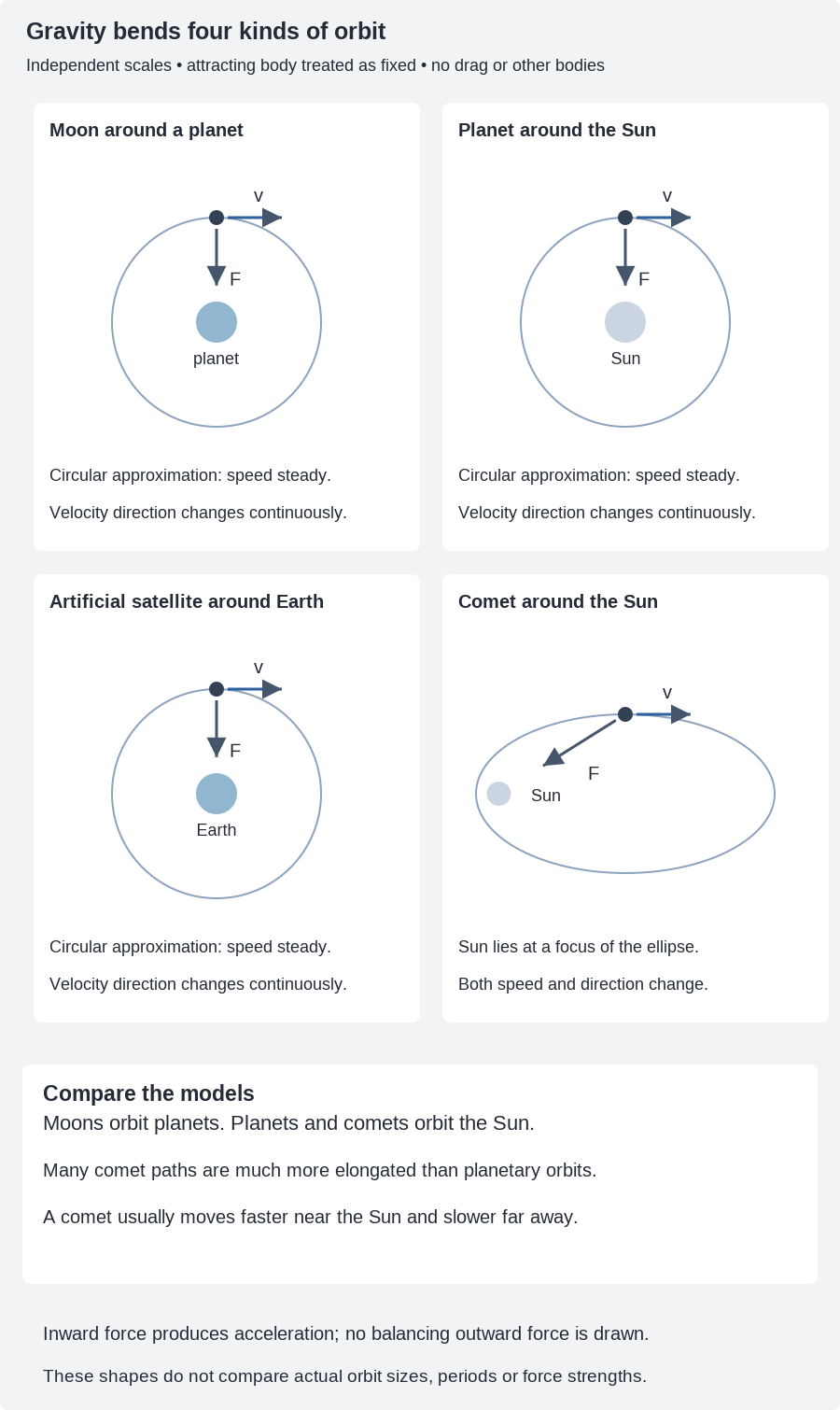
Planetary orbitThe curved path of a body moving around another under gravity. in our Solar SystemThe Sun and all the bodies gravitationally bound to it, including planets, moons and comets. are ellipses, many close enough to circles for simple calculations. They mostly lie in approximately the same plane and orbit in the same direction. moonA natural satellite orbiting a planet or other non-stellar body. are natural satelliteAn object kept in orbit around another body by gravity. of planetA large body orbiting a star that is rounded by its own gravity and has cleared its orbital neighbourhood. and have a range of orbital sizes and inclinations.
Many familiar cometA small icy body orbiting the Sun, developing a coma and sometimes tails when heated near it. have much more elongated orbits, with a close approach to the Sun and a very distant part. Comet paths can have large inclinations. Some comets have shorter periodThe time taken for one complete oscillation or repeating cycle. and less extreme shapes, so do not turn a typical comparison into a rule about every comet.
Focus, distance and speed
For an ellipse the Sun is at one focus. Drawing it at the centre of a strongly elongated ellipse would put the gravitational source in the wrong place. The cometA small icy body orbiting the Sun, developing a coma and sometimes tails when heated near it.’s distanceThe length of a path travelled, without regard to direction. from the Sun varies smoothly. Its speedThe distance travelled per unit time, without specifying direction. is greatest near the Sun and smallest far away because gravityThe attractive interaction between objects with mass. changes both the direction and magnitude of its velocityThe rate of change of displacement, including the direction of motion..
Periods need context
The periodThe time taken for one complete oscillation or repeating cycle. is the time for one complete orbitThe curved path of a body moving around another under gravity.. Larger circular orbits around the same central body have longer periods and lower speedThe distance travelled per unit time, without specifying direction.. Do not compare periods using radius alone when the central massThe quantity measuring an object’s inertia, expressed in kilograms. differ: a moonA natural satellite orbiting a planet or other non-stellar body. orbiting a planetA large body orbiting a star that is rounded by its own gravity and has cleared its orbital neighbourhood. and a planet orbiting the Sun are different systems.
The comparison figure uses separate scales to make the shapes visible. The two orbits are not drawn to the same scale. An ellipse is a continuous curve, not a sudden turn at either end.
Equations
Common misconceptions
- Not every comet has the same period or orbital shape.
- The central attracting body is at a focus, not the centre of an elongated ellipse.