Learning goals
- Derive v = 2πr/T from distance divided by time.
- Use centre-to-centre radius and convert the period.
- Rearrange the relationship and state its circular-orbit limit.
Define the distance and time
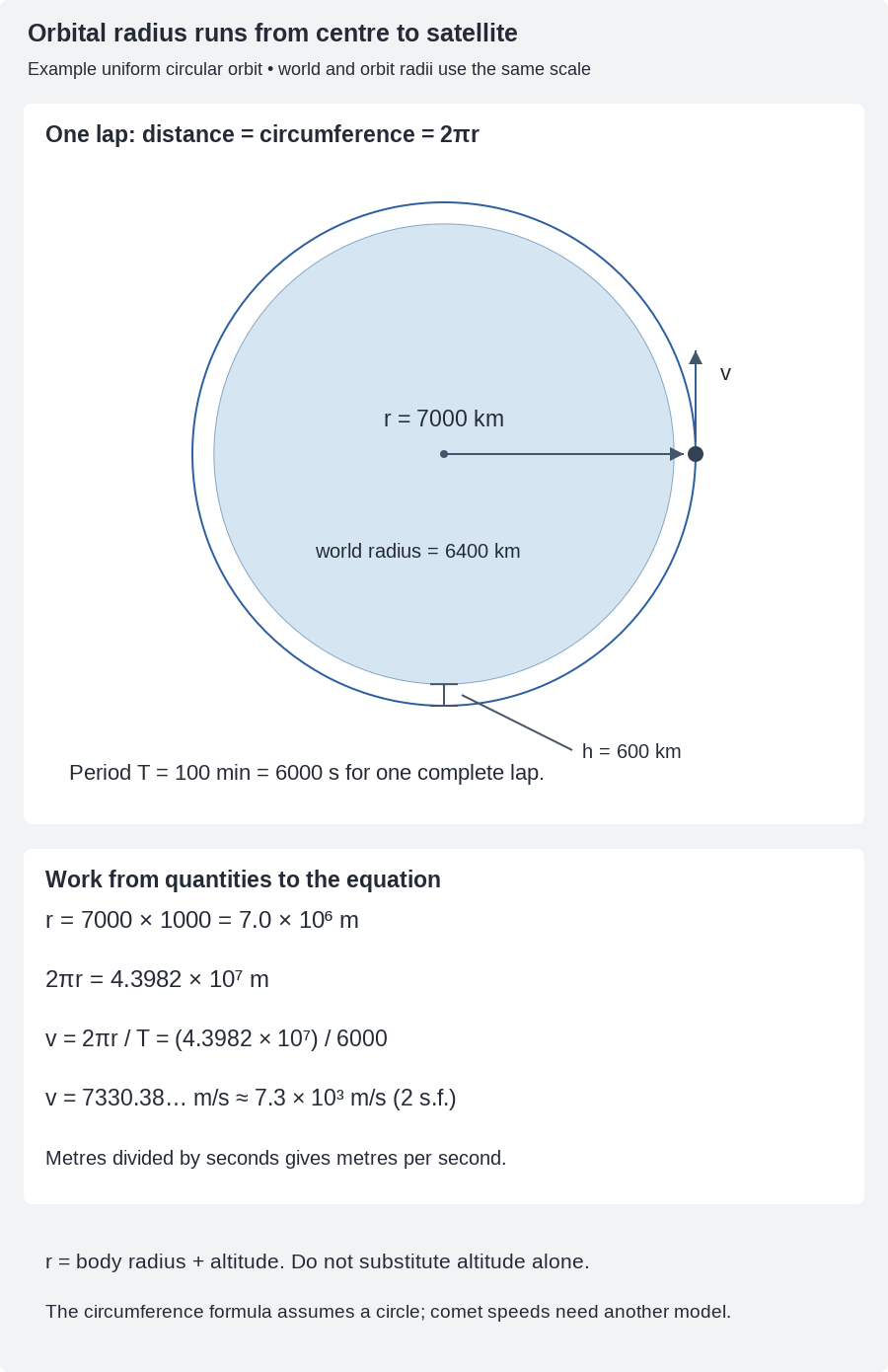
The orbital radiusThe distance from the centre of the attracting body to the centre of an orbiting body in a circular orbit. r runs from the centre of the attracting body to the centre of the orbiting object. It is not altitude above the surface: r = body radius + altitude. One circular lap has length 2πr. The periodThe time taken for one complete oscillation or repeating cycle. T is the time for that complete lap.
For a circular orbitThe curved path of a body moving around another under gravity. with constant speedThe distance travelled per unit time, without specifying direction., v = distanceThe length of a path travelled, without regard to direction./time = 2πr/T. Use r in metres and T in seconds for v in m/s. Radius and period must describe the same orbit.
Worked example with conversions
A satelliteAn object kept in orbit around another body by gravity. orbitThe curved path of a body moving around another under gravity. in the example has radius 7000 km and periodThe time taken for one complete oscillation or repeating cycle. 100 min. First r = 7.0 × 10⁶ m and T = 6000 s. Circumference = 2π × 7.0 × 10⁶ = 4.3982 × 10⁷ m. speedThe distance travelled per unit time, without specifying direction. = 4.3982 × 10⁷ / 6000 = 7.3 × 10³ m/s (2 s.f.).
If the illustrated world has radius 6400 km, the satellite altitude is 7000 − 6400 = 600 km. Substituting 600 km for r would substantially underestimate the distanceThe length of a path travelled, without regard to direction. per lap. The two radii are shown proportionally in the figure.
Rearrange and choose the model
Multiplying by T and dividing by v gives T = 2πr/v. Similarly r = vT/(2π). Check dimensions: m ÷ (m/s) gives seconds. An elongated cometA small icy body orbiting the Sun, developing a coma and sometimes tails when heated near it. orbitThe curved path of a body moving around another under gravity. has varying speedThe distance travelled per unit time, without specifying direction. and is not a circle; this circumference formula cannot give its instantaneous speed by inserting its changing distanceThe length of a path travelled, without regard to direction. from the Sun.
Equations
- v = 2πr/T
- T = 2πr/v
- r = vT/(2π)
Common misconceptions
- Radius is measured from the centre, not from the surface.
- Do not use 2πr for the length of a strongly elliptical orbit.
Connect circular path, orbital period and speed
Change circular radius and period while comparing tangent velocity with inward gravitational-force direction.
What you see
- Labelled diagrams and numerical outputs describe the same selected state.
How to use it
- Change one control at a time, predict the outcome, then compare the readouts. All controls have keyboard-accessible sliders and step buttons.
- Reset restores every model control to its initial value. Nothing is saved.
What it shows
- Orbital speed=2πr/T, with radius in metres and period in seconds for m/s. Velocity is tangent to a circle, while gravitational force acts towards the centre and changes velocity direction. A circular-speed calculation does not establish an elliptical comet speed or the central mass needed for that orbit.
Limits of the model
- Circular motion at constant speed. The selected fraction is a fraction of one orbital period. The central body and orbiter symbols are not drawn to physical size.
- This compares circular geometry; it does not solve gravitational dynamics for a specified central body. Around a fixed body, radius and period are linked, so arbitrary settings do not predict valid Earth orbits. Arrows show directions, not force or speed magnitudes.
Controls
Radius=10000000 m and period=10800 s. Use 2πr/T to calculate speed. The centre dot represents the attracting body; this geometric model does not specify its mass.
Predict, change and explain
At 10000 km radius and a 3 h period, predict speed using SI units. Halve speed by changing period alone. Scrub the orbit fraction and explain why velocity changes even when speed stays constant; compare the two arrows at several positions.
Connect the outcome to the Physics
Orbital speed=2πr/T, with radius in metres and period in seconds for m/s. Velocity is tangent to a circle, while gravitational force acts towards the centre and changes velocity direction. A circular-speed calculation does not establish an elliptical comet speed or the central mass needed for that orbit.