Learning goals
- Distinguish a star, planetary system, galaxy and universe.
- Place the Solar System in the Milky Way.
- Interpret a hierarchy without treating a drawing as a scale model.
Start with our system
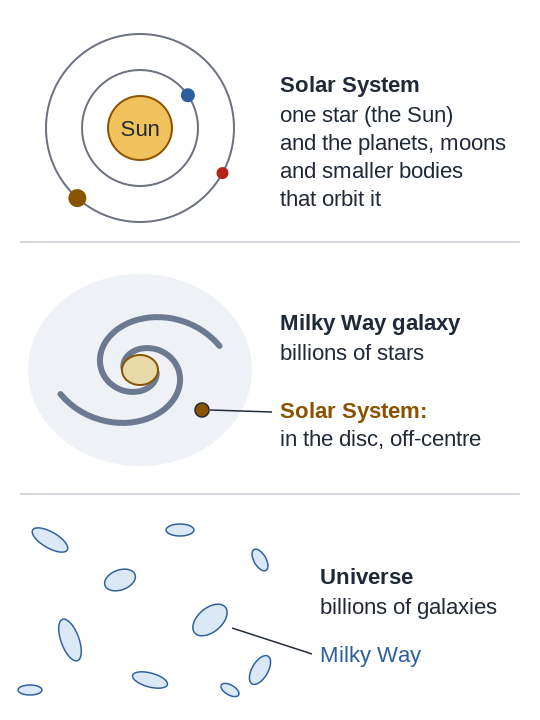
The Sun is a starA self-gravitating sphere of hot gas and plasma that produces energy by nuclear fusion during its main-sequence lifetime.: a self-luminous object whose main-sequence energyA conserved quantity transferred between stores by working, heating, electrical processes or radiation, measured in joules. supply is nuclear fusionJoining light nuclei to form a heavier nucleus with energy released when the products have lower total rest mass.. Earth and the other planetA large body orbiting a star that is rounded by its own gravity and has cleared its orbital neighbourhood. orbitThe curved path of a body moving around another under gravity. it. moonA natural satellite orbiting a planet or other non-stellar body. orbit planets, while smaller bodies such as asteroidA small rocky or metallic body orbiting the Sun, with many found between Mars and Jupiter. and cometA small icy body orbiting the Sun, developing a coma and sometimes tails when heated near it. also belong to the Solar SystemThe Sun and all the bodies gravitationally bound to it, including planets, moons and comets.. Planets are usually seen by reflected starlight.
From one star to a galaxy
A galaxyA large gravitationally bound system of stars, gas, dust and dark matter. is a vast gravitationally bound system containing starA self-gravitating sphere of hot gas and plasma that produces energy by nuclear fusion during its main-sequence lifetime., gasA state of matter whose widely separated particles move randomly, filling the available container., dust and other matter. Large galaxies contain billions of stars; smaller dwarf galaxies contain fewer. The Milky WayThe galaxy containing the Sun and the Solar System. is our galaxy. The Sun is one of its stars, with the Solar SystemThe Sun and all the bodies gravitationally bound to it, including planets, moons and comets. in its disc rather than at the galactic centre.
The universeAll of space, time, matter and energy. contains billions of galaxies. A galaxy is therefore much larger than one planetary system, but it is not the whole universe.
Read a nested drawing carefully
A hierarchy diagram says which system belongs inside which larger system. It cannot keep the sizes of a planetA large body orbiting a star that is rounded by its own gravity and has cleared its orbital neighbourhood., a starA self-gravitating sphere of hot gas and plasma that produces energy by nuclear fusion during its main-sequence lifetime., a galaxyA large gravitationally bound system of stars, gas, dust and dark matter. and their separations on one convenient linear scale. The borders of the drawing organise the explanation; they do not represent walls around the universeAll of space, time, matter and energy..
Equations
Common misconceptions
- The Milky Way is not a single star or the whole universe.
- A zoom diagram does not show the true relative sizes of planets and galaxies.