Learning goals
- Order red, yellow-white and blue-white stars by temperature.
- Describe colour as a broad classification.
- Separate temperature from brightness and size.
Classify the emitted light
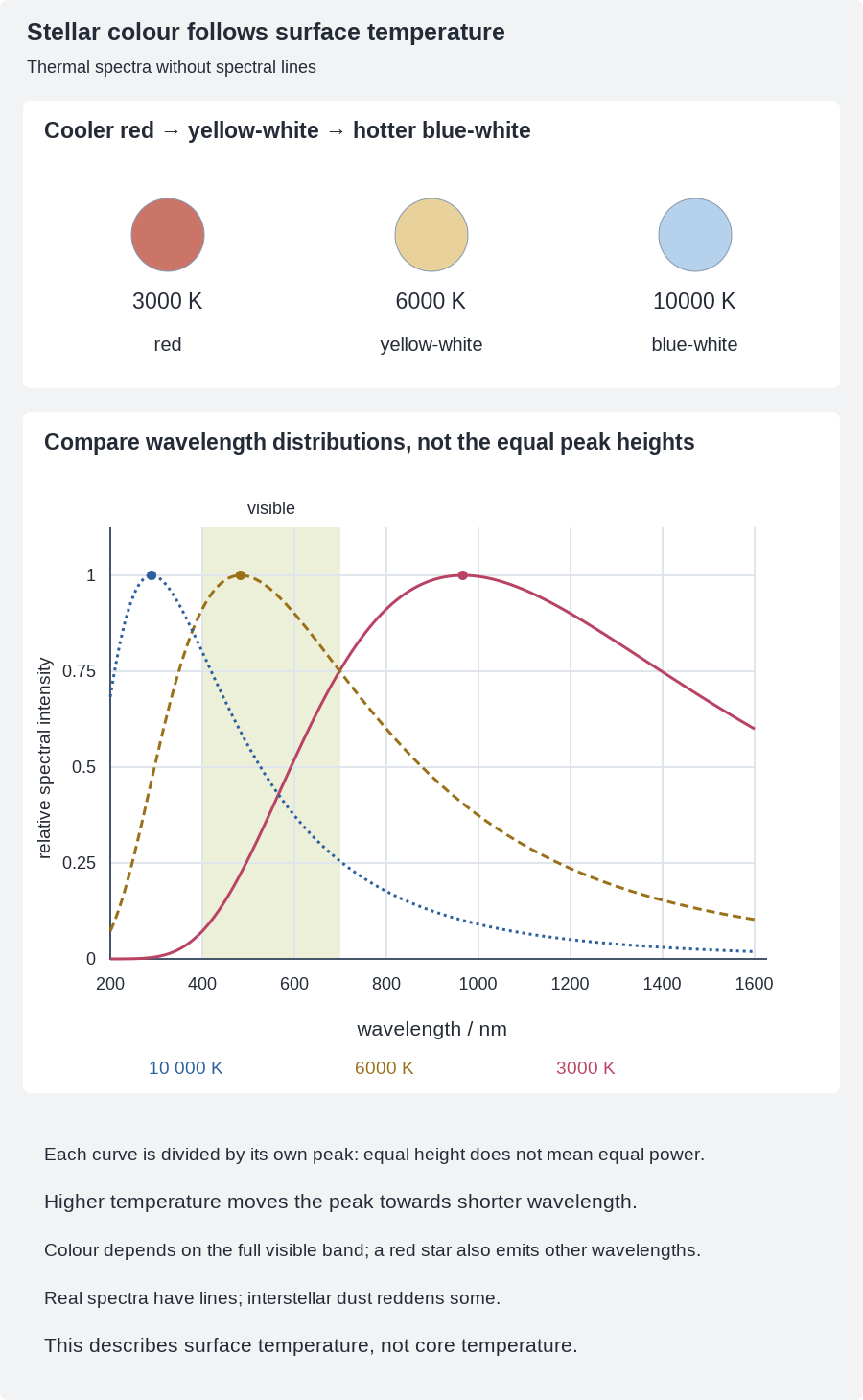
starA self-gravitating sphere of hot gas and plasma that produces energy by nuclear fusion during its main-sequence lifetime. emit a range of wavelengthThe shortest distance between two successive points in phase on a wave.. Their combined visible lightElectromagnetic radiation with wavelengths detected by the human eye, from violet to red. can appear red, orange, yellow-white, white or blue-white. The colour sequence runs from cooler red stars to hotter blue-white stars, with yellow-white stars between. The colour names describe broad groups rather than perfectly pure single colours.
In the comparison figure, 3000 K, 6000 K and 10 000 K are surface temperatureA measure of how hot a system is, related to the average kinetic energy of its particles.. They are not boundaries you must memorise. All three stars emit across a wide spectrum; a red star does not emit only red light.
Colour is not apparent brightness
The amount of light arriving at Earth depends on the emitting surface area and distanceThe length of a path travelled, without regard to direction. as well as surface temperatureA measure of how hot a system is, related to the average kinetic energy of its particles.. A cool red giantAn expanded, cooler-surfaced star formed when a lower-mass star exhausts its core hydrogen. can be very luminous because its area is large. A hot white dwarfA hot, dense stellar remnant left after a lower-mass star sheds its outer layers, with no sustained core fusion. can be faint because it is small. Therefore “brightest-looking” cannot replace “hottest”.
Observational limits
Astronomers compare calibrated light measurements through different filters and analyse spectra. Dust can make starlight appear redder. The classroom colour-temperature relationship refers to the intrinsic stellar light, with such effects accounted for.
Equations
Common misconceptions
- Red stars are cooler at the surface than blue-white stars.
- The colour of a displayed image may be enhanced or affected by dust.