Learning goals
- Explain why hotter stars look bluer.
- Distinguish surface temperature from core temperature.
- Read a normalised spectrum without comparing total power.
A spectrum carries the explanation
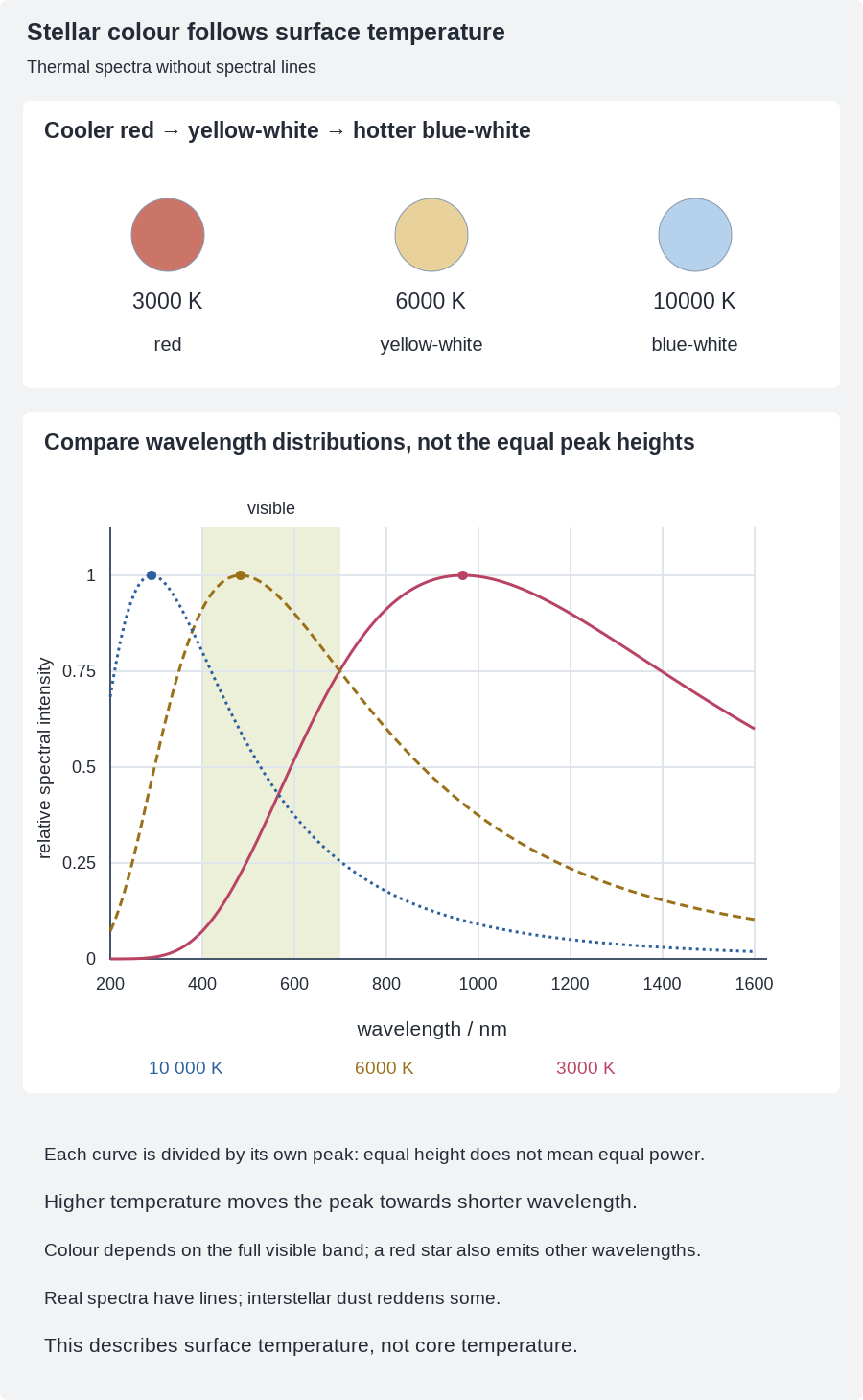
A hot dense surface emits thermal radiationEnergy transferred by electromagnetic waves emitted because of an object’s temperature. across a continuous range of wavelengthThe shortest distance between two successive points in phase on a wave.. Increasing temperatureA measure of how hot a system is, related to the average kinetic energy of its particles. moves the peak to shorter wavelength and changes the balance of blue and red visible lightElectromagnetic radiation with wavelengths detected by the human eye, from violet to red.. The combination appears bluer, even though radiation outside the visible range is also emitted.
The plotted curves use an ideal thermal-emitter model. Their peaks are near 966 nm for 3000 K, 483 nm for 6000 K and 290 nm for 10 000 K. The cool peak is infrared and the hot peak ultraviolet; visible colour depends on the whole visible band, not simply the peak label. You do not need the equation used to generate these curves.
Read the axes and the normalisation
wavelengthThe shortest distance between two successive points in phase on a wave. increases to the right, in nanometres. Each curve is divided by its own peak value, so all reach one. This lets you compare shape and peak position. Equal plotted peaks do not mean equal emitted powerThe energy transferred or work done per unit time, measured in watts.: an actual hotter surface emits more energyA conserved quantity transferred between stores by working, heating, electrical processes or radiation, measured in joules. per unit area.
Use the conclusion carefully
For an otherwise suitable stellar comparison, a blue-white starA self-gravitating sphere of hot gas and plasma that produces energy by nuclear fusion during its main-sequence lifetime. has a hotter surface than a red star. This is not a direct measurement of core temperatureA measure of how hot a system is, related to the average kinetic energy of its particles.. The Sun’s core, where fusion occurs, is much hotter than its visible surface. Real stellar spectra also contain absorption lines, which the smooth curves omit.
Equations
Common misconceptions
- A hot star can have its spectrum peak outside visible blue light.
- Normalised heights cannot establish which star emits more total power.