Learning goals
- Order the required nebula, main-sequence, red-giant and white-dwarf stages.
- Explain why each major transition occurs.
- Distinguish the core from expelled outer layers.
Collapse and main sequence
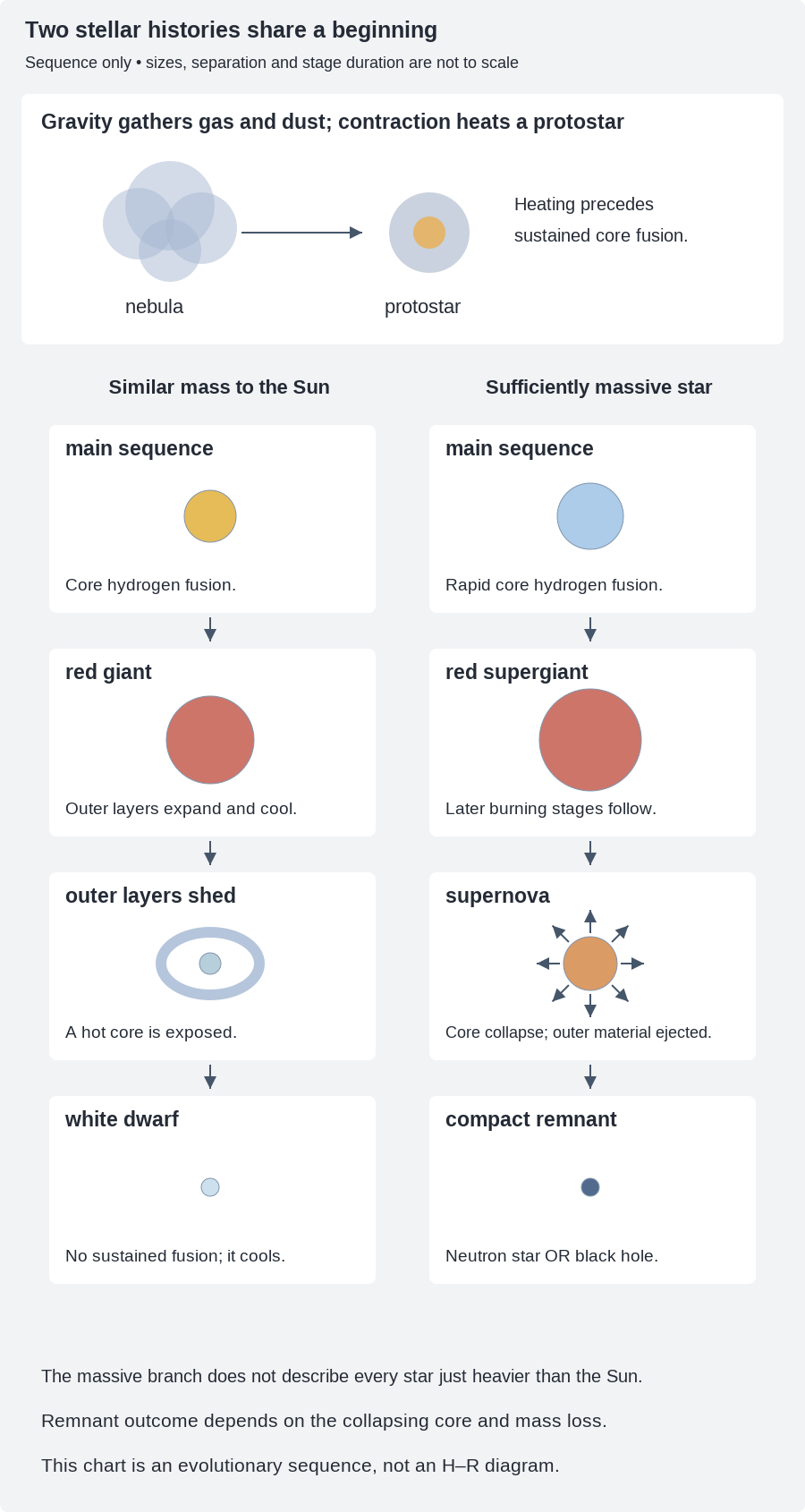
A nebulaAn interstellar cloud of gas and dust in which stars form or from which stellar material spreads. is a cloud of gasA state of matter whose widely separated particles move randomly, filling the available container. and dust. gravityThe attractive interaction between objects with mass. pulls a sufficiently dense region together. As the protostarA contracting concentration of gas and dust that heats before sustained core hydrogen fusion begins. contracts, gravitational energyA conserved quantity transferred between stores by working, heating, electrical processes or radiation, measured in joules. is transferred into thermal energyThe part of internal energy associated with the random motion and interactions of particles. and the core heats. When sustained hydrogen fusion begins in the core, the starA self-gravitating sphere of hot gas and plasma that produces energy by nuclear fusion during its main-sequence lifetime. enters the main sequenceThe stable stage of a star’s life during which hydrogen fusion in its core supplies energy..
During this relatively stable stage, inward gravity is balanced by outward support from a pressureThe normal force exerted per unit area, measured in pascals. gradientThe change in the vertical-axis quantity divided by the corresponding change in the horizontal-axis quantity.. Fusion maintains the energy supply while energy escapes from the surface. Mechanical equilibriumA state in which both the resultant force and the resultant moment on an object are zero. does not mean that fusion or energy transfer has stopped.
Core changes and a red giant
Eventually hydrogen in the core becomes depleted. Core contraction and changing fusion regions alter the structure: hydrogen can fuseA safety device with a wire that melts when excessive current heats it, breaking the circuit. in a surrounding shell and helium can fuse later in the core. The outer layers expand and their surface cools, producing a red giantAn expanded, cooler-surfaced star formed when a lower-mass star exhausts its core hydrogen.. A larger radius and a cooler surface can occur together.
Exposed core and cooling
The starA self-gravitating sphere of hot gas and plasma that produces energy by nuclear fusion during its main-sequence lifetime. sheds its outer layers, leaving a hot, dense white dwarfA hot, dense stellar remnant left after a lower-mass star sheds its outer layers, with no sustained core fusion.. The expelled gasA state of matter whose widely separated particles move randomly, filling the available container. surrounds the remaining core before dispersing. The white dwarf radiates stored thermal energyThe part of internal energy associated with the random motion and interactions of particles. and gradually cools without sustained core fusion.
The four required stages are nebulaAn interstellar cloud of gas and dust in which stars form or from which stellar material spreads. → main sequenceThe stable stage of a star’s life during which hydrogen fusion in its core supplies energy. → red giantAn expanded, cooler-surfaced star formed when a lower-mass star exhausts its core hydrogen. → white dwarf. The diagram adds the protostarA contracting concentration of gas and dust that heats before sustained core hydrogen fusion begins. and layer-loss transitions to explain the sequence. Their spacing does not represent stage duration. A Sun-like star does not normally finish as a core-collapse supernovaA stellar explosion, including the collapse and ejection of outer layers at the end of a massive star’s life., neutron starAn extremely dense remnant formed from the collapsed core of a massive star, composed mainly of neutrons. or black holeA region whose gravity prevents even light from escaping from within its event horizon..
Equations
Common misconceptions
- A red giant has a cooler surface but is not necessarily less luminous.
- A white dwarf is an evolved remnant, not a newly forming star.