Learning goals
- Compare Sun-like and massive-star evolutionary paths.
- Explain core collapse and possible remnants qualitatively.
- Avoid assuming every star heavier than the Sun follows the same path.
Mass affects the sequence
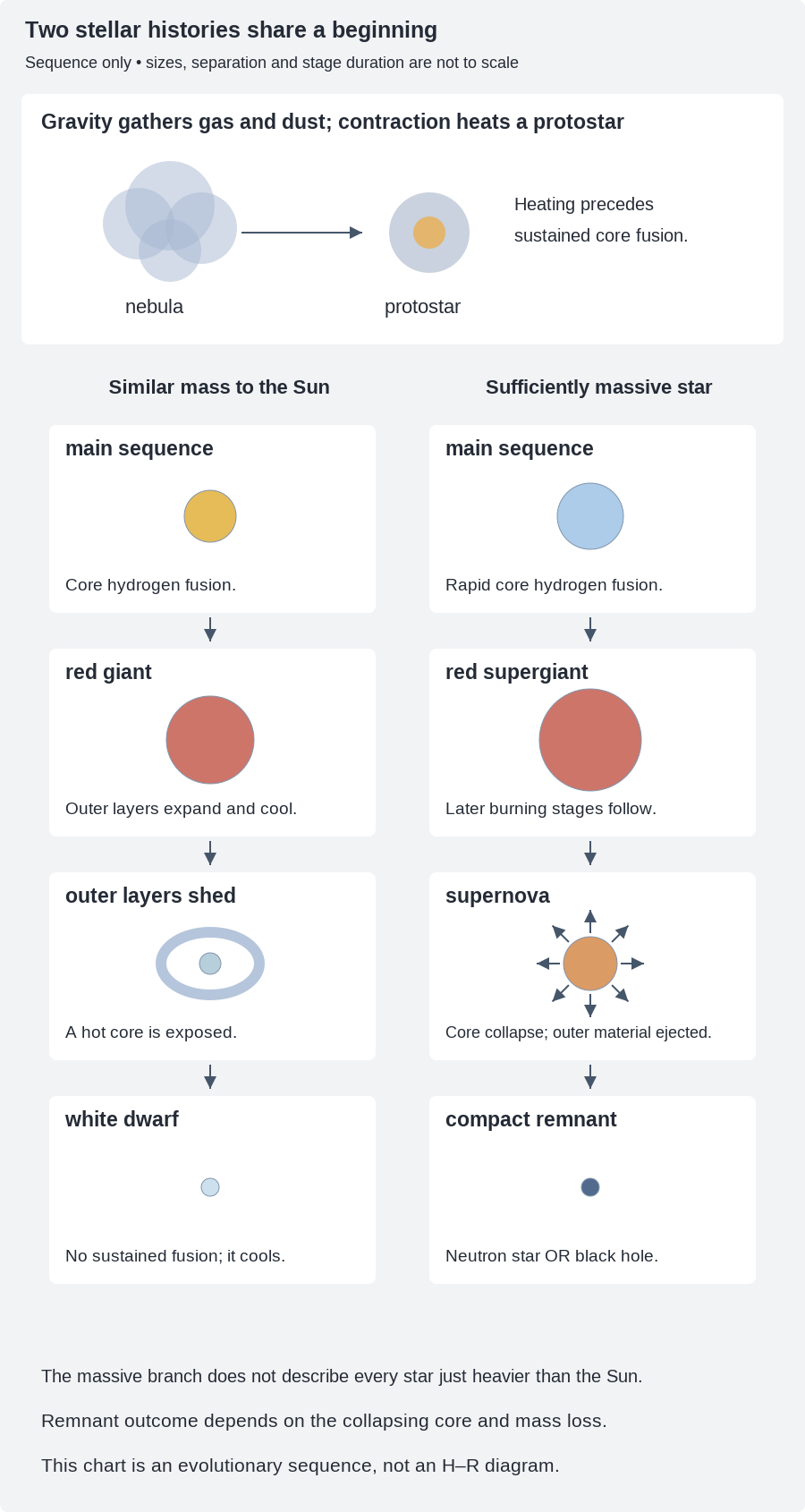
A massive starA self-gravitating sphere of hot gas and plasma that produces energy by nuclear fusion during its main-sequence lifetime. forms from a collapsing cloud and enters the main sequenceThe stable stage of a star’s life during which hydrogen fusion in its core supplies energy. like a Sun-like star. Its core is hotter and it consumes nuclear fuel much faster. Despite having more fuel, a sufficiently massive star has a shorter lifetime.
After core hydrogen depletion, massive stars can become supergiants and fuseA safety device with a wire that melts when excessive current heats it, breaking the circuit. progressively heavier nucleusThe dense central region of an atom containing protons and neutrons, except hydrogen-1 which has no neutron. in later stages. The pathway shown uses a red supergiantAn expanded, high-luminosity stage of a massive star after it exhausts its core hydrogen.. Actual evolutionary tracks depend on massThe quantity measuring an object’s inertia, expressed in kilograms., mass loss and interactions with companion stars.
Collapse and ejection
Fusion towards iron does not provide an unlimited energyA conserved quantity transferred between stores by working, heating, electrical processes or radiation, measured in joules. supply. When a sufficiently massive core can no longer support itself, it collapses rapidly. In the standard course model, this leads to a supernovaA stellar explosion, including the collapse and ejection of outer layers at the end of a massive star’s life. that expels outer material and distributes elements into space. Some elements formed in earlier burning stages; it is misleading to say every heavy element was first made in the explosion.
Two possible compact remnants
A neutron starAn extremely dense remnant formed from the collapsed core of a massive star, composed mainly of neutrons. is an extremely dense remnant made mainly of neutronAn uncharged nuclear particle with a mass approximately equal to that of a proton.. A sufficiently massive collapsing remnant can form a black holeA region whose gravity prevents even light from escaping from within its event horizon., with a region from which light cannot escape. The outcome depends on the massThe quantity measuring an object’s inertia, expressed in kilograms. left in the collapsing remnant.
The branch is for sufficiently massive starA self-gravitating sphere of hot gas and plasma that produces energy by nuclear fusion during its main-sequence lifetime., not every star just heavier than the Sun. Many stars with moderately greater initial mass also leave white dwarfA hot, dense stellar remnant left after a lower-mass star sheds its outer layers, with no sustained core fusion.. No single sharp initial-mass boundary is asserted in the diagram, and some massive stars can collapse without a bright observed supernovaA stellar explosion, including the collapse and ejection of outer layers at the end of a massive star’s life..
Equations
Common misconceptions
- More initial fuel does not guarantee a longer stellar lifetime.
- A black hole is not the endpoint of every star larger than the Sun.