Learning goals
- Define absolute magnitude and its standard distance.
- Interpret smaller or more negative magnitude numbers.
- Explain how distance can hide an intrinsic brightness difference.
Remove the distance difference
Apparent brightness is the light received per unit area at the observer. A starA self-gravitating sphere of hot gas and plasma that produces energy by nuclear fusion during its main-sequence lifetime. farther away usually looks fainter because its light spreads out. luminosityThe total energy emitted by a star per unit time. is the total energyA conserved quantity transferred between stores by working, heating, electrical processes or radiation, measured in joules. it emits per second. Comparing apparent brightness alone does not give a fair comparison of stars at different distanceThe length of a path travelled, without regard to direction..
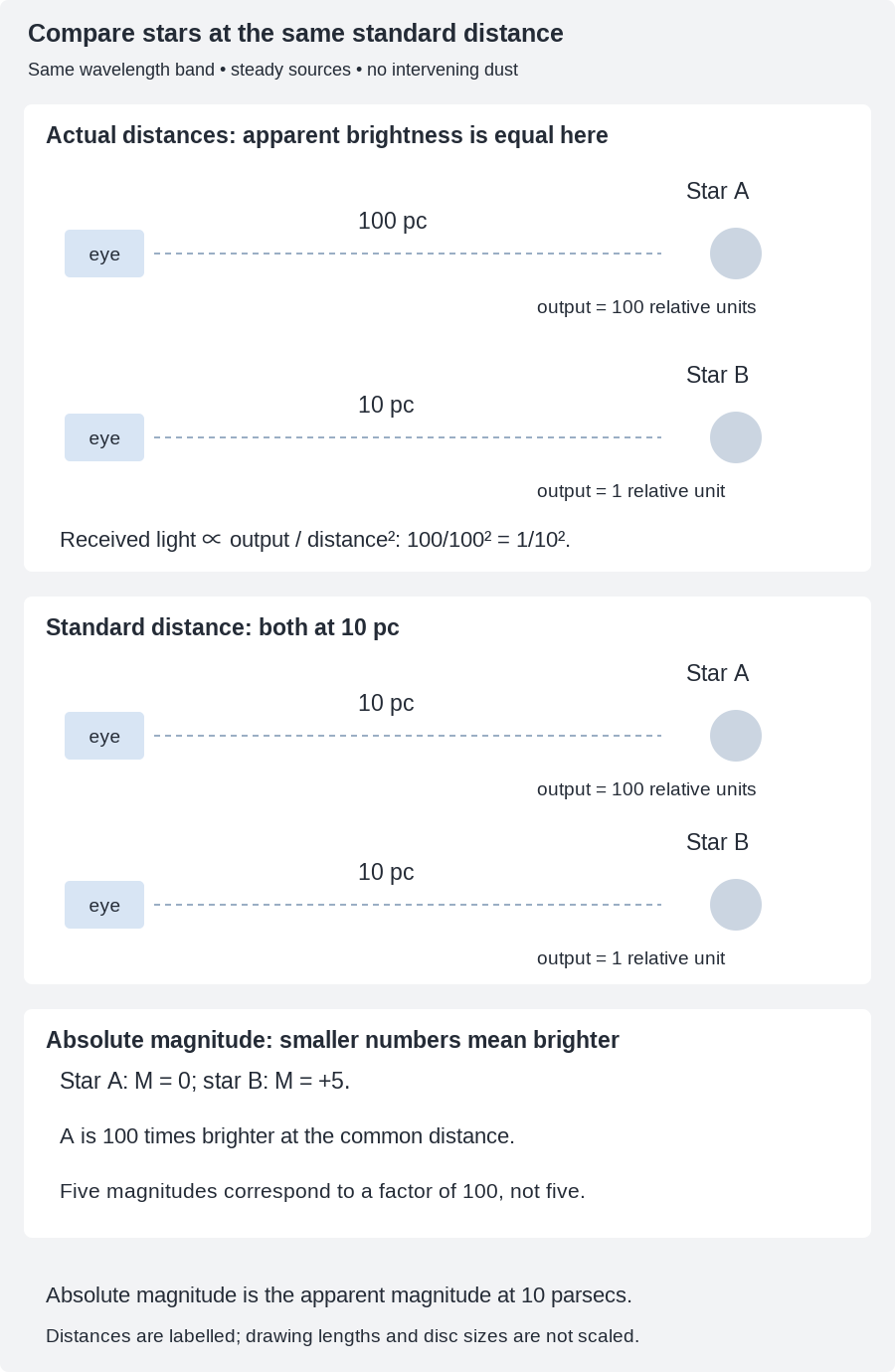
absolute magnitudeThe apparent magnitude a star would have at a distance of ten parsecs, corrected for intervening absorption. is the magnitude a star would have if observed at 10 parsecAn astronomical distance unit equal to approximately 3.26 light-years., with intervening dimming accounted for. Compare magnitudes measured over the same wavelengthThe shortest distance between two successive points in phase on a wave. range.
Read the magnitude scale
Smaller magnitude numbers mean greater brightness. Negative values are possible and are brighter than zero or positive values on the same scale. A difference of five magnitudes corresponds to a factor of 100 in brightness; equal changes in magnitude represent multiplying factors in brightness.
Worked comparison
Consider two example starA self-gravitating sphere of hot gas and plasma that produces energy by nuclear fusion during its main-sequence lifetime.: A emits 100 times the light of B in the compared band, but A is 100 pc away and B is 10 pc away. Light spreading over area proportional to distanceThe length of a path travelled, without regard to direction. squared makes their received brightnesses equal: 100/100² = 1/10².
At the common distance of 10 pc, A would be 100 times brighter. Consistent absolute magnitudeThe apparent magnitude a star would have at a distance of ten parsecs, corrected for intervening absorption. are A = 0 and B = +5. The equal apparent brightness did not mean equal intrinsic output. This simple example ignores dust and uses steady sources.
Equations
Common misconceptions
- A greater numerical magnitude means fainter, not brighter.
- Absolute magnitude compares a fixed distance; it is not the current appearance from Earth.