Learning goals
- Calculate wavelength change and fractional red-shift.
- Use v/c = Δλ/λ₀ with consistent units.
- Recognise the small-shift limit of the simple velocity interpretation.
Identify the two wavelengths
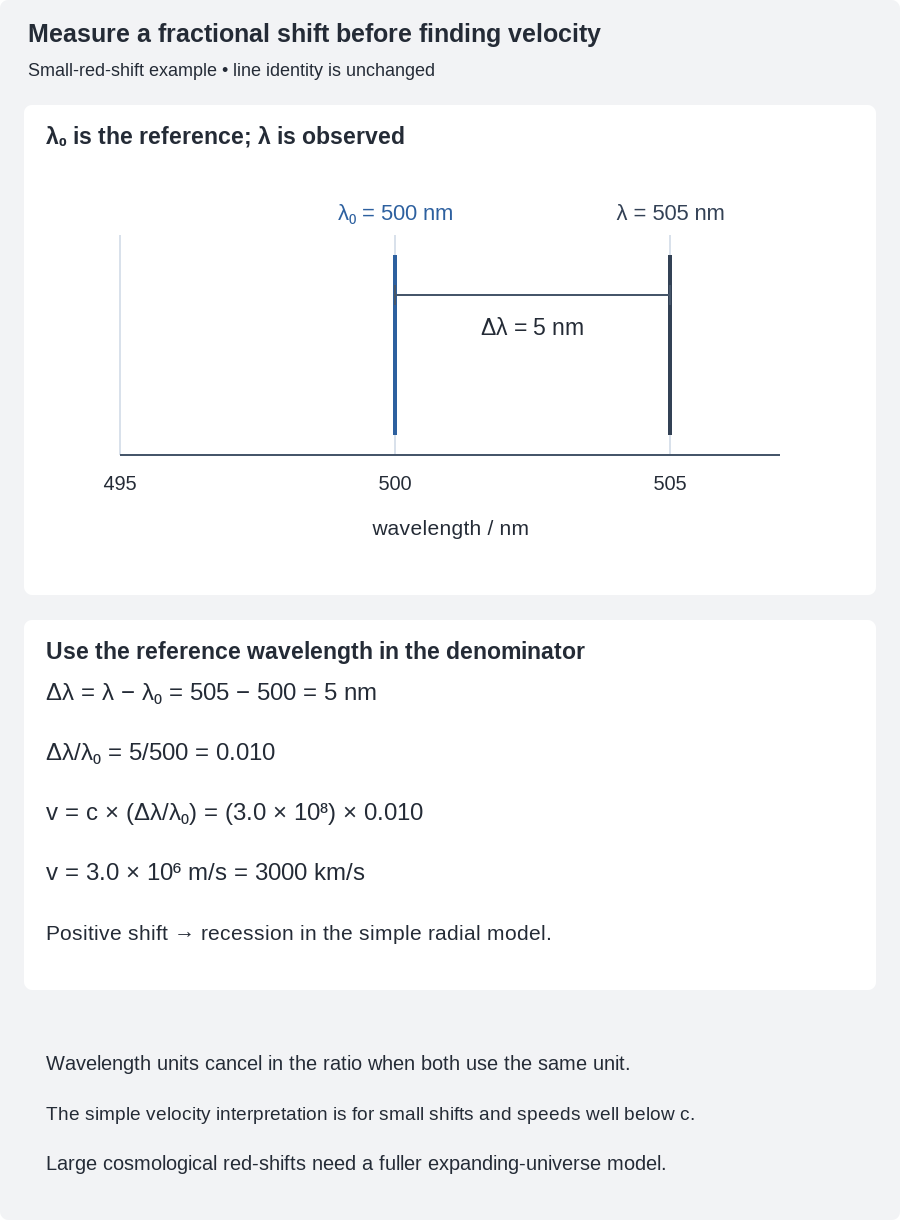
The reference wavelengthThe shortest distance between two successive points in phase on a wave. λ₀ is the laboratory wavelength for an identified spectral line. The observed wavelength λ is where the same line appears in the galaxyA large gravitationally bound system of stars, gas, dust and dark matter. spectrum. The change is Δλ = λ − λ₀. A positive change means red-shiftAn increase in observed spectral wavelengths relative to their laboratory values, including that caused by cosmic expansion.; a negative change means blue-shift.
The fraction Δλ/λ₀ has no unit. Both wavelengths can remain in nanometres because their units cancel, provided they use the same unit. Divide by the reference wavelength, not by the observed wavelength.
Worked galaxy estimate
An example line is at λ₀ = 500 nm in the laboratory and λ = 505 nm in a galaxyA large gravitationally bound system of stars, gas, dust and dark matter.. Change = 505 − 500 = 5 nm. Fractional change = 5/500 = 0.010. From v/c = 0.010 and c = 3.0 × 10⁸ m/s, v = 0.010 × 3.0 × 10⁸ = 3.0 × 10⁶ m/s, or 3000 km/s, receding.
Check the result: 3.0 × 10⁶ / 3.0 × 10⁸ = 0.010, matching the measured fraction. If the change were −5 nm under the same simple radial-motion model, the negative value would indicate approach.
Apply the equation within its purpose
The displayed equation is the required course relationship. Its simple recession-speed interpretation is appropriate for small shifts and speedThe distance travelled per unit time, without specifying direction. well below c. For large red-shiftAn increase in observed spectral wavelengths relative to their laboratory values, including that caused by cosmic expansion., this simple conversion cannot be used to calculate a local speed. Do not infer a local object moving faster than light by applying this approximation far outside its range.
Equations
- Δλ = λ − λ₀
- Δλ/λ₀ = v/c
- v = cΔλ/λ₀
Common misconceptions
- The reference wavelength belongs in the denominator.
- Red-shift means a longer wavelength, not a change in the speed of light in vacuum.
Compare reference and observed spectral lines
Change source radial velocity and reference wavelength, then distinguish absolute shift from fractional shift.
What you see
- Labelled diagrams and numerical outputs describe the same selected state.
How to use it
- Change one control at a time, predict the outcome, then compare the readouts. All controls have keyboard-accessible sliders and step buttons.
- Reset restores every model control to its initial value. Nothing is saved.
What it shows
- Recession gives longer observed wavelength; approach gives shorter wavelength. The same small radial speed gives the same fractional shift for different reference lines, not necessarily the same shift in nm. Use consistent units on each side of Δλ/λ₀=v/c. Spectral-line displacement is distinct from a star’s intrinsic surface colour.
Limits of the model
- The course small-speed relationship Δλ/λ₀=v/c is used with c=300000 km/s. The range is limited to ±15000 km/s (5% of c); this is not a high-redshift cosmological distance model.
- Positive velocity means recession, negative means approach. Bars locate one identifiable spectral line, not literal colours or intensity profiles. Distance, brightness, surface temperature and cosmic expansion are not inferred from one line alone.
Controls
Δλ/λ₀=v/c=6000/300000. The reference and observed wavelengths both use nm; velocity and c both use km/s. A percentage shift is the fraction multiplied by 100.
Predict, change and explain
At reference 500 nm and recession 6000 km/s, predict the shift and observed wavelength. Keep speed fixed and choose 700 nm: compare the shift in nm and the fractional shift. Then reverse the velocity and explain the direction change.
Connect the outcome to the Physics
Recession gives longer observed wavelength; approach gives shorter wavelength. The same small radial speed gives the same fractional shift for different reference lines, not necessarily the same shift in nm. Use consistent units on each side of Δλ/λ₀=v/c. Spectral-line displacement is distinct from a star’s intrinsic surface colour.