Learning goals
- Compare the same spectral line across galaxies.
- Calculate and describe increasing fractional shifts.
- Distinguish a population trend from a rule for every nearby object.
Compare like with like
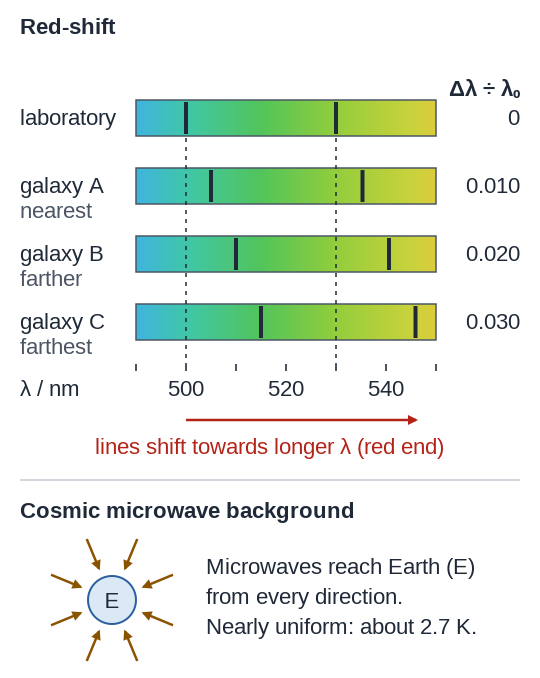
Identify the same laboratory reference line or pattern before comparing shifts. In the spectra, λ₀ = 500 nm. galaxyA large gravitationally bound system of stars, gas, dust and dark matter. A has 505 nm, B 510 nm and C 515 nm. Their fractions are 5/500 = 0.010, 10/500 = 0.020 and 15/500 = 0.030. Larger fraction means a greater relative stretch.
The diagram labels A, B and C as progressively farther away to illustrate the observed large-scale trend. More than one identified line is normally used to secure a real spectral interpretation.
Interpret the trend
At small red-shiftAn increase in observed spectral wavelengths relative to their laboratory values, including that caused by cosmic expansion., the simple course relation gives larger recession-speed estimates for larger fractions. For example, a fractional shift of 0.020 gives v ≈ 0.020 × 3.0 × 10⁸ = 6.0 × 10⁶ m/s. The systematic distanceThe length of a path travelled, without regard to direction. relationship across many galaxyA large gravitationally bound system of stars, gas, dust and dark matter. is evidence of expanding large-scale separations.
Recognise scatter and exceptions
galaxyA large gravitationally bound system of stars, gas, dust and dark matter. also have local motions caused by gravityThe attractive interaction between objects with mass. within groups and clusters. Nearby galaxies can therefore approach and be blue-shifted. Dust, line misidentification and measurement uncertaintyThe estimated range around a measured value within which the true value is expected to lie. also have to be addressed in observations. Describe the overall trend with qualifying words such as “generally”, rather than asserting that every farther individual galaxy must have a larger red-shiftAn increase in observed spectral wavelengths relative to their laboratory values, including that caused by cosmic expansion..
Equations
- fractional red-shift = (λ − λ₀)/λ₀
Common misconceptions
- Apparent dimness is not itself a spectral red-shift measurement.
- A nearby blue-shifted galaxy is compatible with a large-scale expansion trend.