Learning goals
- Describe both required evidence types.
- Explain what each observation supports.
- Separate measured patterns from schematic illustrations.
Measure a spectral displacement
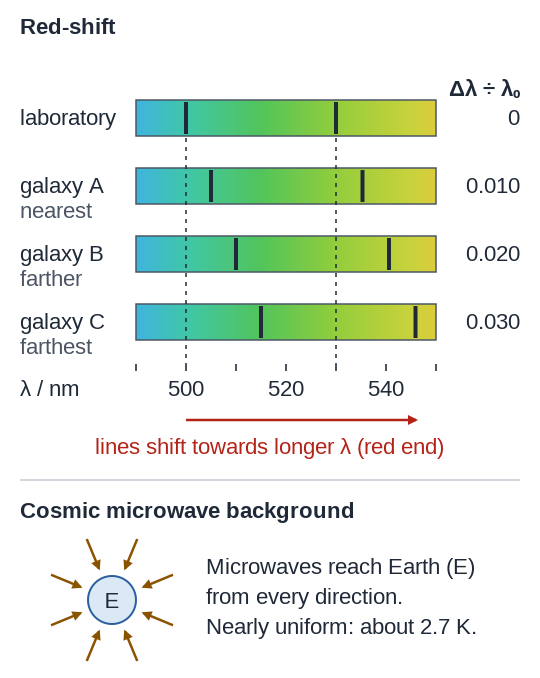
atomAn electrically neutral particle with a small positive nucleus surrounded by electrons. and ionAn atom or group of atoms with a net charge because electrons have been gained or lost. produce identifiable patterns of spectral lines. Compare a galaxyA large gravitationally bound system of stars, gas, dust and dark matter.’s lines with the same transitions measured in a laboratory. If the galaxy lines occur at longer wavelengthThe shortest distance between two successive points in phase on a wave., the spectrum is red-shifted. This is a shift of identifiable features, not merely the statement that a photograph looks red.
Many distant galaxies show red-shiftAn increase in observed spectral wavelengths relative to their laboratory values, including that caused by cosmic expansion., with larger shifts generally associated with greater distanceThe length of a path travelled, without regard to direction.. This pattern supports large-scale expansion. Nearby motions can produce exceptions; a single approaching galaxy does not overturn the population trend.
Observe relic radiation
microwaveElectromagnetic radiation between radio and infrared wavelengths, used in communication and heating. instruments detect the cosmic microwave backgroundMicrowave radiation observed across the sky, left from the early universe when it became transparent. across the sky. It has a nearly uniform thermal spectrum corresponding to about 2.7 K, with small variations. The hot early universeAll of space, time, matter and energy. supplies a natural origin for this radiation, and expansion stretches its wavelengthThe shortest distance between two successive points in phase on a wave. as the universe cools.
Real microwave observations require separating foreground emission from the Milky WayThe galaxy containing the Sun and the Solar System. and other sources. CMB evidence is not the same measurement as a galaxyA large gravitationally bound system of stars, gas, dust and dark matter.’s visible spectral lines.
Join observations to the explanation
Expansion explains why distant galaxyA large gravitationally bound system of stars, gas, dust and dark matter. light is stretched, while relic thermal radiationEnergy transferred by electromagnetic waves emitted because of an object’s temperature. supports a hotter past. A successful model must explain both the broad recession pattern and the background radiationIonising radiation present in the environment from natural sources and human activities.. Neither observation by itself supplies every detail of cosmic history or proves that all model parameters are known exactly.
Equations
Common misconceptions
- CMB is not radiation from a single nearby star.
- Dust reddening changes relative brightness across a spectrum; it does not reproduce the same displacement of each identified line.