Learning goals
- Order broad stages of cosmic evolution.
- Connect expansion and cooling to the formation of nuclei, atoms and structures.
- Explain why red-shift and the CMB support the model.
Trace the broad history
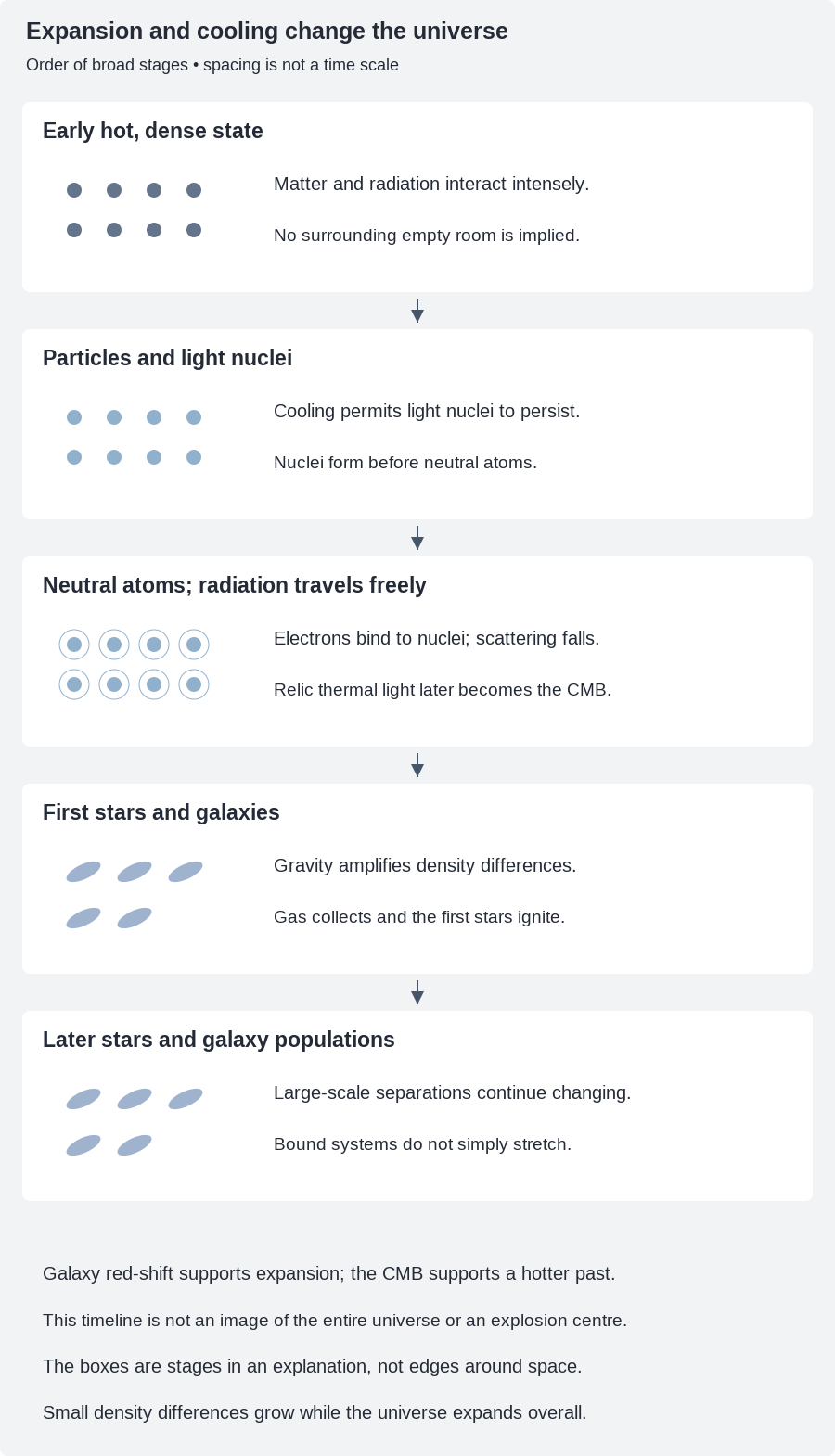
In the early universeAll of space, time, matter and energy., matter and radiation were much hotter and denser than today. Expansion increased large-scale separations and the universe cooled. As conditions changed, particles and light nucleusThe dense central region of an atom containing protons and neutrons, except hydrogen-1 which has no neutron. formed. Later, electronA negatively charged subatomic particle found outside an atom’s nucleus. could remain bound to nuclei as neutral atomAn electrically neutral particle with a small positive nucleus surrounded by electrons..
When electrons became bound in neutral atoms, radiation could travel much more freely through the universe. The cosmic microwave backgroundMicrowave radiation observed across the sky, left from the early universe when it became transparent. is relic thermal radiationEnergy transferred by electromagnetic waves emitted because of an object’s temperature. from that early epoch, stretched and cooled by subsequent expansion. It is not simply light from the first starA self-gravitating sphere of hot gas and plasma that produces energy by nuclear fusion during its main-sequence lifetime..
Structure develops
gravityThe attractive interaction between objects with mass. amplified small densityThe mass of material per unit volume, measured in kilograms per cubic metre in SI units. differences. gasA state of matter whose widely separated particles move randomly, filling the available container. gathered into the first starA self-gravitating sphere of hot gas and plasma that produces energy by nuclear fusion during its main-sequence lifetime. and galaxyA large gravitationally bound system of stars, gas, dust and dark matter.; later generations recycled material altered by stars. The model therefore predicts change over time, not a universeAll of space, time, matter and energy. that has always looked as it does now. Equal spacing of boxes on the timeline does not mean equal elapsed times.
Link the arguments
The systematic red-shiftAn increase in observed spectral wavelengths relative to their laboratory values, including that caused by cosmic expansion. pattern of distant galaxyA large gravitationally bound system of stars, gas, dust and dark matter. supports increasing large-scale separations. Looking back through an expanding model implies a denser past. The cosmic microwave backgroundMicrowave radiation observed across the sky, left from the early universe when it became transparent.’s nearly uniform thermal spectrum supplies separate evidence for an early hot phase. Together these observations support the hot Big BangThe model in which the universe expanded and cooled from an initially hot, dense state. model more strongly than either alone.
The model describes the observable universeAll of space, time, matter and energy.’s development from a very early state. It does not establish a surrounding empty room into which matter exploded, a special centre occupied by Earth, or a complete account of what preceded the earliest well-tested stages.
Equations
Common misconceptions
- The Big Bang is not an explosion of matter away from one centre in pre-existing space.
- The first stars formed after the radiation now observed as the CMB was released.