Learning goals
- Explain cell damage and mutation.
- Link time, distance, shielding and containment to their purposes.
- Explain why waste can need long-term isolation and cooling.
From ionisation to biological effects
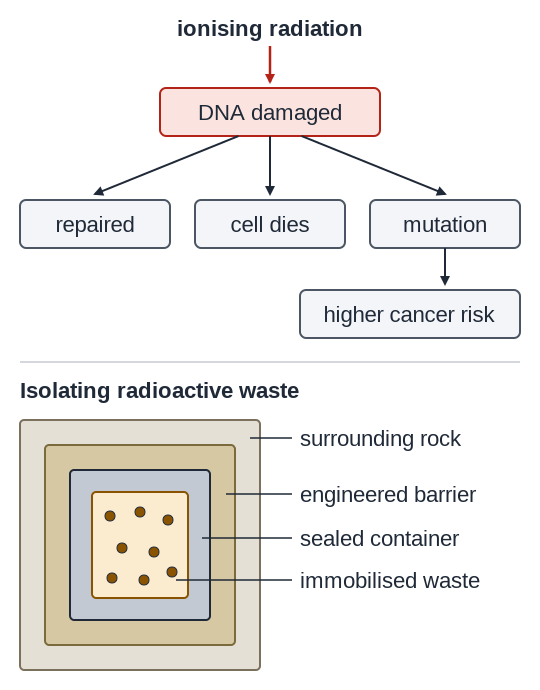
Radiation can ionise molecules directly or create reactive products that damage other molecules, including DNA. Cells may repair the damage, fail to function, die, or survive with altered genetic information. A change in genetic information is called a mutation. Some mutations can increase the chance of cancer; damage does not mean cancer will certainly develop.
Sufficiently large exposures can damage tissue. The consequences depend on the energyA conserved quantity transferred between stores by working, heating, electrical processes or radiation, measured in joules. absorbed, radiation type, exposed tissue and time over which exposure occurs. activityThe number of nuclear decays per unit time in a radioactive sample, measured in becquerels. in Bq alone does not specify a person’s dose because distanceThe length of a path travelled, without regard to direction., shieldingMaterial placed around a radiation source to absorb emissions and reduce exposure. and the exposure route also matter.
Reduce exposure and prevent transfer
For an external source, shorter exposure time reduces accumulated dose under otherwise unchanged conditions. Greater distanceThe length of a path travelled, without regard to direction. usually reduces the radiation reaching a person. Suitable shieldingMaterial placed around a radiation source to absorb emissions and reduce exposure. absorbs or scatters radiation; its choice depends on type and energyA conserved quantity transferred between stores by working, heating, electrical processes or radiation, measured in joules..
Containment prevents radioactive matter spreading into air, water, soil or bodies. It is a different purpose from shielding. Monitoring detects changes or leakage; it does not itself block radiation.
Why waste is a long-term problem
Waste from medicine, industry and nuclear facilities can contain mixtures of radioactive isotopeOne of the forms of an element with the same proton number but a different neutron number.. Some decay quickly; others remain active for a long time. Leakage may contaminate water or enter food chains. Some waste, particularly recently removed reactor fuel, also releases substantial decay heat.
Management can include sorting and characterisation, immobilising material, sealed durable containers, shieldingMaterial placed around a radiation source to absorb emissions and reduce exposure., controlled storage and an appropriate disposal system. Cooling is required where decay heat demands it. Containers, engineered barriers and suitable surrounding geology can provide layers of isolation.
Judge a proposal by what it controls
Burning or chemically treating a material does not generally change its nucleusThe dense central region of an atom containing protons and neutrons, except hydrogen-1 which has no neutron.’s half-lives and may spread contaminationThe presence of unwanted radioactive material on or inside an object or person.. Simply burying uncontained material does not demonstrate safe disposal. The design must account for isotopeOne of the forms of an element with the same proton number but a different neutron number. lifetimes, heat, water movement, containment durability and protection over the required timescale.
Equations
Common misconceptions
- A long half-life does not by itself prove a larger immediate activity or dose.
- Waste is not all equally hazardous; management depends on its contents and properties.