Learning goals
- Define both processes precisely.
- Explain why removing a distant source may not end contamination exposure.
- Relate exposure routes to radiation properties.
External irradiation
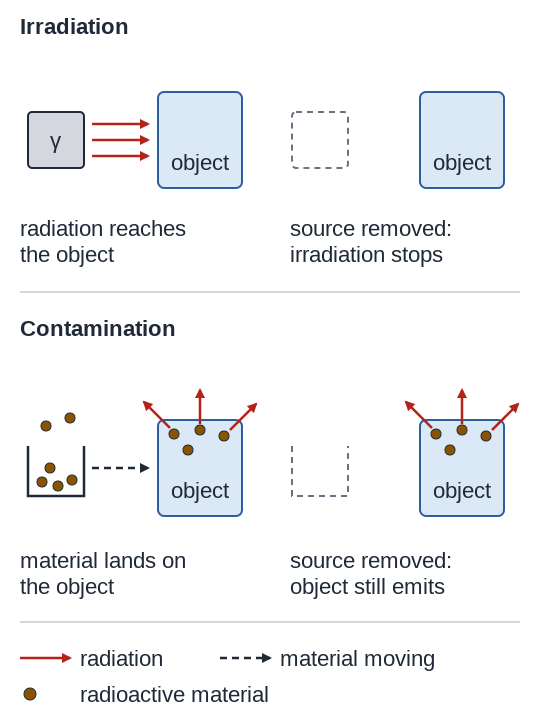
An object is irradiated when radiation reaches it from a source. The source can stay physically separate, for example a sealed gamma source used to sterilise packaged equipment. Removing or adequately shieldingMaterial placed around a radiation source to absorb emissions and reduce exposure. that source ends its contribution to the external exposure.
In the external-source example, radiation reaches the object without radioactive material being transferred to it. Receiving radiation does not by itself establish that the object has been contaminated.
Radioactive contamination
contaminationThe presence of unwanted radioactive material on or inside an object or person. occurs when radioactive material is deposited on a surface or enters an object or body. Dust, liquidA state of matter with closely spaced particles moving past one another, giving a fixed volume but no fixed shape. or aerosols can transfer the material. Contaminating nucleusThe dense central region of an atom containing protons and neutrons, except hydrogen-1 which has no neutron. continue to decay in their new location, so moving away from the original spill does not necessarily remove the source of exposure.
External contamination is on skin, clothes or another surface; internal contamination has entered the body. The deposited material can itself emit radiation and irradiate nearby tissue or other objects. Professional containment and removal procedures address the material, while shieldingMaterial placed around a radiation source to absorb emissions and reduce exposure. addresses radiation travelling from it.
Why the distinction matters
Typical alpha particleA helium nucleus containing two protons and two neutrons, emitted during alpha decay. cannot penetrate the outer dead skin layer, but an alpha-emitting substance inside the body can transfer energyA conserved quantity transferred between stores by working, heating, electrical processes or radiation, measured in joules. densely into nearby living tissue. Penetrating gamma radiationHigh-frequency electromagnetic waves emitted as an excited nucleus loses energy without changing proton or nucleon numbers. from an external source can reach internal tissue even without material entering the body.
The processes can occur together. A contaminated glove can irradiate a hand; a person may also be irradiated by a nearby sealed source without contaminationThe presence of unwanted radioactive material on or inside an object or person.. The important question is whether radioactive matter moved, radiation travelled, or both.
Equations
Common misconceptions
- Irradiation and contamination are not mutually exclusive.
- Shielding can reduce exposure but does not remove contaminating material or stop its nuclei decaying.