Learning goals
- Predict A and Z changes for alpha, beta-minus, gamma and neutron emission.
- Explain beta-minus conversion inside the nucleus.
- Identify whether the daughter is a different element.
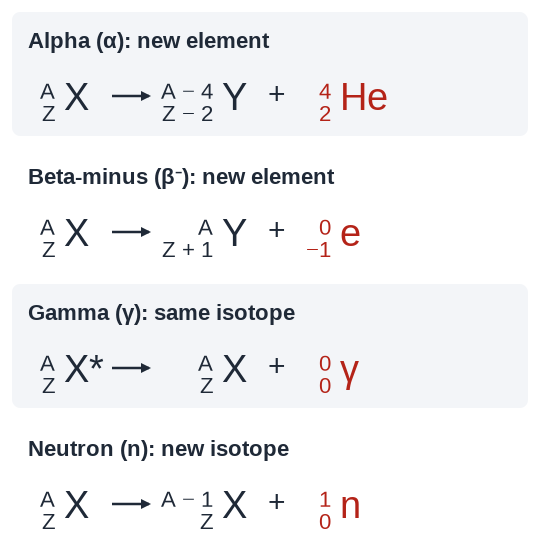
Alpha: lose four nucleons
An alpha particleA helium nucleus containing two protons and two neutrons, emitted during alpha decay. contains two protonA positively charged nuclear particle with a mass approximately equal to that of a neutron. and two neutronAn uncharged nuclear particle with a mass approximately equal to that of a proton.. After alpha emission, the daughter has A − 4 nucleons and Z − 2 protons. Its neutron number decreases by two. The change in atomic numberThe number of protons in an atom’s nucleus, identifying the element. makes it a different element.
For example, uranium-238 with Z = 92 becomes thorium-234 with Z = 90: 238 = 234 + 4 and 92 = 90 + 2.
Beta-minus: convert one neutron
In beta-minus decayA nuclear change converting a neutron into a proton while emitting an electron and an antineutrino., a neutronAn uncharged nuclear particle with a mass approximately equal to that of a proton. changes into a protonA positively charged nuclear particle with a mass approximately equal to that of a neutron. and an electronA negatively charged subatomic particle found outside an atom’s nucleus. is emitted from the nuclear process. The electron is the beta particleA fast electron emitted when a neutron changes into a proton during beta-minus decay.. The daughter has one extra proton and one fewer neutron: Z increases by 1 while A stays the same.
In the nuclear equations used here, a beta particle has upper number 0 because it contains no nucleons, and lower number −1 because it carries negative electric chargeA property of particles responsible for electrical interactions, measured in coulombs.. The upper number does not mean an electron has literally zero massThe quantity measuring an object’s inertia, expressed in kilograms..
Gamma: release nuclear excitation
Gamma emission carries away energyA conserved quantity transferred between stores by working, heating, electrical processes or radiation, measured in joules. from an excited nucleusThe dense central region of an atom containing protons and neutrons, except hydrogen-1 which has no neutron.. No protonA positively charged nuclear particle with a mass approximately equal to that of a neutron. or neutronAn uncharged nuclear particle with a mass approximately equal to that of a proton. is removed or converted, so A and Z are unchanged. The nucleus is a lower-energy state of the same isotopeOne of the forms of an element with the same proton number but a different neutron number..
Gamma can follow another decay when its daughter is left excited. Treat the particle-emission change and the subsequent gamma energy loss separately.
Neutron: lose one neutral nucleon
An emitted neutronAn uncharged nuclear particle with a mass approximately equal to that of a proton. has mass numberThe total number of protons and neutrons in a nucleus. 1 and electric chargeA property of particles responsible for electrical interactions, measured in coulombs. 0. The daughter’s A decreases by 1 but Z stays unchanged, giving a different isotopeOne of the forms of an element with the same proton number but a different neutron number. of the same element.
Check neutron number as well as A and Z. For alpha, beta-minus, gamma and neutron emission, its changes are −2, −1, 0 and −1 respectively. This gives a useful consistency check on the comparison table.
Equations
- alpha: A → A − 4, Z → Z − 2
- beta-minus: A unchanged, Z → Z + 1
- gamma: A and Z unchanged
- neutron: A → A − 1, Z unchanged
Common misconceptions
- Beta-minus emission increases the daughter’s positive charge because a negative electron leaves the nuclear process.
- Neutron emission does not change the element.