Learning goals
- Balance A and charge number separately.
- Solve alpha and beta-minus examples.
- Recognise the limits of a simple balanced equation.
Two bookkeeping rules
Write each nuclear symbol with A above Z to its left. Add all upper numbers on each side to conserve mass numberThe total number of protons and neutrons in a nucleus.. Add all lower numbers to conserve electric chargeA property of particles responsible for electrical interactions, measured in coulombs. number. For ordinary nucleusThe dense central region of an atom containing protons and neutrons, except hydrogen-1 which has no neutron. Z is atomic numberThe number of protons in an atom’s nucleus, identifying the element.; for a beta electronA negatively charged subatomic particle found outside an atom’s nucleus. the lower number is −1, its charge in elementary-charge units.
An equation that balances A and charge is necessary, but does not prove that a reaction actually occurs. Nuclear stability and energyA conserved quantity transferred between stores by working, heating, electrical processes or radiation, measured in joules. also matter. Nucleon-number conservation does not mean the exact total rest massThe quantity measuring an object’s inertia, expressed in kilograms. of reactants and products must be identical.
Worked alpha equation
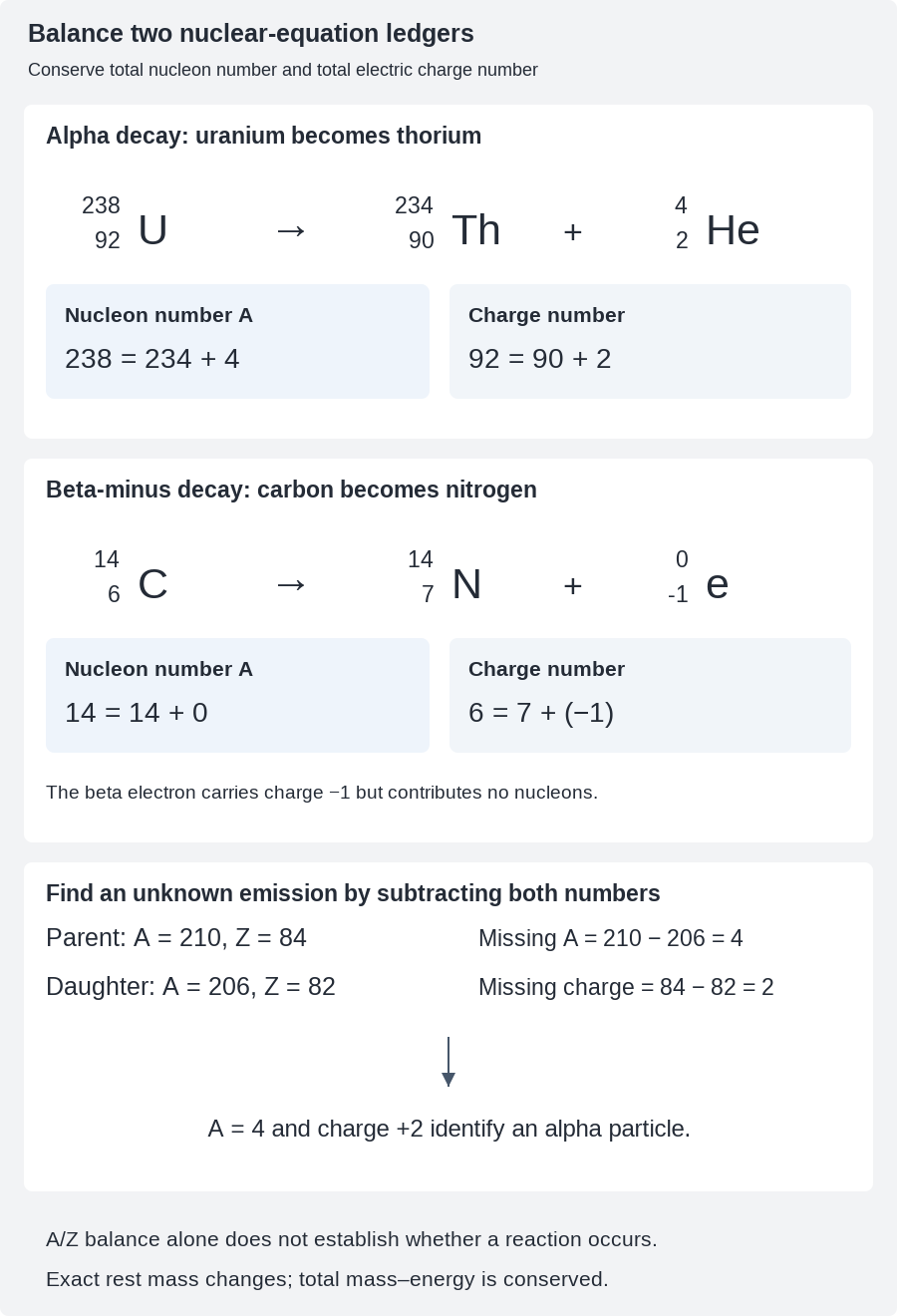
For ²³⁸₉₂U → ²³⁴₉₀Th + ⁴₂He, the upper check is 238 = 234 + 4 and the lower check is 92 = 90 + 2. If the daughter were missing, subtract the alpha numbers first: A = 238 − 4 = 234 and Z = 92 − 2 = 90; then identify element 90 as thorium.
Worked beta-minus equation
For ¹⁴₆C → ¹⁴₇N + ⁰₋₁e, the upper check is 14 = 14 + 0 and the lower check is 6 = 7 + (−1). The daughter is nitrogen because Z = 7. Writing Z = 5 for the daughter would fail electric chargeA property of particles responsible for electrical interactions, measured in coulombs. conservation.
This is the beta-minus notation used for the nucleon-number and charge checks. The electronA negatively charged subatomic particle found outside an atom’s nucleus.’s zero upper number means it is not a nucleon, not that it has no massThe quantity measuring an object’s inertia, expressed in kilograms..
Identify a missing emission
Suppose a nucleusThe dense central region of an atom containing protons and neutrons, except hydrogen-1 which has no neutron. changes from A = 210, Z = 84 to A = 206, Z = 82. The missing emission must carry A = 4 and electric chargeA property of particles responsible for electrical interactions, measured in coulombs. +2, identifying an alpha particleA helium nucleus containing two protons and two neutrons, emitted during alpha decay.. If A is unchanged and the daughter’s Z rises by one, the missing charge is −1: beta-minus.
For gamma, write an excited parent with an asterisk and show the same A and Z after emission. For neutronAn uncharged nuclear particle with a mass approximately equal to that of a proton. emission, the outgoing symbol ¹₀n reduces the daughter’s A by one. Always check both ledgers before naming a particle.
Equations
- ΣA before = ΣA after
- Σcharge number before = Σcharge number after
Common misconceptions
- Do not subtract 1 from A for beta-minus decay: an electron is not a nucleon.
- A balanced A/Z equation does not by itself establish that a nuclear reaction is energetically possible.