Learning goals
- Use Bq, cm, h, min and s correctly.
- Convert time and distance before calculating rates.
- Distinguish source activity from a detector reading.
Activity and the becquerel
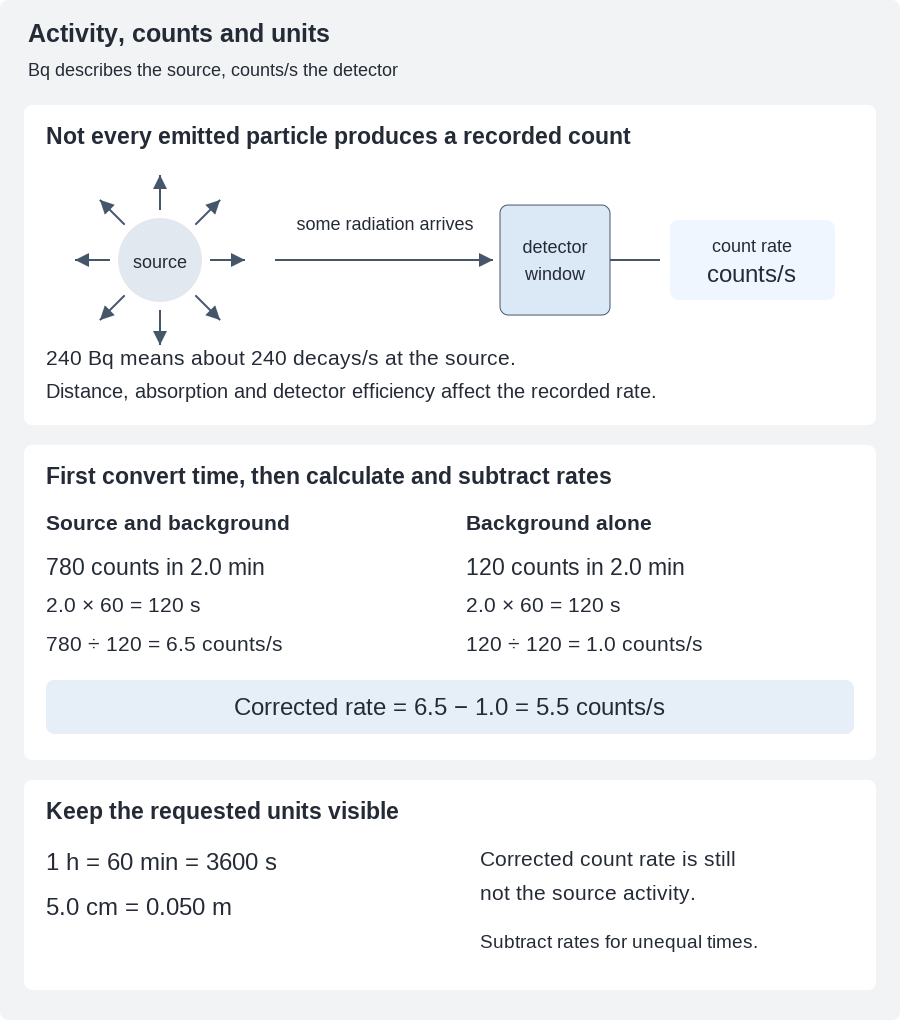
An unstable nucleusThe dense central region of an atom containing protons and neutrons, except hydrogen-1 which has no neutron. can change by radioactive decayA spontaneous, random change in an unstable nucleus that emits particles or electromagnetic radiation.. The activityThe number of nuclear decays per unit time in a radioactive sample, measured in becquerels. of a source is the rate at which its nuclei decay. One becquerelThe unit of activity equal to one nuclear decay per second. (1 Bq) means one decay per second, on average. A 240 Bq source therefore undergoes about 240 decays each second; it does not emit particles at exactly equal time intervals.
Activity describes the source. A detector records only radiation which reaches it and produces a detectable interaction. Its reading also includes background. A measured 12 counts/s is not automatically an activity of 12 Bq.
Time and distance units
Use 1 min = 60 s and 1 h = 60 min = 3600 s. For a rate per second, put the counting time in seconds before dividing. half-lifeThe time for the activity or number of undecayed nuclei of an isotope to decrease to half its initial value. calculations may use hours or minutes if both the elapsed time and the half-life use the same unit.
Source–detector separation and absorber thickness may be recorded in centimetres. Since 1 cm = 0.01 m, a separation of 5.0 cm is 0.050 m. Always label a column as distanceThe length of a path travelled, without regard to direction. / cm or distance / m; a bare number does not specify the apparatus geometry.
Worked detector example
A detector records 780 counts in 2.0 min with a source present. First convert 2.0 min to 120 s. The measured rate is 780 ÷ 120 = 6.5 counts/s. In a separate background measurement, 120 counts in 120 s gives 1.0 count/s. The source contribution is approximately 6.5 − 1.0 = 5.5 counts/s.
This corrected count rateThe number of radiation events registered by a detector per unit time. is still not the source activityThe number of nuclear decays per unit time in a radioactive sample, measured in becquerels.: radiation can miss the detector or be absorbed before reaching it. Keep the geometry and detector unchanged when comparing rates.
Equations
- mean count rate = recorded counts ÷ counting time
- 1 Bq = 1 nuclear decay per second
- 1 h = 3600 s; 1 cm = 0.01 m
Common misconceptions
- Bq is not a unit of radiation energy or absorbed dose.
- Subtract rates, not raw counts from measurements lasting different times.