Learning goals
- Explain terrestrial and cosmic background sources.
- Explain why measured background varies.
- Use a representative background measurement.
Sources on Earth
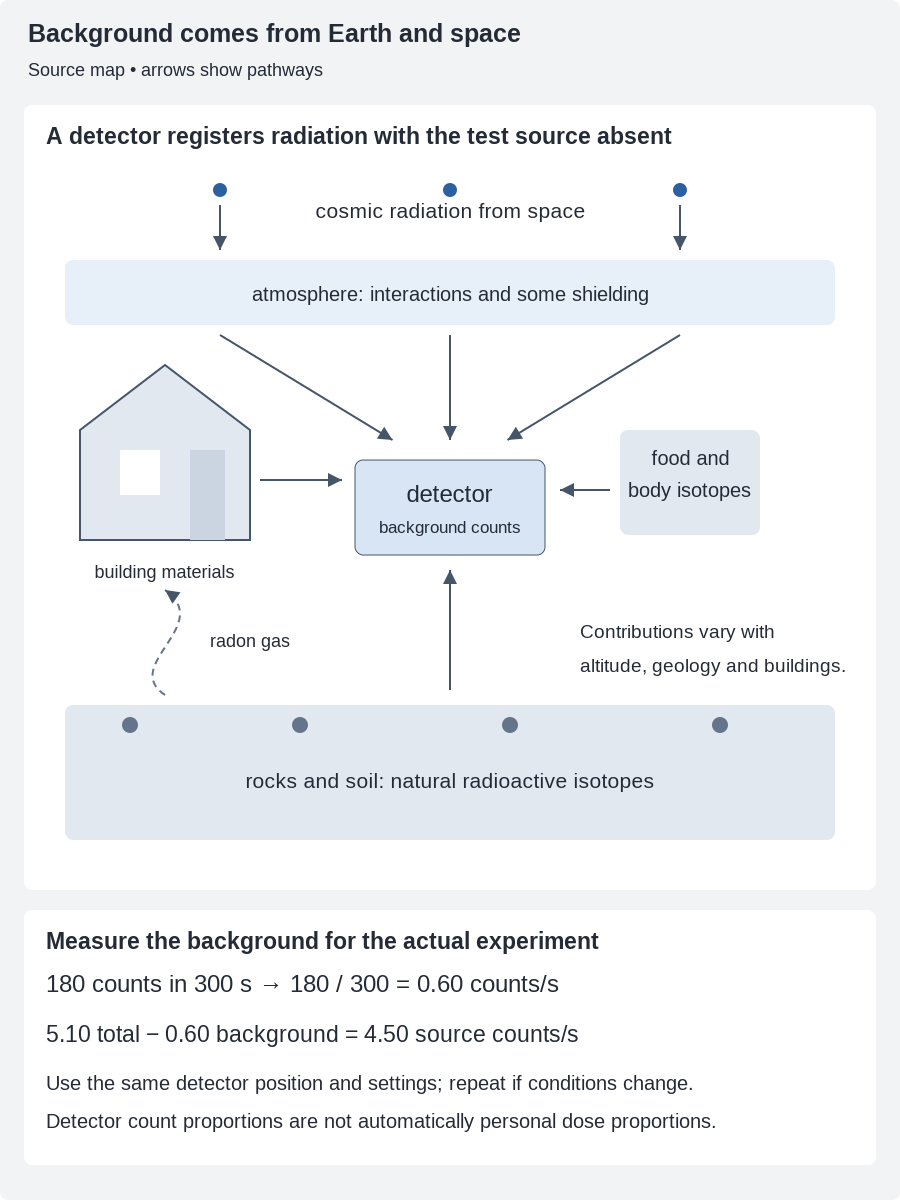
Some naturally occurring isotopeOne of the forms of an element with the same proton number but a different neutron number. in rocks and soil decay and emit radiation. Building materials made from those rocks can contribute too. Radon is a radioactive gasA state of matter whose widely separated particles move randomly, filling the available container. produced in decay chains in the ground; it and its decay products can enter the air and buildings.
Food, water and living organisms contain small quantities of naturally radioactive isotopes. Radiation therefore does not require a nearby artificial source or a nuclear powerThe energy transferred or work done per unit time, measured in watts. station. Different local geology, building materials and ventilation can produce different contributions.
Sources from space
Energetic particles arrive from space and interact with the atmosphere, producing secondary radiation. The atmosphere provides shieldingMaterial placed around a radiation source to absorb emissions and reduce exposure., so the cosmic contribution generally increases with altitude. Buildings and other shielding also affect what reaches a particular detector.
Background varies randomly in time as well as between locations. A detector responds differently to different types and energyA conserved quantity transferred between stores by working, heating, electrical processes or radiation, measured in joules., so its measured count proportions are not automatically the same as the proportions of a person’s dose.
Measure the relevant background
Remove the experimental source to secure storage, keep the detector in its measurement position and collect counts over a suitable duration. Repeat or count for longer to estimate a mean. If conditions may have changed, measure again after the experiment.
For example, 180 background counts over 300 s gives 0.60 counts/s. A source-plus-background reading of 5.10 counts/s then gives 4.50 counts/s attributable to the source in that geometry. Subtract rates when durations differ.
Medical exposures and releases from human activityThe number of nuclear decays per unit time in a radioactive sample, measured in becquerels. can add to total radiation exposure. Keep the distinction between the particular background measured for an experiment and a population exposure chart; neither is a fixed universal mixture.
Equations
- source contribution ≈ measured total rate − background rate
Common misconceptions
- Background is not constant to the nearest count in every short interval.
- Natural origin alone does not determine biological risk; dose, radiation type and exposure route matter.