Reasoning about waves, rays and sound
Distinguish a wave from its medium, explain boundary changes and evaluate how a wave measurement supports a conclusion.
Specification 5.2, 5.3, 5.4, 5.5, 5.6, 5.7, 5.8, 5.9, 5.10, 5.11, 5.14, 5.15, 5.16, 5.17, 5.18, 5.19, 5.20, 5.21, 5.22, 5.23, 5.24P, 5.25P, 5.26P, 5.27P, 5.28P, 5.29P
Ratings, marks and Maths and Logic completion stay in this browser on this device. Written answers are temporary and are never recorded or transmitted. Reset clears only Physics practice progress, including Maths and Logic completion.
Answers and choices are temporary. Only started/completed flags are saved on this device. Practice can be retried or revealed; the check counts each question’s first answer. These are original practice tasks, not official exam questions.
Starting here
A wave carries energy and information. In a simple mechanical-wave model, local particles oscillate while the disturbance advances; they do not all travel along with it. Light is an electromagnetic wave and needs no material medium.
Identify the diagram’s axes and geometry. Spacing in a displacement–distance snapshot can represent wavelength; spacing in a time trace represents period. At a stationary boundary, frequency stays constant while speed and wavelength may change. The figure shows a ray changing direction at both faces of a parallel-sided glass block.
Key ideas
- Transverse and longitudinal describe the direction of oscillation relative to propagation, not whether the drawn line points up or right.
- Use the normal at the boundary for ray angles. Total internal reflection needs the correct media order as well as an angle above critical.
- A valid comparison controls timebase, voltage scale, microphone response and geometry as appropriate.
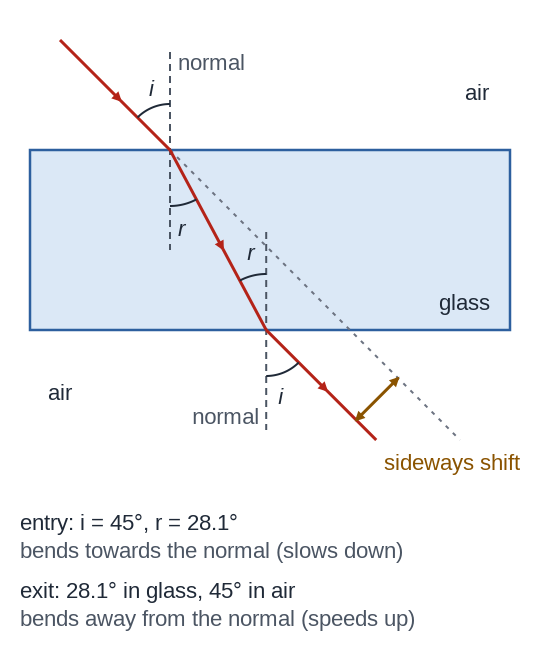
Worked example
In the figure, the emergent ray is parallel to the incident ray. A student says this proves that the ray never changed direction inside the block. Assess the claim.
- Each boundary. The ray bends towards the normal on entering slower glass and away from the normal on returning to air.
- Geometry. The faces are parallel and the outside medium is air at both faces, so the final direction matches the initial direction.
- Path. The ray is displaced sideways. Equal outside directions do not mean the internal path was unchanged.
Answer: The conclusion ignores the two separate boundaries. The diagram supports bending at both faces and a parallel, displaced emergent ray under the stated conditions.
Activities
Opens when you finish the stage above.
Build the skill
Opens when you finish the stage above.
Check
Opens when you finish the stage above.