Learning goals
- Select the wave-speed or frequency-period relationship.
- Carry out sound and electromagnetic-wave calculations with prefixes and standard form.
- Check results and distinguish changes of source from changes of medium.
Choose from the information given
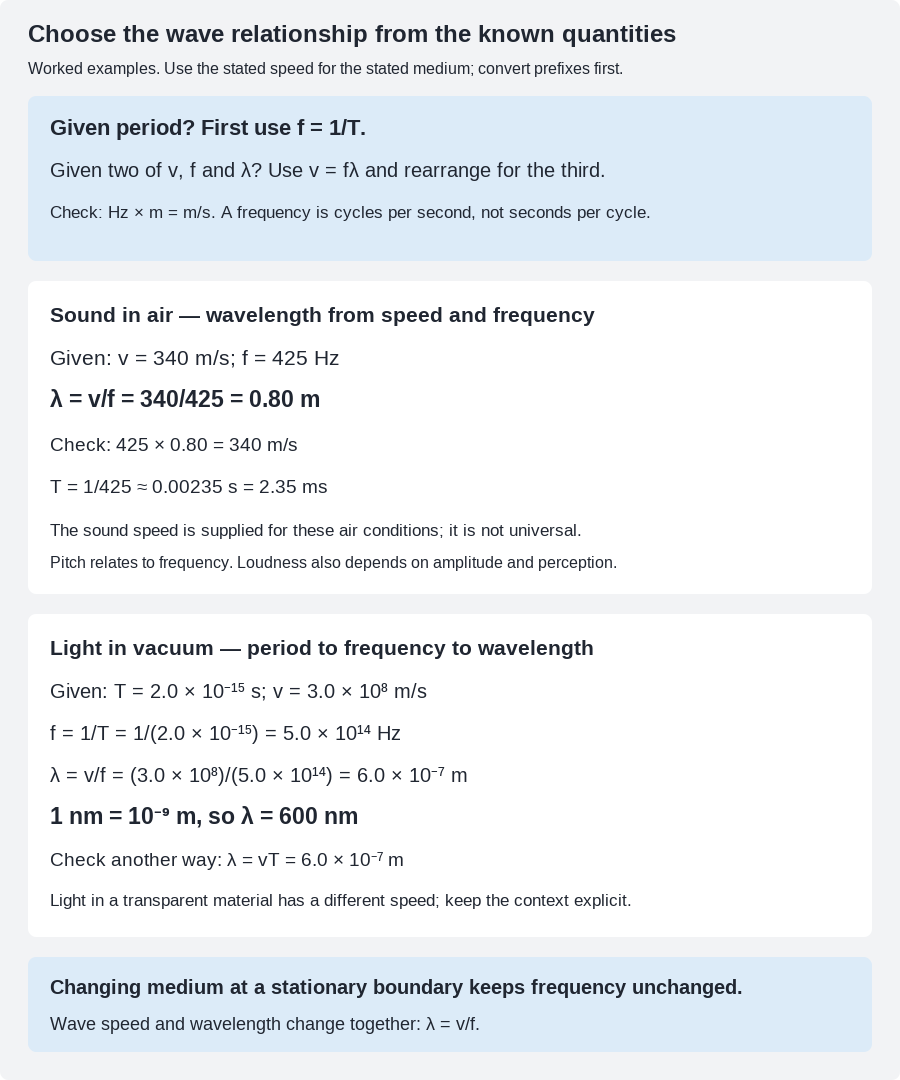
List the known quantities with units and identify the unknown. If periodThe time taken for one complete oscillation or repeating cycle. is given, f = 1/T provides frequencyThe number of complete oscillations or wave cycles per second, measured in hertz.. If two of speedThe distance travelled per unit time, without specifying direction., frequency and wavelengthThe shortest distance between two successive points in phase on a wave. are known, use v = fλ and rearrange for the third. Combining them also gives λ = vT.
Do not assume the same speed for every waveA travelling disturbance that transfers energy without an overall transfer of matter.. soundA mechanical wave produced by vibrations and transmitted through a material medium. speed depends on the medium and conditions; use the value supplied. All electromagnetic waveA transverse wave of oscillating electric and magnetic fields that travels through a vacuum at the speed of light. have speed about 3.0 × 10⁸ m/s in a vacuum, but their speed in a material can differ.
Sound example
A soundA mechanical wave produced by vibrations and transmitted through a material medium. waveA travelling disturbance that transfers energy without an overall transfer of matter. in air has frequencyThe number of complete oscillations or wave cycles per second, measured in hertz. 425 Hz and the stated speedThe distance travelled per unit time, without specifying direction. 340 m/s. Its wavelengthThe shortest distance between two successive points in phase on a wave. is λ = v/f = 340/425 = 0.80 m. Substituting back gives 425 × 0.80 = 340 m/s.
Its periodThe time taken for one complete oscillation or repeating cycle. is T = 1/425 ≈ 0.00235 s = 2.35 ms. A different pitchThe perceived highness or lowness of a sound, determined mainly by its frequency. means a different frequency; it does not by itself establish a different speed in the same air. loudnessThe perceived strength of a sound, related to its intensity and the listener’s hearing response. is a separate issue involving amplitudeThe maximum displacement from the equilibrium position in an oscillation. and perception.
Electromagnetic example
Light in vacuum has periodThe time taken for one complete oscillation or repeating cycle. 2.0 × 10⁻¹⁵ s. frequencyThe number of complete oscillations or wave cycles per second, measured in hertz. f = 1/T = 1/(2.0 × 10⁻¹⁵) = 5.0 × 10¹⁴ Hz. With v = 3.0 × 10⁸ m/s, wavelengthThe shortest distance between two successive points in phase on a wave. λ = v/f = (3.0 × 10⁸)/(5.0 × 10¹⁴) = 6.0 × 10⁻⁷ m.
Since 1 nm = 10⁻⁹ m, the wavelength is 600 nm. As an independent check, λ = vT = 3.0 × 10⁸ × 2.0 × 10⁻¹⁵ = 6.0 × 10⁻⁷ m. Bracket the full power-of-ten value when entering a reciprocal into a calculator.
Changing the medium
At a stationary boundary, the transmitted waveA travelling disturbance that transfers energy without an overall transfer of matter. keeps the source frequencyThe number of complete oscillations or wave cycles per second, measured in hertz.. If the same 5.0 × 10¹⁴ Hz light travels at a stated 2.0 × 10⁸ m/s inside a material, λ = 2.0 × 10⁸ / 5.0 × 10¹⁴ = 4.0 × 10⁻⁷ m = 400 nm there. Its frequency has not increased to compensate.
Report the wavelengthThe shortest distance between two successive points in phase on a wave. with its medium: a quoted 600 nm vacuum wavelength and 400 nm material wavelength can describe the same frequency. This calculation prepares for refractionA change in wave speed at a boundary between media, causing a change in direction at non-normal incidence., where speedThe distance travelled per unit time, without specifying direction., wavelength and sometimes direction change together.
Equations
- v = fλ; f = 1/T; λ = vT
- 1 nm = 10⁻⁹ m; 1 ms = 10⁻³ s
Common misconceptions
- Using the same equation does not imply using the same speed for sound and light.
- Frequency stays constant at a stationary boundary; a change in wavelength does not necessarily mean a change in source frequency.
Connect a wave snapshot to a local time trace
Change amplitude, frequency and wavelength while distinguishing wave propagation from local oscillation.
What you see
- Labelled diagrams and numerical outputs describe the same selected state.
How to use it
- Change one control at a time, predict the outcome, then compare the readouts. All controls have keyboard-accessible sliders and step buttons.
- Reset restores every model control to its initial value. Nothing is saved.
What it shows
- Wave speed=fλ and period=1/f. A snapshot plots displacement against position; the lower graph records one fixed point against time. The pattern and energy travel right while each marker oscillates locally. Amplitude changes the size of displacement, not the speed or period in this model.
Limits of the model
- An ideal smooth repeating transverse wave travels right without loss of amplitude. The black marker remains at position 2 m while moving transversely.
- The controls define a geometric wave, not a mechanical calculation for a particular rope or fixed medium. In a medium of fixed wave speed, frequency and wavelength cannot change independently. At zero amplitude the entered frequency and wavelength cannot be measured from the flat trace.
Controls
Predict, change and explain
At amplitude 0.5 m, frequency 1 Hz and wavelength 2 m, predict speed and period. Scrub time and follow the black marker. Then compare frequency 2 Hz with wavelength 1 m: what stays the same and what changes?
Connect the outcome to the Physics
Wave speed=fλ and period=1/f. A snapshot plots displacement against position; the lower graph records one fixed point against time. The pattern and energy travel right while each marker oscillates locally. Amplitude changes the size of displacement, not the speed or period in this model.