Learning goals
- Explain approaching and receding source cases.
- Relate wavefront spacing to observed frequency and sound pitch.
- Keep source motion, observer motion and medium assumptions distinct.
Successive emissions start in different places
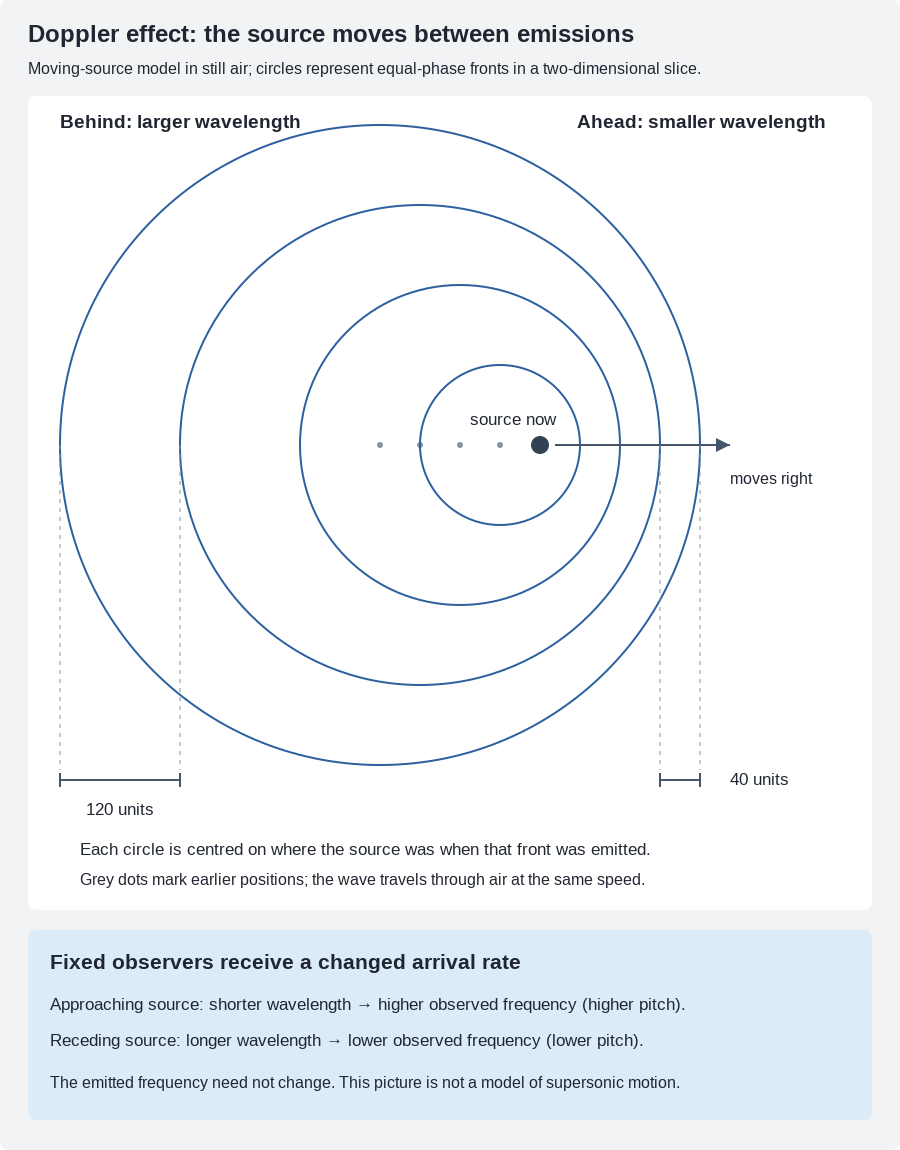
A stationary source emitting at a constant frequencyThe number of complete oscillations or wave cycles per second, measured in hertz. produces equally spaced fronts spreading from one position. If the source moves, each new front begins at a new position. Once emitted in still air, each soundA mechanical wave produced by vibrations and transmitted through a material medium. front spreads through the air at the wave speedThe distance a wave disturbance travels per unit time, equal to frequency multiplied by wavelength. from the position where it was emitted.
Ahead of an approaching source, it moves towards the earlier front before emitting the next one, reducing the spacing. Behind the source, the spacing increases. The circular fronts in the diagram have different centres for this reason; they must not all be centred on the source’s electric currentThe amount of electric charge passing a point per unit time, measured in amperes. position.
What a fixed observer detects
A fixed observer ahead receives more wavefrontA line or surface joining points on a wave that are in the same phase. each second because their spacing is smaller while their speedThe distance travelled per unit time, without specifying direction. through the air is unchanged. The observed frequencyThe number of complete oscillations or wave cycles per second, measured in hertz. is higher, and soundA mechanical wave produced by vibrations and transmitted through a material medium. has a higher pitchThe perceived highness or lowness of a sound, determined mainly by its frequency.. Behind a receding source, the larger spacing gives fewer arrivals each second and a lower pitch.
This is the Doppler effectA change in observed wave frequency caused by relative motion between a source and an observer.. The actual frequency produced by the source need not change. An approaching and then receding siren can appear to drop in pitch even if its driver keeps the sound source operating in the same way. A change in loudnessThe perceived strength of a sound, related to its intensity and the listener’s hearing response. is not the definition of the effect.
Read the model
The diagram emits a front every equal time interval. In each interval the front travels 80 relative drawing units and the source moves 40. Ahead, successive fronts are separated by 80 − 40 = 40 units; behind, by 80 + 40 = 120 units. The corresponding stationary-source spacing would be 80 units.
These proportional drawing units show the waveA travelling disturbance that transfers energy without an overall transfer of matter. spacing. The source moves more slowly than soundA mechanical wave produced by vibrations and transmitted through a material medium. in this model. Supersonic motion requires a different wavefrontA line or surface joining points on a wave that are in the same phase. pattern and is not shown.
Other relative motion and light
An observer moving towards incoming soundA mechanical wave produced by vibrations and transmitted through a material medium. also meets fronts more frequently, even if the source is stationary. In that case the spacing already present in the air does not itself change merely because the observer moves. Distinguish the source-motion picture from the more general change in arrival rate.
electromagnetic waveA transverse wave of oscillating electric and magnetic fields that travels through a vacuum at the speed of light. also exhibit a Doppler effectA change in observed wave frequency caused by relative motion between a source and an observer., with approaching sources shifted towards higher observed frequencyThe number of complete oscillations or wave cycles per second, measured in hertz. and receding sources towards lower ones. Light needs no air medium, so do not transfer the still-air explanation literally to light. red-shiftAn increase in observed spectral wavelengths relative to their laboratory values, including that caused by cosmic expansion. is developed further in astrophysics.
Equations
Common misconceptions
- The observed frequency can change without the emitted frequency changing.
- An approaching sound source does not simply make sound travel faster through still air.
- For sound, a moving observer changes the encounter rate without rearranging wavefront spacing in the air.