Learning goals
- Explain compressions, rarefactions and local particle oscillation.
- Use reflection to explain echoes.
- Explain refraction when sound speed changes.
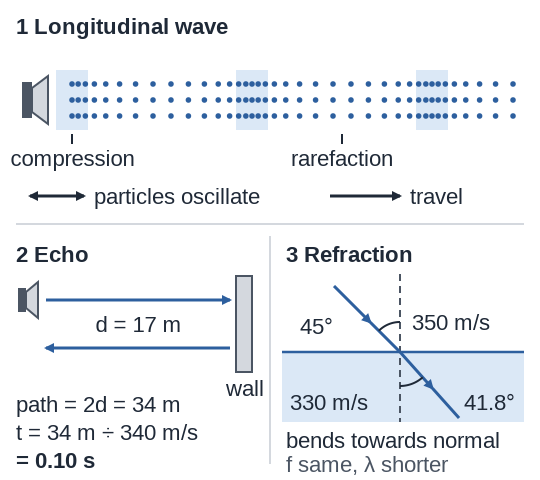
From a vibrating source to a pressure wave
As a loudspeaker cone moves forwards, it pushes nearby air into a region of increased pressureThe normal force exerted per unit area, measured in pascals. and densityThe mass of material per unit volume, measured in kilograms per cubic metre in SI units. called a compressionA region of a longitudinal wave where particles are closer together and pressure is higher.. As it moves back, a region of lower pressure and density, a rarefactionA region of a longitudinal wave where particles are farther apart and pressure is lower., forms. Interactions between neighbouring particles pass the disturbance outwards.
The organised oscillationOne complete repeated motion about an equilibrium position. of the air is parallel to the direction of travel, so soundA mechanical wave produced by vibrations and transmitted through a material medium. in air is longitudinal. Individual molecules also have random thermal motion; the diagram represents the additional collective oscillation, not a still lattice of air particles. In the ideal small-amplitude model, the waveA travelling disturbance that transfers energy without an overall transfer of matter. transfers energyA conserved quantity transferred between stores by working, heating, electrical processes or radiation, measured in joules. without a net flow of air from speaker to listener.
Why a medium is needed
soundA mechanical wave produced by vibrations and transmitted through a material medium. relies on interactions between particles. It can travel through gasA state of matter whose widely separated particles move randomly, filling the available container., liquidA state of matter with closely spaced particles moving past one another, giving a fixed volume but no fixed shape. and solidA state of matter whose closely packed particles vibrate around fixed positions, giving a fixed shape and volume. but cannot cross a vacuum. Light does not need such a medium, which explains why a distant event can be seen even when its sound cannot reach us.
A pressure-time trace can be drawn as a sine curve without making the sound transverse. The classification depends on particle oscillationOne complete repeated motion about an equilibrium position. relative to propagation, not on the shape of a plotted graph.
Reflection and echoes
At a boundary such as a large wall, some soundA mechanical wave produced by vibrations and transmitted through a material medium. energyA conserved quantity transferred between stores by working, heating, electrical processes or radiation, measured in joules. returns as a reflected waveA travelling disturbance that transfers energy without an overall transfer of matter.. If it reaches the listener sufficiently later than the direct sound, it is heard as a separate echo. Shorter repeated delays can instead merge into reverberation.
If source and listener are together a distanceThe length of a path travelled, without regard to direction. d from a wall, the echo travels 2d. For a sound speedThe distance travelled per unit time, without specifying direction. 340 m/s and wall distance 17 m, return time is 34/340 = 0.10 s. This is a round trip, not the time to reach the wall alone.
Refraction
soundA mechanical wave produced by vibrations and transmitted through a material medium. can be refracted when its speedThe distance travelled per unit time, without specifying direction. changes between regions. For example, temperatureA measure of how hot a system is, related to the average kinetic energy of its particles. differences in air can produce different sound speeds. At an oblique boundary into a slower region, a ray bends towards the normalA reference line or direction perpendicular to a surface or plane.; into a faster region it bends away.
At a stationary boundary the frequencyThe number of complete oscillations or wave cycles per second, measured in hertz. stays set by the source. The wavelengthThe shortest distance between two successive points in phase on a wave. changes because v = fλ. A real gradual temperature change bends the path progressively; the diagram uses two uniform regions and a sharp boundary to make the direction change clear.
Equations
- v = fλ; for an echo back to the source, t = 2d/v.
Common misconceptions
- A sine-shaped graph does not make sound in air transverse.
- Air molecules do not travel all the way from the loudspeaker to the listener as the sound signal.
- Use the round-trip distance for an echo.
- At a stationary refracting boundary, sound frequency stays the same.