Learning goals
- Calculate n from c and c from n.
- Use the material-to-air assumption explicitly.
- Check whether a given incidence angle produces total internal reflection.
Why the equation has a 1
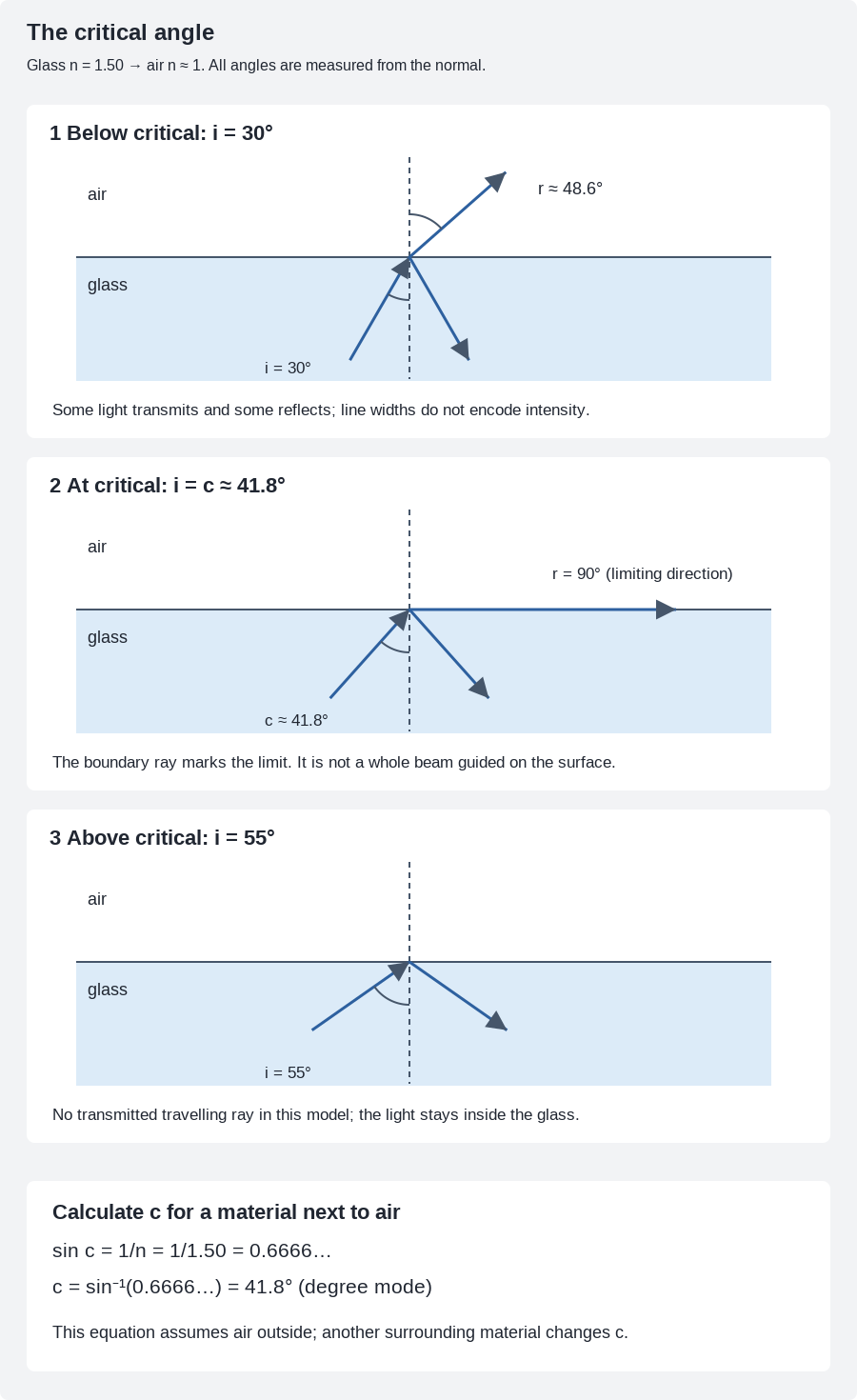
At the critical angleThe angle of incidence in the higher-index medium for which the refracted ray travels along the boundary., the refracted angle in air is 90°, and sin 90° = 1. Applying the reversible refractionA change in wave speed at a boundary between media, causing a change in direction at non-normal incidence. relationship gives n = 1/sin c for a material next to air, treating the index of air as 1.
refractive indexThe ratio of light’s speed in a vacuum to its speed in a material. n has no unit. The critical angle c is measured inside the material from the normalA reference line or direction perpendicular to a surface or plane., in degrees for these calculations. This is a boundary property: the simple formula assumes air or approximately vacuum outside.
Worked example: find c
For glass with n = 1.50, rearrange to sin c = 1/n = 1/1.50 = 0.6666…. In degree mode, c = sin⁻¹(0.6666…) = 41.810…°, or 41.8°.
An internal angle of 45° is greater than 41.8°, so a glass-to-air ray at 45° undergoes total internal reflectionComplete reflection at a boundary when light in a higher-index medium strikes a lower-index medium above the critical angle.. An internal angle of 30° is below it and can transmit into the air.
Worked example: find n
For a material-to-air critical angleThe angle of incidence in the higher-index medium for which the refracted ray travels along the boundary. of 42.0°, calculate sin 42.0° ≈ 0.6691, then n = 1/0.6691 ≈ 1.49. Keep unrounded values until the final result.
A smaller critical angle corresponds to a larger refractive indexThe ratio of light’s speed in a vacuum to its speed in a material. relative to air. For n = 2.00, c = sin⁻¹(0.500) = 30.0°. The higher-index material has a wider range of internal angles that exceed its critical angle.
Check the boundary and the calculation
Do not use n = 1/sin c unchanged for a fibre with glass cladding: the surrounding material is not air. The critical angleThe angle of incidence in the higher-index medium for which the refracted ray travels along the boundary. depends on both materials. In the fibre example on 5.20, the given critical angle is about 69.0°, so compare the internal incidence angle with that value.
For a material-to-air calculation, sin c = 1/n must give a value between 0 and 1. If the value is greater than 1, check the values and rearrangement rather than forcing a calculator answer. Always identify the materials before selecting the equation.
Equations
- n = 1/sin c for material → air; sin c = 1/n; c = sin⁻¹(1/n).
Common misconceptions
- Inverse sine finds an angle; it is not the reciprocal of sine.
- The critical angle is not 1/n in degrees.
- Do not use the air-only form unchanged for a fibre with non-air cladding.
- Compare the incidence angle with c only after checking higher-to-lower-index travel.
Find the transition to total internal reflection
Change the angle inside glass and identify refraction, the critical case and total internal reflection.
What you see
- Labelled diagrams and numerical outputs describe the same selected state.
How to use it
- Change one control at a time, predict the outcome, then compare the readouts. All controls have keyboard-accessible sliders and step buttons.
- Reset restores every model control to its initial value. Nothing is saved.
What it shows
- The critical angle satisfies sin c=1/n for glass to air. Below c, a refracted ray emerges away from the normal. At c its limiting direction lies along the boundary. Above c no transmitted ray is drawn: total internal reflection requires travel towards the lower-index medium and incidence greater than c.
Limits of the model
- A flat glass-to-air boundary, with incidence measured inside glass from the normal. The selected glass index is relative to air.
- Ray directions only: partial reflection below the critical angle is shown dashed, without an intensity model. At the critical angle the limiting refracted direction is along the boundary.
Controls
Angles are measured from the dashed normal, not from the horizontal surface. Reflection has the same angle as incidence. At normal incidence both sines are zero, so use a non-zero angle to determine refractive index from their ratio. Compare incidence with the displayed critical angle. At the critical case, the limiting refracted ray lies along the boundary.
Predict, change and explain
At n=1.5, compare incidence 40° and 45°. Then choose n=2 and incidence 30° to inspect the critical case. Explain both conditions needed for total internal reflection and how this helps guide light in an optical fibre.
Connect the outcome to the Physics
The critical angle satisfies sin c=1/n for glass to air. Below c, a refracted ray emerges away from the normal. At c its limiting direction lies along the boundary. Above c no transmitted ray is drawn: total internal reflection requires travel towards the lower-index medium and incidence greater than c.