Learning goals
- Recall and use the approximate hearing limits.
- Compare frequencies inside and outside the hearing range.
- Convert kHz and compare frequencies on a labelled scale.
A frequency range
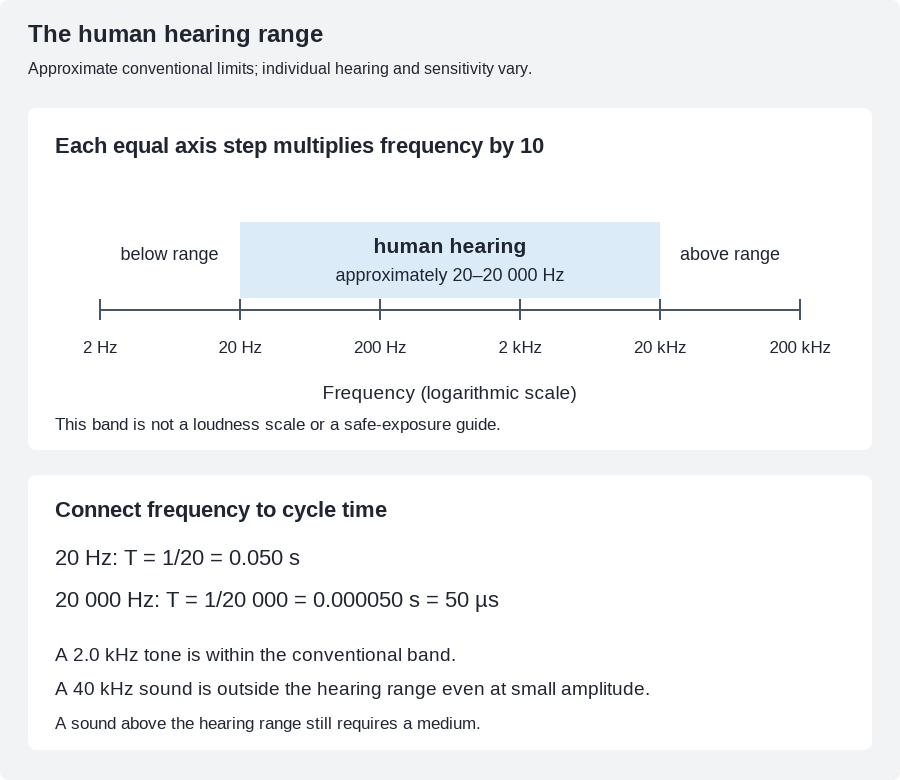
A frequencyThe number of complete oscillations or wave cycles per second, measured in hertz. of 20 Hz means 20 vibrations per second; 20 000 Hz means 20 000 per second. The approximate range commonly quoted for human hearing is 20–20 000 Hz, or 20 Hz–20 kHz.
These are conventional limits, not a guarantee that every person can hear every frequency in the band. Sensitivity varies with the person, age, frequency and soundA mechanical wave produced by vibrations and transmitted through a material medium. level; the upper limit is often lower.
Outside the range
soundA mechanical wave produced by vibrations and transmitted through a material medium. below 20 Hz or above 20 000 Hz lie outside the conventional human hearing range. They are still sound waveA travelling disturbance that transfers energy without an overall transfer of matter. and require a medium; being inaudible does not make them electromagnetic radiation.
A 15 Hz sound is below the conventional range. A 2.0 kHz tone equals 2000 Hz and lies within the conventional band. A 40 kHz signal equals 40 000 Hz and is above the range, even if its amplitudeThe maximum displacement from the equilibrium position in an oscillation. is small.
Read the scale carefully
The figure uses a logarithmic frequencyThe number of complete oscillations or wave cycles per second, measured in hertz. axis: each equal step represents multiplication by ten. This allows a wide range to fit on one diagram. The gap from 20 to 200 Hz therefore occupies the same width as 200 to 2000 Hz, despite the different numerical differences.
The shaded band identifies the approximate frequency interval only. It does not show equal loudnessThe perceived strength of a sound, related to its intensity and the listener’s hearing response. sensitivity or a safe soundA mechanical wave produced by vibrations and transmitted through a material medium. level. Do not test hearing limits by increasing a source to an uncomfortable volume.
Connect frequency to period
At the lower conventional limit, T = 1/20 = 0.050 s. At the upper limit, T = 1/20 000 = 0.000050 s, or 50 µs. The higher frequencyThe number of complete oscillations or wave cycles per second, measured in hertz. has a much shorter cycle time.
Equations
- 1 kHz = 1000 Hz; T = 1/f.
Common misconceptions
- A frequency above the hearing range does not mean an especially loud sound.
- Human hearing limits vary; 20–20 000 Hz is an approximate conventional range.
- Equal distances on a logarithmic axis mean equal ratios, not equal additions.