Learning goals
- Describe a two-microphone investigation of sound speed in air.
- Calculate speed from a time difference and separation.
- Evaluate echoes, alignment, timing resolution and alternative methods.
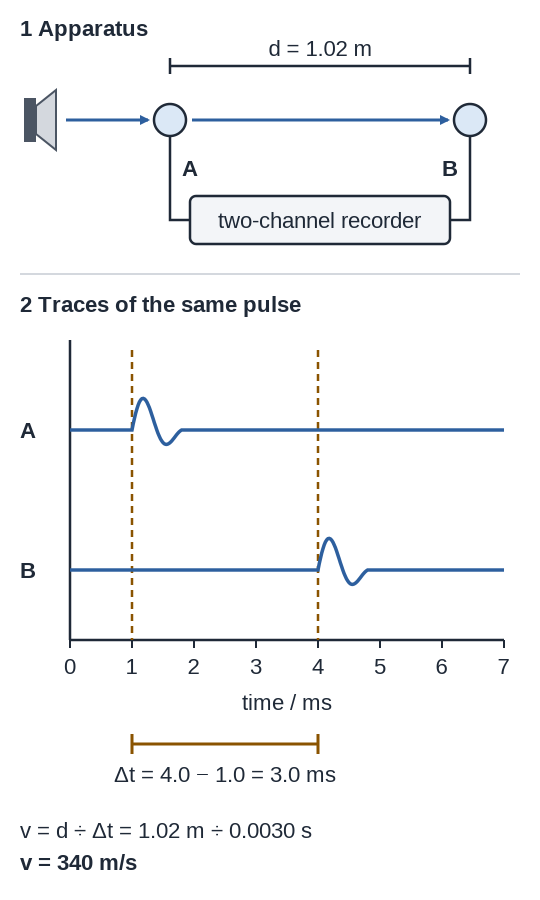
Measure a travel-time difference
Connect two microphones to a two-channel oscilloscopeAn instrument displaying how an input voltage changes with time. or suitable data logger. Align the soundA mechanical wave produced by vibrations and transmitted through a material medium. source and microphones along the same direction, with the source beyond the first microphone. Measure the separation d between the microphones using a tape or metre rule.
Produce a brief sound pulse at a comfortable level. It reaches microphone A first and B later. The difference Δt between corresponding features of the two traces is the time to travel the additional distanceThe length of a path travelled, without regard to direction. d, provided source and microphones are collinear in that order.
Obtain reliable measurements
Use a clear pulse and identify the same feature on both channels, such as the leading edge. A repeating pure tone can create ambiguity about which cycles correspond. Set a time scale that resolves the small delay and use matching channels or account for any known electronic offset.
Repeat at the same separation, then change the separation and repeat. Keep the room conditions similar and record the air temperatureA measure of how hot a system is, related to the average kinetic energy of its particles.. Reduce reflectionThe return of a wave into its original medium after meeting a boundary. by choosing a clear space away from nearby walls; identify the first direct arrival rather than a later echo. Keep the soundA mechanical wave produced by vibrations and transmitted through a material medium. comfortable and never make a sharp loud sound beside an ear.
Worked measurement
For a separation of 1.02 m, the same pulse feature appears at 1.0 ms on channel A and 4.0 ms on channel B. The delay is 4.0 − 1.0 = 3.0 ms = 0.0030 s.
Therefore v = d/Δt = 1.02/0.0030 = 340 m/s, or 3.4 × 10² m/s to two significant figures. The absolute time from the screen origin is irrelevant; the difference between arrivals matters.
Process several separations
Calculate a speedThe distance travelled per unit time, without specifying direction. for each separation and compare consistent repeats. Alternatively, plot separation d vertically against delay Δt in seconds horizontally. The gradientThe change in the vertical-axis quantity divided by the corresponding change in the horizontal-axis quantity. estimates v. A nonzero intercept may reveal a fixed timing offset or a distance-reference error.
A greater separation gives a longer delay and reduces the fractional effect of a fixed timing uncertaintyThe estimated range around a measured value within which the true value is expected to lie., but the pulse must remain detectable. distanceThe length of a path travelled, without regard to direction. must refer to the microphone sensing positions; a sideways source gives a path difference that is not simply their separation.
An echo alternative
With source and listener or microphone together a known distanceThe length of a path travelled, without regard to direction. d from a large reflecting wall, measure the delay between a pulse and its echo. The travelled distance is 2d, so v = 2d/t. A wall 17 m away and a 0.10 s echo delay would give 340 m/s.
Manual reaction timeThe interval between a stimulus and the start of a response. is a substantial fraction of short delays. Electronic recording, or timing multiple regular echo intervals carefully, can reduce the fractional error. State the path used: a one-way baseline and an echo round trip require different distances.
Equations
- v = d/Δt for the additional one-way microphone path; d in m, Δt in s.
- v = 2d/t for an echo returning to the source from a wall at distance d.
Common misconceptions
- Subtract the two arrival times; do not divide separation by the second screen time alone.
- Convert milliseconds to seconds.
- Microphone separation equals extra path length only for the correct alignment.
- Echo timing uses twice the wall distance.