Learning goals
- Calculate refractive index from paired angles.
- Rearrange the equation to find an angle.
- Explain why angle ratios and sine ratios differ.
What the ratio describes
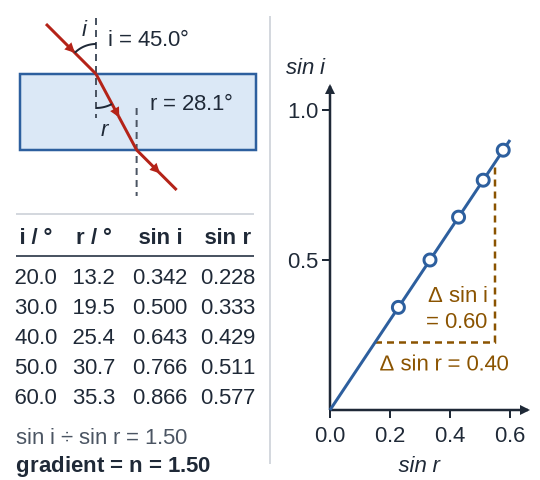
For air-to-glass refractionA change in wave speed at a boundary between media, causing a change in direction at non-normal incidence., n = sin i / sin r, where i is the angle in air and r is the angle in glass. Both are measured from the normalA reference line or direction perpendicular to a surface or plane.. Air is treated as having refractive indexThe ratio of light’s speed in a vacuum to its speed in a material. approximately 1; the ratio describes how much the ray bends for the chosen material and light.
Refractive index has no unit because it is a ratio of two dimensionless sine values. For ordinary transparent glass n is greater than 1, so r is smaller than i at nonzero air-to-glass incidence. At different incident angles the sine ratio remains approximately constant for the same material and wavelengthThe shortest distance between two successive points in phase on a wave..
Find refractive index
A ray enters glass with i = 45.0° and r = 28.1°. In degree mode, sin 45.0° = 0.7071 and sin 28.1° ≈ 0.4710. Therefore n = 0.7071/0.4710 ≈ 1.50.
Keep unrounded calculator values during the calculation and round the final answer appropriately. Dividing 45.0 by 28.1 would give about 1.60, which is not the required sine ratio.
Find a refracted angle
For n = 1.50 and i = 50.0°, rearrange first: sin r = sin i/n. Substitute sin r = sin 50.0°/1.50 ≈ 0.5107. Then use the inverse sine: r = sin⁻¹(0.5107) ≈ 30.7°.
The result is smaller than 50°, as expected for entry from air into glass. Do not confuse sin⁻¹ with 1/sin: inverse sine finds an angle.
Reverse the ray carefully
The path is reversible. For the same glass-to-air path, the glass angle and air angle swap their roles as incidence and refractionA change in wave speed at a boundary between media, causing a change in direction at non-normal incidence.. The material value n is still sine of the air angle divided by sine of the glass angle; blindly dividing sin of the new incidence by sin of the new refraction would give 1/n.
At normalA reference line or direction perpendicular to a surface or plane. incidence i = r = 0°. The ray is undeviated, but 0/0 cannot be used to measure n. Use nonzero angles for this practical.
Equations
- n = sin i/sin r for air → material, with i in air and r in the material.
- sin r = sin i/n; r = sin⁻¹(sin i/n).
Common misconceptions
- Use sin i/sin r, not i/r.
- Set degree mode for degree measurements.
- Refractive index has no unit and does not become 1/n merely because the ray is reversed.
- Normal incidence gives no usable sine ratio.
Trace reflection and refraction at one glass face
Change incidence and refractive index, then compare angles measured from the local normal.
What you see
- Labelled diagrams and numerical outputs describe the same selected state.
How to use it
- Change one control at a time, predict the outcome, then compare the readouts. All controls have keyboard-accessible sliders and step buttons.
- Reset restores every model control to its initial value. Nothing is saved.
What it shows
- For air into glass, n=sin i/sin r. The transmitted ray bends towards the normal when incidence is non-zero; at normal incidence its direction is unchanged. Reflection remains at an angle equal to incidence. A single boundary does not demonstrate the full parallel-sided-block path.
Limits of the model
- A stationary flat air-to-glass boundary; glass has the selected refractive index relative to air. One face is modelled, not a full block or prism.
- The rays show directions, not relative energy or brightness. The partial reflection is dashed; no reflected/transmitted intensity is calculated.
Controls
Angles are measured from the dashed normal, not from the horizontal surface. Reflection has the same angle as incidence. At normal incidence both sines are zero, so use a non-zero angle to determine refractive index from their ratio. The transmitted ray bends towards the normal for non-zero incidence. This model shows only one glass face.
Predict, change and explain
At n=1.5 and i=30°, predict whether r is larger or smaller. Compare sin i/sin r with n. Try normal incidence, then increase i while keeping n fixed. Explain why measuring from the surface would give the wrong angles.
Connect the outcome to the Physics
For air into glass, n=sin i/sin r. The transmitted ray bends towards the normal when incidence is non-zero; at normal incidence its direction is unchanged. Reflection remains at an angle equal to incidence. A single boundary does not demonstrate the full parallel-sided-block path.