Learning goals
- Identify all seven named regions of the electromagnetic spectrum.
- Explain what is continuous about the spectrum.
- Distinguish a common vacuum speed from frequency and wavelength.
One family of waves
electromagnetic waveA transverse wave of oscillating electric and magnetic fields that travels through a vacuum at the speed of light. are travelling disturbances of electric and magnetic fieldA region where magnets, magnetic materials or moving charges experience magnetic forces.. They transfer energyA conserved quantity transferred between stores by working, heating, electrical processes or radiation, measured in joules. without needing particles of a material to carry the disturbance. They can therefore cross empty space: sunlight reaches Earth through the near-vacuum between the Sun and our atmosphere. soundA mechanical wave produced by vibrations and transmitted through a material medium., by contrast, needs a material medium.
These waveA travelling disturbance that transfers energy without an overall transfer of matter. are transverse: the field oscillationOne complete repeated motion about an equilibrium position. are perpendicular to the direction of travel. A drawn sine curve represents the variation of a field; it is not the path of a particle moving through space.
A continuous spectrum
In order of increasing frequencyThe number of complete oscillations or wave cycles per second, measured in hertz., the named regions are radio waveElectromagnetic radiation of longer wavelength than microwaves, used for broadcasting and communication., microwaveElectromagnetic radiation between radio and infrared wavelengths, used in communication and heating., infrared, visible lightElectromagnetic radiation with wavelengths detected by the human eye, from violet to red., ultraviolet, X-rayHigh-frequency electromagnetic radiation with wavelengths shorter than ultraviolet, used to image internal structures. and gamma rayVery high-frequency electromagnetic radiation emitted when a nucleus loses energy.. Visible light is the small region that human eyes detect. Radiation outside it is not absent simply because we cannot see it; suitable detectors respond to different regions.
Continuous means there are no gaps of forbidden wavelengthThe shortest distance between two successive points in phase on a wave. between the named regions. Region names group waveA travelling disturbance that transfers energy without an overall transfer of matter. with similar uses and interactions with matter; their boundaries are conventions, not physical walls. Diagrams with equally sized boxes show order, not equal ranges of wavelength.
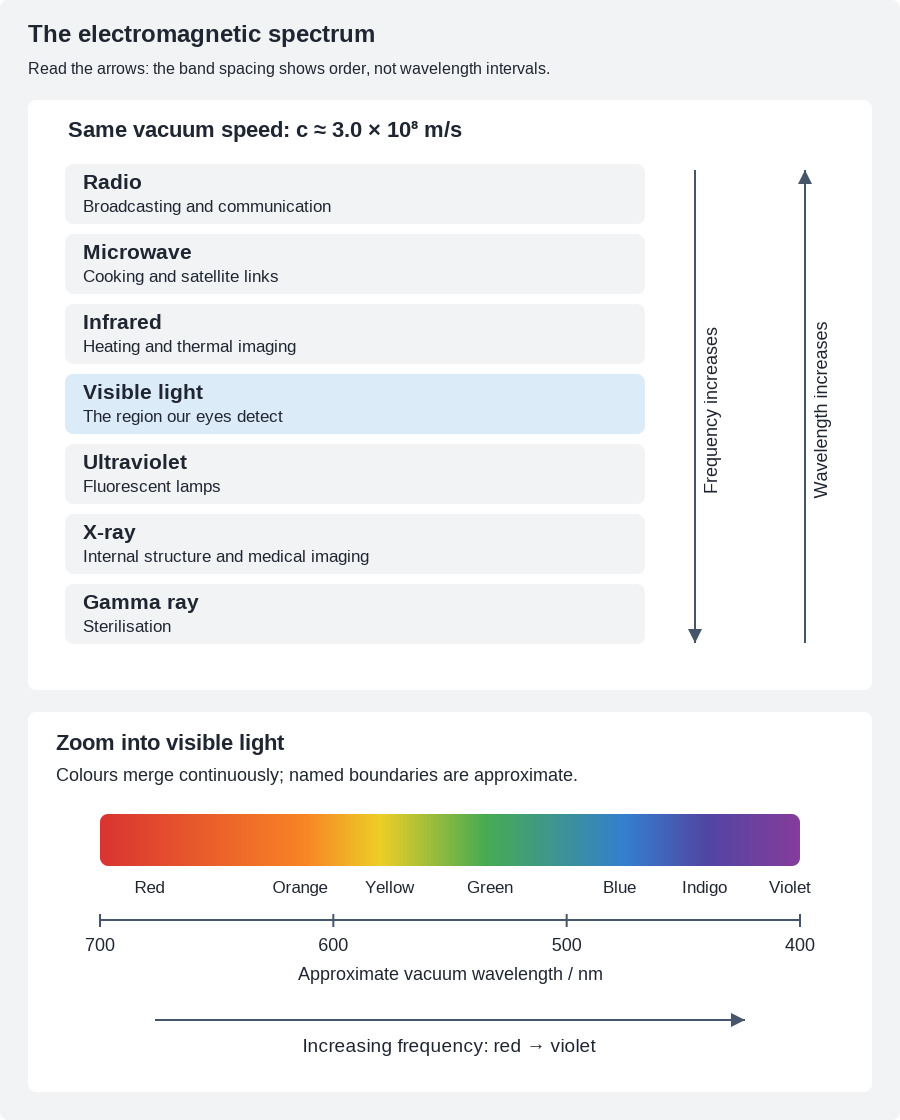
Same speed, different oscillations
In free space, every electromagnetic waveA transverse wave of oscillating electric and magnetic fields that travels through a vacuum at the speed of light. travels at approximately 3.0 × 10⁸ m/s. The relationship c = fλ therefore requires a higher frequencyThe number of complete oscillations or wave cycles per second, measured in hertz. to accompany a shorter wavelengthThe shortest distance between two successive points in phase on a wave.. A gamma rayVery high-frequency electromagnetic radiation emitted when a nucleus loses energy. does not cross a vacuum faster than a radio waveElectromagnetic radiation of longer wavelength than microwaves, used for broadcasting and communication..
In matter the speedThe distance travelled per unit time, without specifying direction. can be smaller and can depend on the material and frequency. The statement about a common speed applies to free space. At a stationary boundary, frequency stays the same while speed and wavelength can change.
Worked comparison
For a radio waveElectromagnetic radiation of longer wavelength than microwaves, used for broadcasting and communication. of frequencyThe number of complete oscillations or wave cycles per second, measured in hertz. 1.0 × 10⁸ Hz in vacuum, λ = c/f = (3.0 × 10⁸)/(1.0 × 10⁸) = 3.0 m. For visible lightElectromagnetic radiation with wavelengths detected by the human eye, from violet to red. of frequency 5.0 × 10¹⁴ Hz, λ = (3.0 × 10⁸)/(5.0 × 10¹⁴) = 6.0 × 10⁻⁷ m, or 600 nm.
Both travel 3.0 × 10⁸ m in one second in vacuum. The light completes many more oscillationOne complete repeated motion about an equilibrium position. in that time, so those oscillations occupy a much shorter distanceThe length of a path travelled, without regard to direction. each.
Equations
- c = fλ; c ≈ 3.0 × 10⁸ m/s in free space, f in Hz and λ in m.
Common misconceptions
- Invisible does not mean absent: radio, infrared and ultraviolet are real electromagnetic waves.
- The named bands are continuous and their drawn widths need not be to scale.
- All electromagnetic waves have the same vacuum speed, not necessarily the same speed in matter.