Learning goals
- Give the order of all seven regions in either direction.
- Order the visible colours by wavelength and frequency.
- Explain the inverse relationship using a common wave speed.
Read the direction before ordering
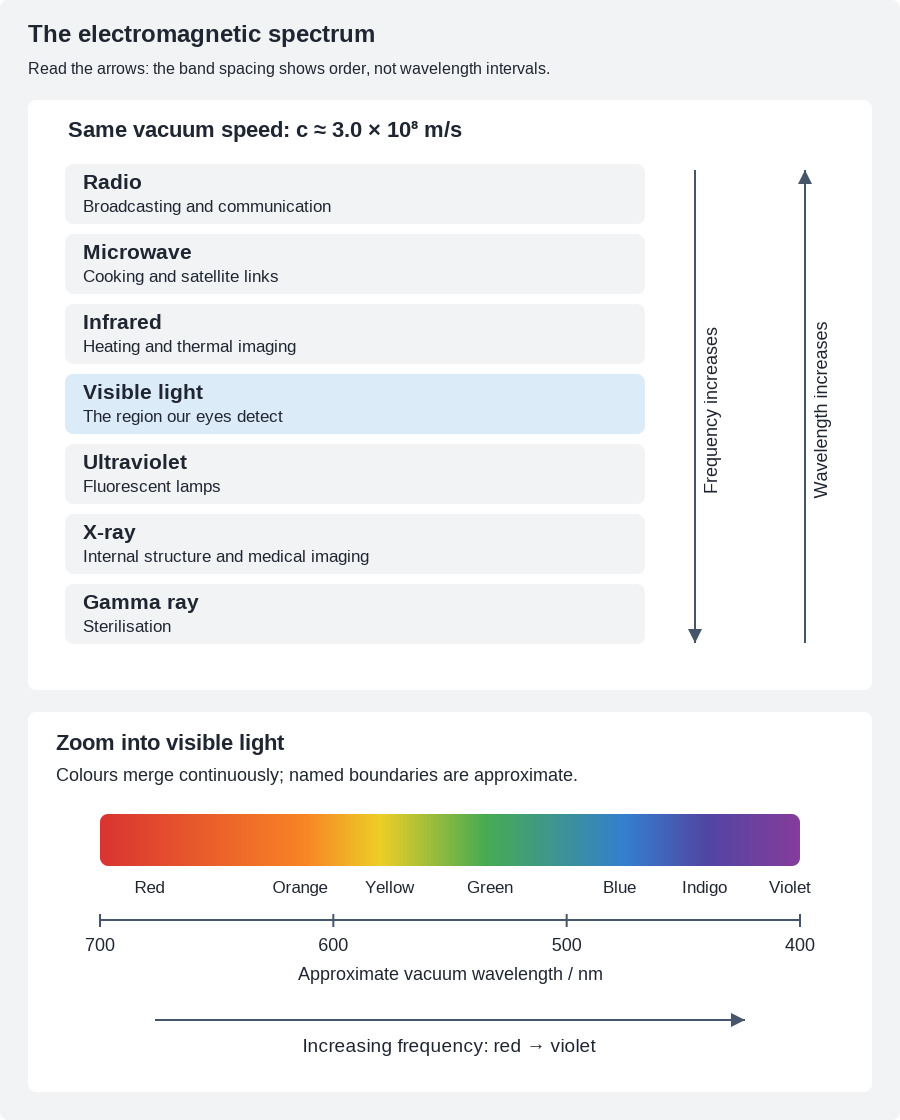
From longest wavelengthThe shortest distance between two successive points in phase on a wave. to shortest: radio, microwaveElectromagnetic radiation between radio and infrared wavelengths, used in communication and heating., infrared, visible, ultraviolet, X-rayHigh-frequency electromagnetic radiation with wavelengths shorter than ultraviolet, used to image internal structures., gamma. That is also the order from lowest frequencyThe number of complete oscillations or wave cycles per second, measured in hertz. to highest, because all have the same free-space speedThe distance travelled per unit time, without specifying direction.. Reversing the direction reverses both lists.
If a question asks for increasing wavelength, begin with gamma rayVery high-frequency electromagnetic radiation emitted when a nucleus loses energy. and end with radio waveElectromagnetic radiation of longer wavelength than microwaves, used for broadcasting and communication.. Label the property and direction explicitly; an unexplained list is easy to reverse.
Zoom into the visible region
From longer wavelengthThe shortest distance between two successive points in phase on a wave. to shorter, the conventional colour sequence is red, orange, yellow, green, blue, indigo, violet. Red lies next to infrared; violet lies next to ultraviolet. frequencyThe number of complete oscillations or wave cycles per second, measured in hertz. rises from red towards violet.
The colours merge continuously; there are no sharp physical steps between them. An approximate visible range is 700 nm at the red end to 400 nm at the violet end, but human sensitivity and the chosen boundaries vary. Learn the order rather than treating these endpoints as exact limits.
Worked comparison of red and violet
Take red light of wavelengthThe shortest distance between two successive points in phase on a wave. 700 nm = 7.00 × 10⁻⁷ m and violet light of wavelength 400 nm = 4.00 × 10⁻⁷ m. In vacuum, red has f = c/λ = 4.29 × 10¹⁴ Hz, and violet has f = 7.50 × 10¹⁴ Hz, to three significant figures using c = 3.00 × 10⁸ m/s.
The shorter violet wavelength gives the larger frequencyThe number of complete oscillations or wave cycles per second, measured in hertz.. Both speedThe distance travelled per unit time, without specifying direction. are still c. If a vacuum wavelength is halved, frequency doubles; neither the colour name nor the drawn band width determines the speed.
Equations
- f = c/λ; for a fixed speed, frequency is inversely proportional to wavelength.
- 1 nm = 10⁻⁹ m.
Common misconceptions
- Red has a longer wavelength but a lower frequency than violet.
- Visible colours are a continuous range, not seven isolated allowed wavelengths.
- A spectrum diagram must state whether spacing shows order or a numerical scale.