Learning goals
- Describe the specified uses of all seven electromagnetic regions.
- Explain a relevant physical property for each use.
- Distinguish emission, detection, absorption and transmission.
Radio and microwave communication
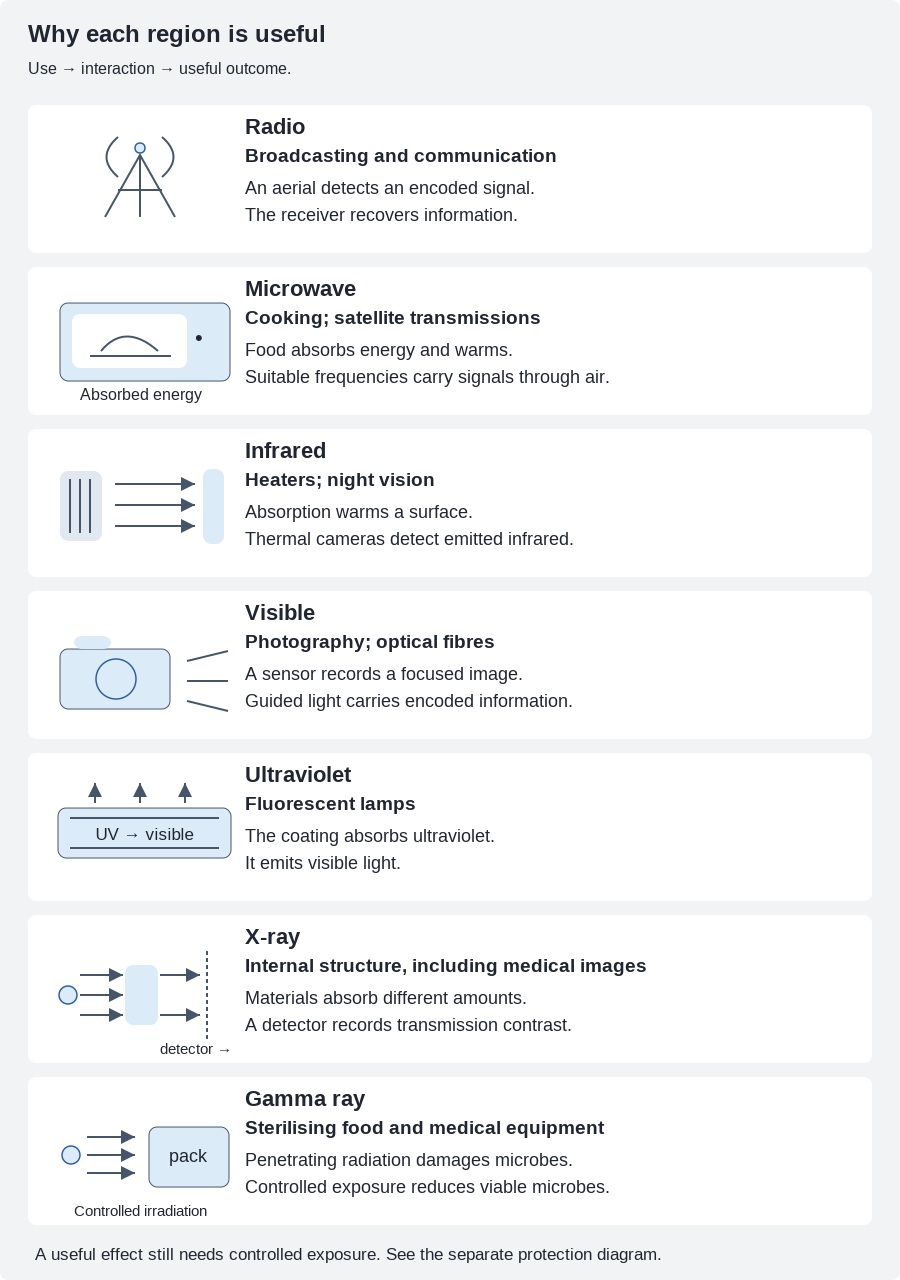
A transmitter varies an electromagnetic signal to encode information. An aerial at the receiver detects the arriving waveA travelling disturbance that transfers energy without an overall transfer of matter. and equipment recovers the information. radio waveElectromagnetic radiation of longer wavelength than microwaves, used for broadcasting and communication. are used for broadcasting and communication; the signal travels much faster than soundA mechanical wave produced by vibrations and transmitted through a material medium. travelling directly between people.
microwaveElectromagnetic radiation between radio and infrared wavelengths, used in communication and heating. are used for satelliteAn object kept in orbit around another body by gravity. transmissions. Suitable microwave frequencyThe number of complete oscillations or wave cycles per second, measured in hertz. pass through the atmosphere, and dishes direct signals towards the satellite or receiving station. This is an application of transmission and detection, not of heating the receiver.
Microwave cooking and infrared heating
Food absorbs microwaveElectromagnetic radiation between radio and infrared wavelengths, used in communication and heating. energyA conserved quantity transferred between stores by working, heating, electrical processes or radiation, measured in joules., increasing its internal energyThe total microscopic kinetic and potential energies of the particles within a system. and temperatureA measure of how hot a system is, related to the average kinetic energy of its particles.. Absorption involves the response of molecules, including water molecules, to the alternating electric fieldA region where an electric charge experiences an electrical force.. Heating is not automatically uniform: regions can absorb differently, so follow the appliance instructions for turning, stirring and standing.
An infrared heater emits radiation that is absorbed by a surface, transferring energy and warming it. No air is needed between the emitter and absorber for this radiative transfer. The heater may also transfer energy by convectionEnergy transfer by bulk movement of a fluid, commonly driven by density differences within it., but that is a different mechanism.
Infrared night vision and visible images
Warm objects emit infrared radiationElectromagnetic radiation with wavelengths longer than visible red light, emitted by objects because of their temperature. even in darkness. A thermal-imaging camera detects differences in the incoming infrared signal and displays a visible image, often using artificial colours. Those colours are a display choice, not the actual colour of the invisible infrared waveA travelling disturbance that transfers energy without an overall transfer of matter.. Other night-vision systems amplify available light or detect reflected infrared; not all use thermal emission.
In photography, a lens forms an image on a light-sensitive sensor or film. visible lightElectromagnetic radiation with wavelengths detected by the human eye, from violet to red. can also carry information in an optical fibreA thin transparent strand that guides light by repeated total internal reflection.: encoded light is guided by total internal reflectionComplete reflection at a boundary when light in a higher-index medium strikes a lower-index medium above the critical angle., developed in 5.20. Many long-distance communication fibres use infrared in practice; visible light remains a valid example of guided transmission.
Ultraviolet in a fluorescent lamp
An electrical discharge inside the lamp produces ultraviolet radiationElectromagnetic radiation with shorter wavelengths than visible violet light, capable of damaging cells.. A fluorescent coating absorbs it and emits visible lightElectromagnetic radiation with wavelengths detected by the human eye, from violet to red.. The coating converts radiation from one region to another; ultraviolet itself is not the visible glow. The lamp structure limits direct exposure to its ultraviolet output.
X-rays reveal internal structure
X-rayHigh-frequency electromagnetic radiation with wavelengths shorter than ultraviolet, used to image internal structures. can pass through an object, but different thicknesses and materials absorb different amounts. A detector records the transmitted radiation. This contrast reveals hidden features, such as bones in medical imaging or flaws inside a manufactured part.
The image does not arise because bones emit X-rays. It records differences in transmission from an external source. Medical and industrial use requires controlled exposure because X-rays can damage living cells.
Gamma rays sterilise
gamma radiationHigh-frequency electromagnetic waves emitted as an excited nucleus loses energy without changing proton or nucleon numbers. penetrates suitable packaging and damages microorganisms, preventing them from surviving or reproducing. Controlled irradiationExposure to radiation from a source without necessarily transferring radioactive material. can sterilise medical equipment and is used to reduce microorganisms in food.
The useful damage to microbial cells is also the reason people need shieldingMaterial placed around a radiation source to absorb emissions and reduce exposure. from the source. Irradiation is exposure to radiation; it is distinct from contaminating an object with radioactive material. The application does not require leaving the radiation source in the product.
Equations
Common misconceptions
- Explain why the radiation is useful, not just the name of the device.
- A thermal-camera colour is not the visible colour of infrared radiation.
- Fluorescent lamps convert ultraviolet to visible light; ultraviolet is not directly visible.
- Irradiation and radioactive contamination are different processes.