Learning goals
- Explain the specified effects of excessive microwave, infrared, ultraviolet and gamma exposure.
- Match each hazard to a suitable protective measure.
- Distinguish thermal damage from ionising-radiation damage.
Risk depends on exposure
The effect depends on radiation type, intensity, exposure duration and the tissue exposed. A useful radiation is not automatically harmless, and the word radiation does not mean every exposure has the same danger. Absorbed energyA conserved quantity transferred between stores by working, heating, electrical processes or radiation, measured in joules. matters, not simply whether a source is present.
microwaveElectromagnetic radiation between radio and infrared wavelengths, used in communication and heating. and infrared are non-ionising: they do not cause ionisationFormation of ions by the removal or addition of electrons. in these applications. Absorption can still heat tissue enough to damage it. gamma rayVery high-frequency electromagnetic radiation emitted when a nucleus loses energy. are ionising: they can remove electronA negatively charged subatomic particle found outside an atom’s nucleus. from atomAn electrically neutral particle with a small positive nucleus surrounded by electrons. and damage cellular molecules, including DNA.
Microwaves: internal tissue heating
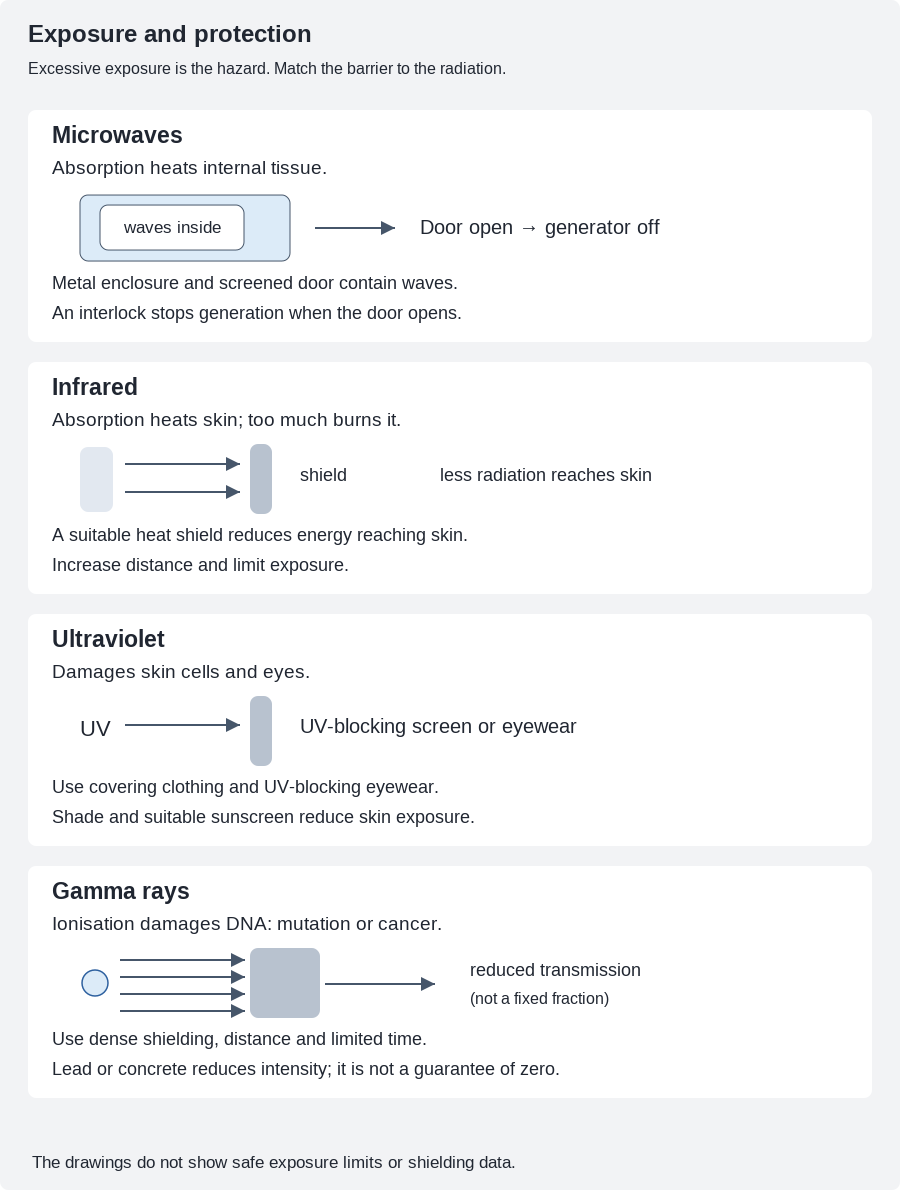
microwaveElectromagnetic radiation between radio and infrared wavelengths, used in communication and heating. can be absorbed within tissue and raise its temperatureA measure of how hot a system is, related to the average kinetic energy of its particles.. Excessive exposure can damage tissue internally, even though the waveA travelling disturbance that transfers energy without an overall transfer of matter. are invisible. A domestic oven contains the radiation using its metal enclosure and screened door; an interlock stops generation when the door opens.
Use equipment as designed and do not use a microwave oven with a damaged or poorly fitting door. Never bypass an interlock. Protection here prevents the strong field in the cooking chamber from reaching the body; it is separate from avoiding burns from hot food.
Infrared: skin burns
Absorbed infrared transfers energyA conserved quantity transferred between stores by working, heating, electrical processes or radiation, measured in joules. to the skin. If energy arrives faster than it can be carried away, temperatureA measure of how hot a system is, related to the average kinetic energy of its particles. rises enough to cause a burn. Greater distanceThe length of a path travelled, without regard to direction., shorter exposure and a suitable heat shield reduce the energy reaching the skin.
A shield must be appropriate for the source and may itself get hot. Feeling warmth is not a reliable way to judge invisible ultraviolet or gamma exposure, whose important effects are different.
Ultraviolet: cell and eye damage
Excess ultraviolet can damage skin cells and cellular DNA. It can also damage the eyes, with severe exposure or long-term damage potentially causing loss of sight. This is why staring at a UV source is unsafe even when it does not appear bright.
Reduce exposure with shade and covering clothing, use suitable sunscreen on exposed skin and wear eyewear that specifically blocks UV. Dark tint alone does not establish UV protection. Laboratory UV sources need appropriate screens and eye protection. The mechanism and penetration vary across UV wavelengthThe shortest distance between two successive points in phase on a wave., so do not label all UV as having identical effects.
Gamma rays: mutation and cancer
gamma rayVery high-frequency electromagnetic radiation emitted when a nucleus loses energy. can ionise atomAn electrically neutral particle with a small positive nucleus surrounded by electrons. inside the body. Damage to DNA may kill a cell or alter its genetic information; such a change is a mutation. Some surviving damaged cells can divide uncontrollably and lead to cancer. Exposure increases risk; it does not guarantee that a particular person will develop cancer.
Use suitable thick lead or concrete shieldingMaterial placed around a radiation source to absorb emissions and reduce exposure., minimise time near a source and increase distanceThe length of a path travelled, without regard to direction., using remote handling where required. Shielding reduces intensity rather than guaranteeing zero transmission. Radioactive sources belong in controlled, supervised arrangements; ordinary clothing or sunscreen is not gamma shielding.
Match the protection to the mechanism
For a heater, a heat shield reduces absorbed infrared. For a UV lamp, UV-blocking screening and eye protection prevent damaging exposure. For a gamma source, dense shieldingMaterial placed around a radiation source to absorb emissions and reduce exposure., distanceThe length of a path travelled, without regard to direction. and short exposure address its penetrating ionising radiationRadiation with enough energy to remove electrons from atoms or molecules and form ions.. Naming a barrier without explaining what it reduces is incomplete reasoning.
Equations
Common misconceptions
- Non-ionising does not mean incapable of harm: intense microwaves and infrared can cause heating injuries.
- UV protection cannot be inferred from dark appearance alone.
- Gamma shielding attenuates radiation; it does not make every transmitted photon disappear.
- A mutation is a change in genetic information, not a certainty of cancer.