Learning goals
- Define transverse and longitudinal waves precisely.
- Identify compressions and rarefactions.
- Apply the definitions to ropes, sound and light without confusing the models.
Transverse: perpendicular oscillations
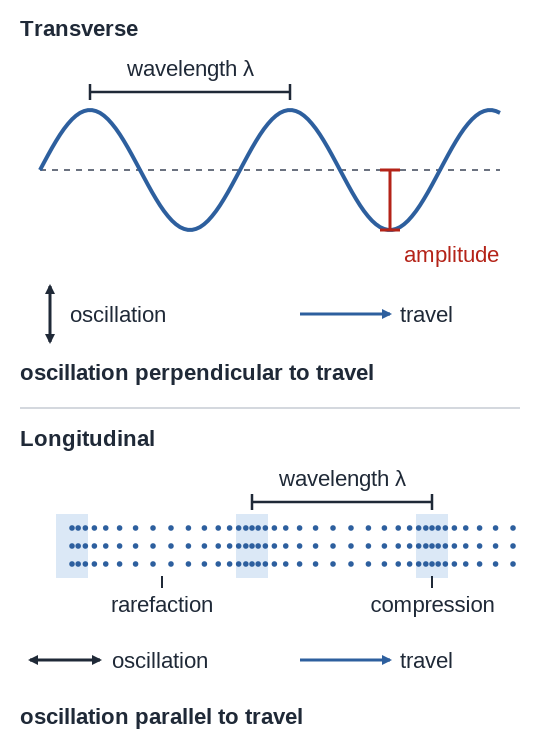
In a transverse waveA wave whose oscillations are perpendicular to the direction of energy transfer., oscillationOne complete repeated motion about an equilibrium position. are perpendicular to the direction of waveA travelling disturbance that transfers energy without an overall transfer of matter. travel or energyA conserved quantity transferred between stores by working, heating, electrical processes or radiation, measured in joules. transfer. If a wave travels horizontally along a stretched rope, each rope section can move up and down. The rope sections do not travel along the rope with the crestA point of maximum positive displacement on a transverse wave..
The left-hand snapshot shows a transverse displacementThe straight-line change in position from a starting point, with a specified direction. pattern. The wavelengthThe shortest distance between two successive points in phase on a wave. is the distanceThe length of a path travelled, without regard to direction. between equivalent points on successive cycles, such as adjacent crests; amplitudeThe maximum displacement from the equilibrium position in an oscillation. is maximum displacement from equilibriumA state in which both the resultant force and the resultant moment on an object are zero.. Rotating the entire rope does not change the classification: the relative directions matter, not whether the motion happens to be vertical.
Longitudinal: parallel oscillations
In a longitudinal waveA wave whose oscillations are parallel to the direction of energy transfer., oscillationOne complete repeated motion about an equilibrium position. are parallel to waveA travelling disturbance that transfers energy without an overall transfer of matter. travel. Moving one end of a stretched spring back and forth along its length creates regions where coils are close together, called compressionA region of a longitudinal wave where particles are closer together and pressure is higher., and regions where they are farther apart, called rarefactionA region of a longitudinal wave where particles are farther apart and pressure is lower.. These regions travel while the coils oscillate locally.
soundA mechanical wave produced by vibrations and transmitted through a material medium. in air is longitudinal. Air particles move back and forth around their equilibriumA state in which both the resultant force and the resultant moment on an object are zero. positions; compressions have greater pressureThe normal force exerted per unit area, measured in pascals. and densityThe mass of material per unit volume, measured in kilograms per cubic metre in SI units. than the average, and rarefactions have less. The distanceThe length of a path travelled, without regard to direction. between adjacent compression centres is one wavelengthThe shortest distance between two successive points in phase on a wave.. A compression followed by the adjacent rarefaction is only half a cycle for a sinusoidal wave.
Light and the limits of the rope analogy
Light is a transverse electromagnetic waveA transverse wave of oscillating electric and magnetic fields that travels through a vacuum at the speed of light.. Its electric and magnetic fieldA region where magnets, magnetic materials or moving charges experience magnetic forces. oscillate perpendicular to its direction of travel; it does not need particles in a material medium and can cross a vacuum. The rope drawing is useful for directions but is not a literal model of particles carrying light.
A soundA mechanical wave produced by vibrations and transmitted through a material medium. pressureThe normal force exerted per unit area, measured in pascals.–position graph may look like a transverse sine curve, but the upward axis then represents pressure, not upward particle motion. Classify the actual oscillationOne complete repeated motion about an equilibrium position. relative to energyA conserved quantity transferred between stores by working, heating, electrical processes or radiation, measured in joules. transfer, rather than judging from the shape of an arbitrary graph.
Equations
Common misconceptions
- A longitudinal wave does not carry each air particle from the source to the listener.
- A sine-shaped pressure graph does not make sound in air transverse.
- Light does not need a rope-like material medium in space.
Connect a wave snapshot to a local time trace
Change amplitude, frequency and wavelength while distinguishing wave propagation from local oscillation.
What you see
- Labelled diagrams and numerical outputs describe the same selected state.
How to use it
- Change one control at a time, predict the outcome, then compare the readouts. All controls have keyboard-accessible sliders and step buttons.
- Reset restores every model control to its initial value. Nothing is saved.
What it shows
- Wave speed=fλ and period=1/f. A snapshot plots displacement against position; the lower graph records one fixed point against time. The pattern and energy travel right while each marker oscillates locally. Amplitude changes the size of displacement, not the speed or period in this model.
Limits of the model
- An ideal smooth repeating transverse wave travels right without loss of amplitude. The black marker remains at position 2 m while moving transversely.
- The controls define a geometric wave, not a mechanical calculation for a particular rope or fixed medium. In a medium of fixed wave speed, frequency and wavelength cannot change independently. At zero amplitude the entered frequency and wavelength cannot be measured from the flat trace.
Controls
Predict, change and explain
At amplitude 0.5 m, frequency 1 Hz and wavelength 2 m, predict speed and period. Scrub time and follow the black marker. Then compare frequency 2 Hz with wavelength 1 m: what stays the same and what changes?
Connect the outcome to the Physics
Wave speed=fλ and period=1/f. A snapshot plots displacement against position; the lower graph records one fixed point against time. The pattern and energy travel right while each marker oscillates locally. Amplitude changes the size of displacement, not the speed or period in this model.