Learning goals
- State both conditions for total internal reflection.
- Explain how optical fibres carry encoded information.
- Trace the direction change in a right-angled prism.
When transmission is replaced by reflection
Light travelling from higher to lower refractive indexThe ratio of light’s speed in a vacuum to its speed in a material. normally refracts away from the normalA reference line or direction perpendicular to a surface or plane.. At a particular internal incidence angle, the critical angleThe angle of incidence in the higher-index medium for which the refracted ray travels along the boundary., the limiting refracted ray lies along the boundary. At larger incidence angles there is no transmitted travelling ray in the simple ray model: the light is totally internally reflected.
Both conditions are necessary: the ray approaches from the higher-index side, and its angle to the normal is greater than the critical angle for that pair of materials. reflectionThe return of a wave into its original medium after meeting a boundary. still obeys equal angles. A large angle on entering glass from air cannot produce total internal reflectionComplete reflection at a boundary when light in a higher-index medium strikes a lower-index medium above the critical angle..
Information along an optical fibre
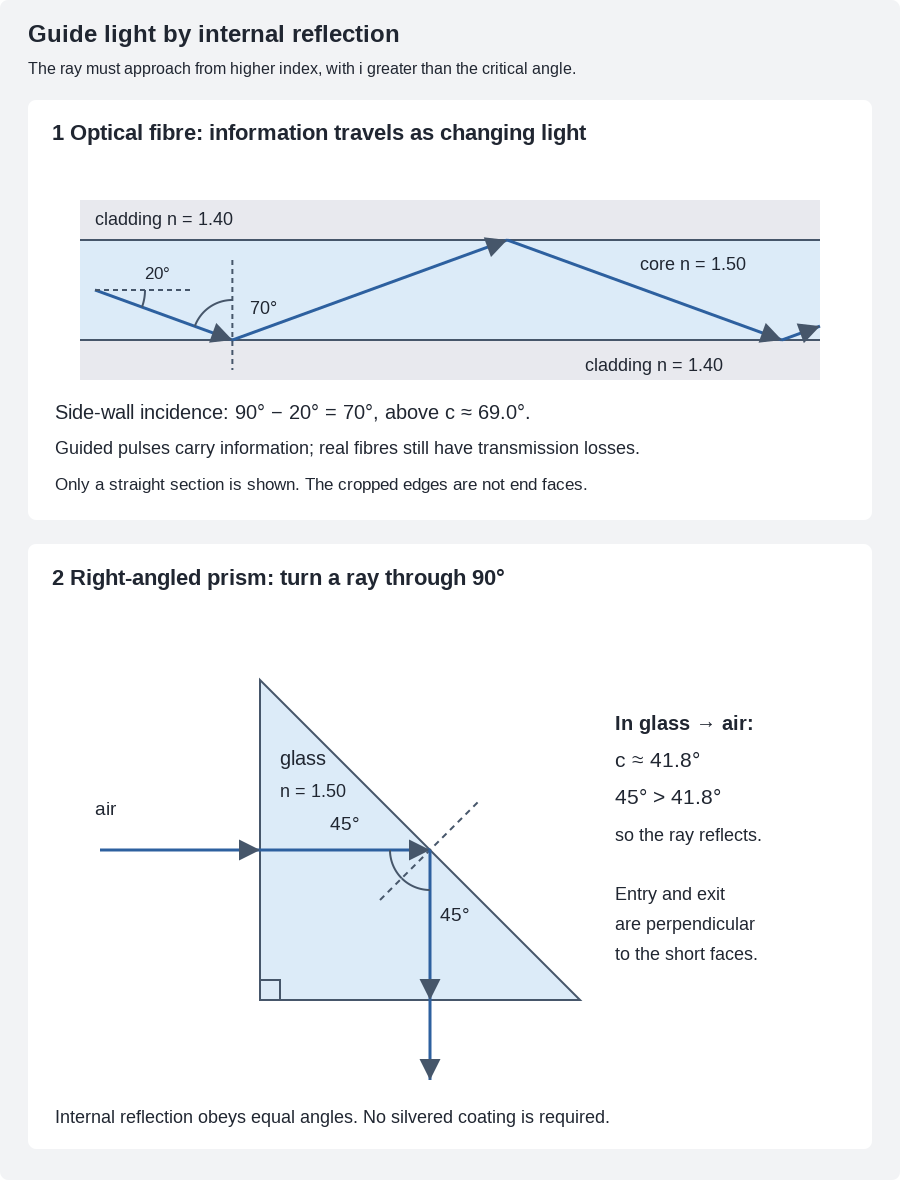
An optical fibreA thin transparent strand that guides light by repeated total internal reflection. has a transparent core surrounded by cladding with a lower refractive indexThe ratio of light’s speed in a vacuum to its speed in a material.. Light launched at suitable angles repeatedly meets the core–cladding boundary above its critical angleThe angle of incidence in the higher-index medium for which the refracted ray travels along the boundary.. total internal reflectionComplete reflection at a boundary when light in a higher-index medium strikes a lower-index medium above the critical angle. guides it along the core.
The transmitter varies the light, for example as a sequence of pulses, to encode information. A detector at the other end converts the received light to an electrical signal. Glass does not transport electronA negatively charged subatomic particle found outside an atom’s nucleus. along the optical path; the changing light signal carries the information.
Why the angles and materials matter
The incidence angle is measured from the normalA reference line or direction perpendicular to a surface or plane. to the side wall, not from the fibre axis. In the straight fibre, a ray 20° to the axis meets each side wall at 70° to its normal. With core index 1.50 and cladding index 1.40, the critical angleThe angle of incidence in the higher-index medium for which the refracted ray travels along the boundary. is about 69.0°, so this ray is guided.
Other launch angles may fail the condition and lose light into the cladding. Sharp bends can also cause losses, and real fibres absorb or scatter some light. total internal reflectionComplete reflection at a boundary when light in a higher-index medium strikes a lower-index medium above the critical angle. describes the ideal boundary interaction; it does not mean an arbitrarily long fibre transmits all its input energyA conserved quantity transferred between stores by working, heating, electrical processes or radiation, measured in joules..
Turn a ray in a prism
In a right-angled isosceles glass prism, a ray entering perpendicular to one short face reaches the long face at 45° to its normalA reference line or direction perpendicular to a surface or plane.. For glass index 1.50 in air, the critical angleThe angle of incidence in the higher-index medium for which the refracted ray travels along the boundary. is about 41.8°, so 45° is large enough for total internal reflectionComplete reflection at a boundary when light in a higher-index medium strikes a lower-index medium above the critical angle..
The reflected ray turns through 90° and leaves perpendicular to the other short face, without further bending there. This lets a prism redirect an image or beam, as in optical instruments. Check the surrounding material and geometry before assuming every prism path undergoes total internal reflection.
Equations
- Total internal reflection requires n_inside > n_outside and i > c.
- For a straight fibre with parallel sides, angle to axis + incidence angle to side-wall normal = 90°.
Common misconceptions
- At i = c the limiting refracted ray is along the surface; the total-reflection condition is i > c.
- The lower-index cladding is essential; ordinary mass density alone does not specify the condition.
- The fibre-axis angle is not the side-wall incidence angle.
- Total internal reflection does not remove absorption or bending losses.
Find the transition to total internal reflection
Change the angle inside glass and identify refraction, the critical case and total internal reflection.
What you see
- Labelled diagrams and numerical outputs describe the same selected state.
How to use it
- Change one control at a time, predict the outcome, then compare the readouts. All controls have keyboard-accessible sliders and step buttons.
- Reset restores every model control to its initial value. Nothing is saved.
What it shows
- The critical angle satisfies sin c=1/n for glass to air. Below c, a refracted ray emerges away from the normal. At c its limiting direction lies along the boundary. Above c no transmitted ray is drawn: total internal reflection requires travel towards the lower-index medium and incidence greater than c.
Limits of the model
- A flat glass-to-air boundary, with incidence measured inside glass from the normal. The selected glass index is relative to air.
- Ray directions only: partial reflection below the critical angle is shown dashed, without an intensity model. At the critical angle the limiting refracted direction is along the boundary.
Controls
Angles are measured from the dashed normal, not from the horizontal surface. Reflection has the same angle as incidence. At normal incidence both sines are zero, so use a non-zero angle to determine refractive index from their ratio. Compare incidence with the displayed critical angle. At the critical case, the limiting refracted ray lies along the boundary.
Predict, change and explain
At n=1.5, compare incidence 40° and 45°. Then choose n=2 and incidence 30° to inspect the critical case. Explain both conditions needed for total internal reflection and how this helps guide light in an optical fibre.
Connect the outcome to the Physics
The critical angle satisfies sin c=1/n for glass to air. Below c, a refracted ray emerges away from the normal. At c its limiting direction lies along the boundary. Above c no transmitted ray is drawn: total internal reflection requires travel towards the lower-index medium and incidence greater than c.